
Proper estate planning aids in maintaining family harmony and stability by clearly defining the distribution and minimizing potential disputes among legal heirs. Property transfer facilitates the efficient management and distribution of wealth, enabling individuals to transfer assets to their beneficiaries according to their wishes[1].
It is important to transfer the assets through legal and valid methods to protect the interest of both transferor and transferee. In India, Succession is governed by personal laws of different communities according to their religion to a large extent. However, the authors explore some common ways to transfer property during lifetime and after demise of an individual in brief below:
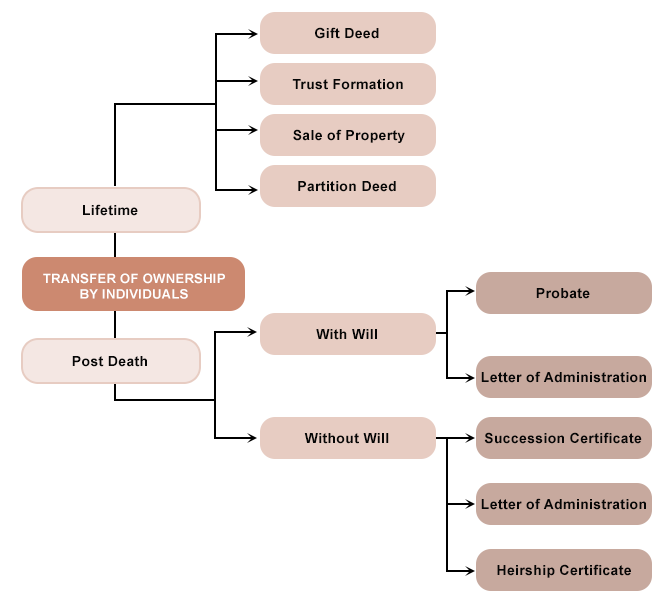
DURING LIFETIME
- Gift Deed: A movable or immovable property can be transferred as a gift during one’s lifetime by executing a gift deed, transferring ownership without any exchange of consideration. Our earlier article on concept of gift deed can be read here .
- Trust Formation: Setting up a trust during a lifetime of the property owner, allows transfer of property to the trust for the benefits of the beneficiaries according to the terms and conditions outlined in the trust deed. Trust formation serves various purposes including estate planning, assets protection, tax benefits, charity etc.
- Sale Deed: Ownership can be transferred during one’s lifetime through a registered sale deed, where the owner sells the property to purchaser in exchange for an agreed sale consideration. Sale deed is the controlling document for any sale transaction and should always capture key details like the proper flow of title, representations and warranties, consideration, covenants etc. For registration of sale deed, it should be submitted to the office of the Sub-Registrar of Assurances within whose jurisdiction the property is situated.
- Partition deed: A jointly owned property can be transferred by partition deed among co-owners of a property who wish to divide their respective shares among themselves. This deed facilitates the transfer of ownership of specific portion of the property from one co-owner to another, ensuring a clear and legally valid transfer. The deed should be registered with the Sub-Registrar of Assurances to establish legally binding document.
AFTER DEMISE [2]
An individual can bequeath his/her movable and immovable properties through a valid Will. He/she can outline how the property is to be distributed among the beneficiaries named in the Will after his/her death. Creating a Will ensures that assets are distributed according to individual’s wishes and helps in avoiding potential disputes among family members. A Will can help settling any outstanding debts and financial obligations, any charitable bequests and provisions for minor children or disabled family members. Our earlier article on the concept of Will can be read here. The testator/testatrix can also create a trust by Will and designate the specific assets that will be transferred into trust upon their death for the benefits of beneficiaries.
PROBATE
Probate is a legal process that occurs after testator’s death to validate and ensure genuineness of Will. The executor appointed by the Will applies for probate in the jurisdiction where the deceased person resided. Probate is also required to transfer title for certain assets such as real estate, from the deceased person to the beneficiaries. Illustration: A has made a Will, whereby he has appointed B his executor. Post demise of A, B will apply for probate of Will of A.
LETTER OF ADMINISTRATION
Where there is no executor appointed in a Will or he/she declines or is incapable to act, or cannot be found, in such situation a beneficiary named in the Will can file applications for grant of Letter of Administration. For obtaining Letter of Administration, an application is to be filed to a District Court of competent jurisdiction which will appoint the Administrator to manage and dispose of the estate of deceased person as per the applicable laws and regulations. Illustration: A has made a Will, whereby no executor is appointed. Post demise of A, C who is beneficiary under the Will, shall apply for letter of administration.
INTESTATE SUCCESSION:
In the absence of a valid Will, assets can be transferred based on the laws of intestate succession, which determine how the property is distributed among the legal heirs. Intestate succession outlines the order of priority for the distribution of assets among the legal heirs which may include the surviving spouse, children, parents, siblings and other relatives. Distribution of assets involves legal procedures, such as obtaining succession certificate, heirship certificate, letter of administration from competent court to ensure that distribution of assets is conducted in compliance with the applicable laws. It facilitates the transfer of property title from deceased person to legal heirs.
SUCCESSION CERTIFICATE
A succession certificate is a legal document issued by a District Court under whose jurisdiction the deceased ordinarily resided at the time of his death, or, if at that time had no fixed place of residence, the District Judge, within whose jurisdiction any part of the property of the deceased may be found, may grant the succession certificate.
Succession certificate is required for movable assets to facilitate the transfer of various types of assets such as bank deposits, demat, securities and other movable assets from the deceased to legal heirs. This certificate serves as legal proof of the rightful claim of the person obtaining the certificate as the legitimate successor to the estate of the deceased person.
LETTER OF ADMINISTRATION
A letter of administration is required where a deceased person has not left behind a valid Will. This document is necessary for lawful transfer of ownership in the immovable property or for the management and distribution of the assets of the deceased person according to the personal laws.
HEIRSHIP CERTIFICATE
An heirship certificate [ABYL1] [YNZ2] is a legal document to determine the legal heir of a deceased person’s property. Legal heirs of the deceased person have to obtain heirship certificate from the District Court particularly when immovable property is involved and deceased did not leave behind a valid Will. Once the Court has reviewed the evidence and established the rightful heirs, an heirship certificate will be issued to confirm the legal heirs and their shares in the deceased person’s property.
As per the UNIFORM CIVIL CODE IN INDIA BILL, 2020 introduced in Rajya Sabha on 9th
December 2022, the committee established thereto is directed to take appropriate steps for codification and implementation of Uniform Civil Code in the country. The committee has been directed to ensure the applicability of the Uniform Civil Code for marriage, divorce, succession, adoption, guardianship and partition of land and assets on all citizens without any discrimination.
It is anticipated that in few years, the Indian government may consider a significant reform in the legal landscape pertaining to inheritance laws. As part of this prospective reform, the provisions related to inheritance, testamentary matters, and intestate succession may be covered under the ambit of the Uniform Civil Code (UCC) in India.
- The article reflects the general work of the author on the date of publication and the views expressed are personal. No reader should act on any statement contained herein without seeking detailed professional advice.
- This aspect is covered as per the provisions of Indian Succession Act, 1925
For any feedback or response on this article, the authors can be reached on charusheela.vispute@ynzgroup.co.in and kedar.gurjar@ynzgroup.co.in

Author : Charusheela Vispute
Charusheela is a Partner of Estate planning and trademark, having specialisation in property and testamentary matters. By qualification she is Bachelor of Arts and Bachelor of Law from Mumbai University

Co-Author : Kedar Gurjar
Kedar is an Associate at YNZ Legal. By qualification he is Bachelor of Commerce and Bachelor of Law from G.J. Advani Law college, Bandra, Mumbai University.