
Introduction:
Meaning of E-Sports and its Evolution[1]:
The scenario of sports in India has changed dynamically since the last decade. Earlier, talking about sports used to provoke majorly cricket or football centric thoughts in our minds. However, in the last few years sports and technology intertwined their ways. The product of this evolution brings us to esports which is said to be the future of sports industry.
E-Sports means Electronic Sports and it is an online platform for professional players to showcase their gaming skills. Such professional players are called esports athletes. Generally, people tend to consider esports just as a form of online gaming. Esports as a separate entity from the broader category of online gaming like fantasy, rummy and casinos which usually involve stakes. Even though, esports competitions are conducted virtually, there is a thin line of difference between esports and online gaming. Esports is like a subset of online gaming as we can see below:
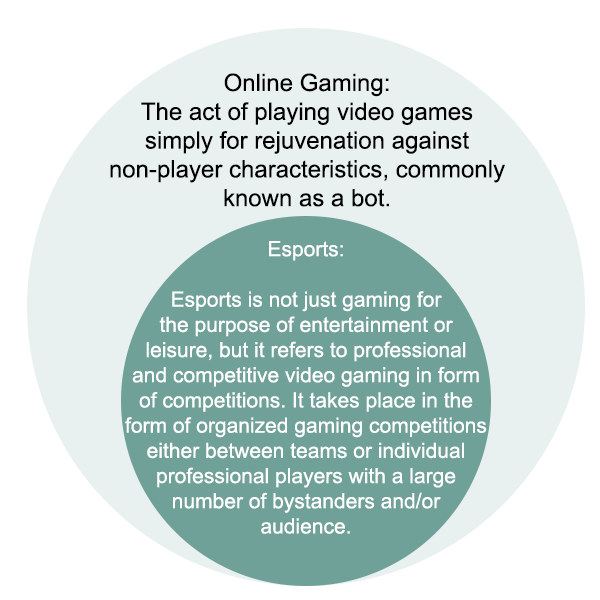
Originated back in 1972, esports has started picking up pace in the 2000s. The International Dota 2021 World Championship had a prize pool of $40 million[2]. We all have been wondering how the field of esports is growing at such a pace and receiving such admiration? Majorly, it is because the attraction of this field specially among the youth has given birth to a lot of esports athletes as well as content creators who have both gaming and content creation skills that take the buzz of competitions across the boundaries. Content creators with the help of live streaming and social media promotion of renowned competitions have made esports an ocean of opportunities. A gamer “DrLupo” through his annual charity stream raised more than $3.68 million for the fight against cancer[3]. Esports also made an appearance at the 2021 Tokyo Olympics. The Korean Esports Association (KeSPA) created by the South Korean Government is the first body dedicated to videogaming and esports regulations in the world. [4]
RECOGNITION OF E-SPORTS BY THE INDIAN GOVERNMENT:
Currently, through notification dated 23rd December 2022, Esports was integrated with mainline sports discipline by the government of India and the Ministry of Youth Affairs and Sports is required to officially look into e- Sports[5].
The Indian government by giving recognition to esports as a part of multi-sports event has provided a major boost. With the inclusion of esports in the multi-sports category, the recognised esports tournaments might attain the same status as that of offline sporting events in the country like national level tournaments. Early last year, the Commonwealth Games 2022 in Birmingham included esports as a pilot event. Esports will also debut at the postponed Asian Games in Hangzhou later in 2023. General gaming laws are also changing in India and more information on this aspect can be obtained here[6] . However, there is a distinction between online gaming and e-sports and thus the government notification also identifies different ministries to look into them.
LEGAL ASPECTS OF ESPORTS IN INDIA:
India noticed esports players increase from 300,000 in 2020 to 600,000 in 2021, with revenue growing by 29 per cent from ₹ 7.5 billion in 2020 to ₹ 9.7 billion in 2021.[7].
A) Need of a central legislation:
Inspite of the crucial role that e-Sports is playing in the economy today, the laws governing the same are not very well defined. Article 245 and Article 246 of the Constitution of India, read with Schedule VII, differentiates as to whether the Union and/or the State can make laws on a particular subject.
The matters related to sports are currently considered to be State matters in India however, considering esports and its nation-wide spread, it should not be legislated by one State alone as most of the major competitions in the country consist of teams and players from different states. Esports are played virtually across the globe and are connected with technology right from its roots. Hence, Central Government’s involvement is crucial to protect people’s interests from cybercrime, e-doping and other related issues.
If a possible dispute were to arise with respect to any e-Sport tournament, whether related to:
- Unauthorized usage of the gaming software without the permission of the developers;
- Usage of cheat software by the athletes;
- The nature of the game itself being improper (like containing an element of gambling or being addictive or violent or spreading illegal and improper content);
The legal minds would have to apply multiple legislations to address identification of violations, prescribing penalties and providing realm to play such esports in legal manner without breaking any laws. We already have few archaic laws like the Public Gambling Act 1867, Prize Competitions Act 1955 and the other general legislations available. These acts should be looked from a current scenario and may be revisited to accommodate the present-day situation.
B) Intellectual Property Rights in e Sports:
Investors’ fraternity were early to spot investment opportunities in e-Sports. A popular gamer and streamer named “Ninja” earns around USD one million a month from just playing and streaming games on Twitch and YouTube.[8]
| Form of IPR | Relation with Esports |
|---|---|
| Patent | In esports, the only thing that can be protected with the help of patents is the game itself. The patent protects the invention which may be used in creating the game. For example, if the game developers invent any unique technology like the unreal engine technology (used by Epic Games), then the developer may seek to protect the same via patent. |
| Trademarks | Esports usually attract the audiences, mostly the youth, by the name of the game. It is the name of the game that generally describes the genre it belongs to and the developers should obtain a trademark registration of the names, logos etc. to avoid unauthorised use. |
| Copyrights | Copyright is created in an original literary, artistic, dramatic, musical or a cinematographic work and registration is not mandatory. Considering the multiple components of a game, multiple copyright protection may be available for source and object codes of the game, user manuals as literary works, characters may be protected under artistic works, background music etc. may be protected under musical works, and if any unique video is created, the same may be protected as a cinematographic film. |
| Industrial Design | An industrial design is a distinct protection granted to certain specific features, shapes, patterns etc. that may be applied to any article in a finished form. One must remember that for any protection under the Designs Act, registration is mandatory. In the context of e Sports, industrial designers can use their technical expertise in creation of unique avatars. It is the designers who create a mesmerising effect for the players of that game. For e.g. While playing Fifa 23, doesn’t it feel spine chilling to watch the avatar of Cristiano Ronaldo and the minute details of his face and overall body structure created by the designer that literally leaves the players on the edge of their seat every time they play the game to experience such a great depiction of their idol. Another example can be merchandise which are sold in huge numbers of widely loved game titles like Dota 2 and Counter-Strike. Such merchandise may include designs of hoodies, action figures, wall posters, mobile covers, mugs, etc. |
Legislation to tackle e-Doping in Esports:
As athletes get involved in sports, their desire to excel sometimes cross boundaries and thus malpractices like doping develop. Doping means unlawful use of drugs by an athlete for enhancing performance. Esports already has a massive fan following and this creates pressure on players to perform well resulting into them doping for improved performance. Like players in traditional sports consume substances for better energy, stamina and power, in similar manner doping in esports is called e-doping and this takes place in the following two forms:
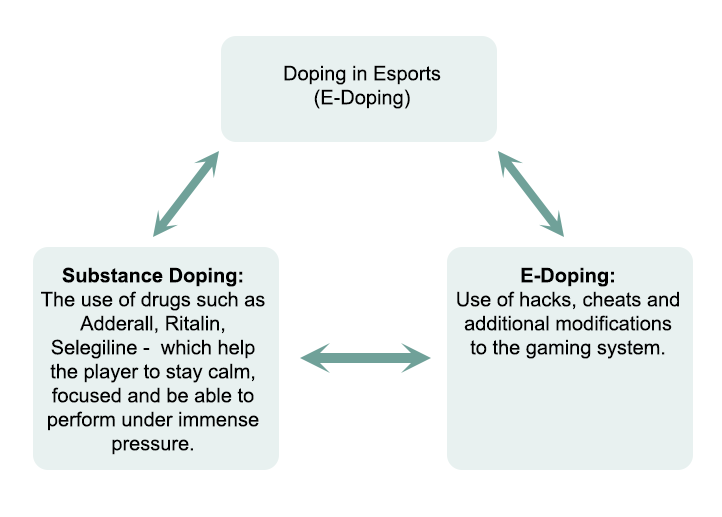
The National Doping Act, though enacted in 2022 does not deal with e doping currently and the government is required to come up with strong rules to check these malpractices.
Case Law: Riot Games, Inc. v. Stefan Delgado Argote et al
For reference purposes, there is an interesting judgement of California District Court on eSports that is worth noting. In this case, the Plaintiff, Riot is the developer of the game ‘League of Legends’ (LoL), which has tremendous popularity all over the world. LoL falls under the genre of Multiplayer Fighting Game. In LoL, two teams of powerful champions compete against each other. Each champion has an intriguing design, special attacks and playstyles that make the experience of battle across computer generated battlefields very close to real.
The Plaintiff alleged that the Defendants operated a cheating software called ‘LeagueSharp’, that specially allows certain LoL players to play in an unfair manner to get undue advantages over legitimate players. These unfair advantages included, seeing hidden information, automating gameplay to play with unreal accuracy and collecting rankings and gift items which is not possible for a normal human player.
The Court ruled in favour of the plaintiffs and held that that the Defendants had violated section 1201 of the Digital Millennium Copyright Act (DMCA) 2017 wilfully and for private commercial gain by providing and trafficking Riot’s server technology and in multiple ways evading Riot’s anti-cheat software. Since there is neck to neck competition in playing LoL, any perception that a player might be cheating or using unfair advantages in the game may result in players losing interest and leaving the LoL community resulting into steep losses of Riot.
Based on the facts of the case, on 1st March 2017 Riot received a $10 million compensation through a settlement between the parties to close the dispute amicably. Also, the United States District Court for the Central District of California ordered a ban on LeagueSharp to access any Riot server and playing any of Riot’s game in the future.
Conclusion:
It is remarkable that esports having made its mark in India not long back, has grown tremendously in a very short time. One of the reasons behind this, is the Covid-19 pandemic. The field of esports has been like a beam of light spread through all the negativity that the pandemic has brought. Just like every other aspect of the economy, the pandemic has had an impact over the traditional sports. All the major competitions were shut and even when they crawled back to action, the stadiums were empty for quite some time. All the sports enthusiasts including the fans were sitting back at home waiting desperately to get back into action. Meanwhile, esports crept up as another form of sporting entertainment. In the time of self-quarantine and social distancing, the virtual world of esports has brought great adrenaline rush that sporting enthusiasts were craving for, through competitive and organized video gaming.
Even though esports has not yet cemented as a dedicated stream of career or recognition in India, it would be apt to say that esports is here to stay. With collision of the worlds of traditional sports and esports, India is about to witness promising changes in this sector in the years to come. A few of such prominent changes may include development of local sports of Indian culture which through the medium of esports might get recognition and liking on the global level, sports like cricket and football which are known world-wide are getting intensely competitive on the fields, and similarly the fans who dream of being on the field can play their hearts out virtually and brush up their skills after regularly facing ranked players from all over the world, already many major esports tournaments are hosted in India and this number is only going to grow ensuring thick flow of revenue into our economy.
It is time for us to fasten our seatbelts, the ride of esports is here and is taking us to the future in a fast and furious manner by triggering existing and new law points. This means, ‘the courts have to be ready; the legislature has to be ready too and gamers have to keep their remotes steady, they are in for a treat through and through!’
- The article reflects the general work of the authors and the views expressed are personal. No reader should act on any statement contained herein without seeking detailed professional advice.
- https://esportsfederation.in/
- https://www.sportskeeda.com/fortnite/5-times-streamers-ended-receiving-life-changing-donations-live-stream
- https://hir.harvard.edu/esports-part-1-what-are-esports/
- 241420-Gazette Notification dtd. 23.12.2022-Amendment in AoBR-Allocation of Online Gaming to MeitY and e-Sports to Dept. of Sports.pdf
- https://www.linkedin.com/feed/update/urn:li:activity:7029067 982282579968
- https://www.ndtv.com/business/indias-esports-industry-gets-a-boost-after-government-recognition-3662758
- https://www.esportsearnings.com/search? search=ninja&type=player
- Riot Games, Inc. v. Stefan Delgado Argote et al- Case number 2:16-cv-05871 decided on 1st March 2017
For any feedback or response on this article, the authors can be reached on atharva.amdekar@ynzgroup.co.in

Author : Atharva Amdekar
Atharva is an Associate at YNZ Legal. By qualification he is Bachelor of Commerce and Bachelor of Law from Mumbai University