
Practicing medicine is one of the most noble professions. The great epic Ramayana tells us that even Lord Rama had to join hands before a Vaidya (as was a doctor called in those days) when his dear brother Lakshmana was injured in battle.
Approaching a doctor is generally a matter of trust. However, the connotations are changing in todays’ busy world. Many cases of medical negligence have come to light. Similarly, cases wherein patients have actually harassed medical professionals due to the treatment not meeting their expectations have also been noticed.
To institute a safe procedure, many hospitals have introduced many practices and paperwork before meeting a doctor in a hospital. This article deals with the critical document: CONSENT FORM that patients must execute before undergoing any surgical/ non-surgical procedure and which also serves as a safeguard for many doctors.
REQUISITES OF CONSENT:
The important elements of consent can be described as information, comprehension and voluntariness. Consent is the critical aspect of today’s healthcare and an incomplete or invalid consent is at the heart of many litigations that medical professionals face. As per the Indian Medical Council (Professional Conduct, Etiquette and Ethics) Regulations, 2002 it is a settled principle that doctor is required to obtain consent. However, the mode and the contents of the same remains an ambiguous area in the minds of the patients.
A consent is considered to be proper and informed consent when:
- The consent is given by a competent person i.e. the patient himself/ herself when the patient is able to understand the procedure or his/ her valid guardian, relative, next of kin in case the patient is unable to give consent;
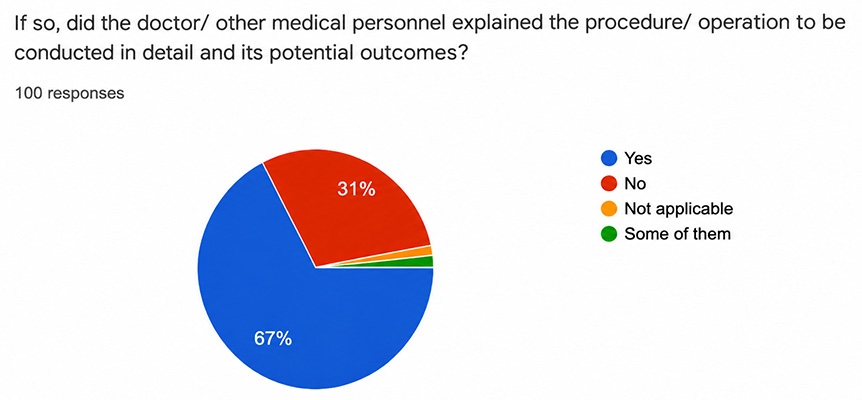
- The medical professional before performing any procedure or surgery has explained to the patient the complete proposed procedure in a language that is understood best by the patient; To understand this issue better, the author conducted a sample survey and it was noticed that almost 81% of the people had signed the consent form and confirmed that they had given some consent for a mode of treatment. However, only 67% of the patients were explained the details of the procedure. More than 20% of the surveyed patients thought that it was just a routine signature form.
TYPES OF CONSENT
- Implied consent given by patient for consultation or examination.
- Express consent given by patient for any procedure or surgery.
- Proxy Consent or Consent on behalf of Patient.
Implied Consent:
When patient comes to a doctor for obtaining treatment on his ailment, he is agreeable to general basic medical examination and consultation in general sense. This is known as implied consent and does not apply to procedures which are not complex and not surgical but routine examination.
Express Consent:
Express consent means the consent given explicitly by the patient to the medical practitioner. Express consent may be in the form of oral or written consent. Usually, oral consent is obtained when relatively minor examinations are there. For all other procedures such as diagnostic procedures, or procedure to be performed under general or partial anaesthesia, or for surgical operations express written consent has to be signed by the Patient and/or the Patient’s relatives.
A medical professional has to inform any patient all the information about the medical procedure or examination in a language, using non-medical terms which can be understood best by the patient, and the information shall include but not be limited to the diagnosis, prognosis, nature of the treatment and procedure and risks involved.
Proxy Consent or consent on behalf of patient:
When a patient is not of sound mind, is minor in age or is unable to give his consent to the medical practitioner, medical practitioner should obtain consent of next of kin, relative, guardian or the attendant in dire circumstances.
Any consent which generalizes or does not specify the procedure to be undertaken i.e. a blanket consent, is not legally valid.
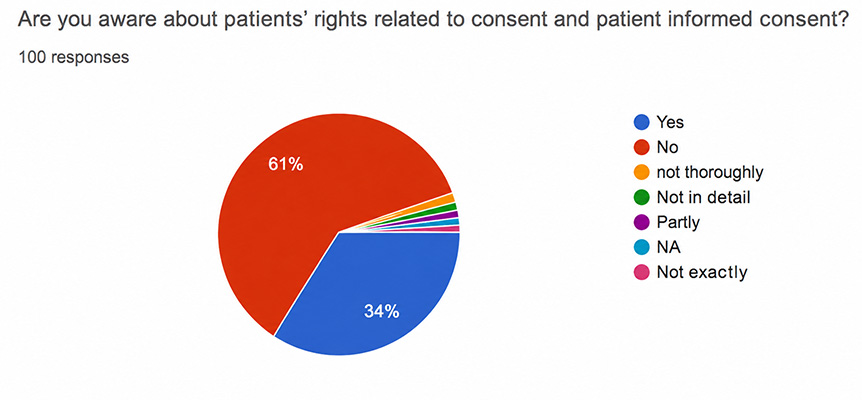
In our sample survey it was noted that there is lack of awareness about consent and rights of the patient under consent.
Legal Viewpoint
Medical Council Rules: The Indian Medical Council (Professional conduct, Etiquette and Ethics) Regulations, 2002, govern the duties and responsibilities of registered medical practitioners and lay down the requirement and guidelines for situations where informed consent is to be obtained from patients.
The Telemedicine practice guidelines, 2020 which gained utmost importance for online consultations also have a detailed section specific to the topic of consent. The telemedicine consent can be express or implied. The consent doesn’t have to be long, but a simple “I agree to avail consultation via telemedicine” should suffice. However, certain hospitals include limitations and broad disclaimers in consent form which may not be sufficient as per the law.
Law of Tort:
The principle of tort recognises the right to integrity of one’s body. Thus, without the valid consent, each examination of the patient or even a minor procedure may amount to battery[1] under the tort law. However, if a proper consent was obtained then a level of protection offered to the medical professional.
Criminal Law:
A medical professional may be convicted under the provisions of Indian Penal Code, 1860 under various provisions related to injury to body such as homicide and culpable homicide, if the consent was not proper and unfortunately results in the death of a patient.
Constitution of India:
Each person has the right to privacy and protection of life and personal liberty which is governed by Article 21 of Constitution of India. Thus, no medical professional can actually touch a patient without his/her consent. However, this right may be curtailed if the patient has agreed to the same.
Consumer Protection Act, 1986:
After the case of Indian Medical Association Vs. V P Shantha[2] (medical services have been brought under the purview of Consumer Protection Act, 1986. Thus, relief for any alleged negligence on the part of the doctors may be sought under the same.
Case law:
Samira Kohli vs Dr. Prabha Manchanda & Anr [3] Ms. Kohli had consulted a doctor and was advised to undergo a diagnostic laparoscopy. This procedure was to be done under anaesthesia. Consent was obtained from her in form of consent forms for admission and for the laparoscopy. On her admission card in hospital, it was mentioned that laparotomy may be needed. During the laparoscopy, the doctor’s assistant came out of the operation theatre while the patient was still unconscious and obtained the oral consent of the mother for hysterectomy. Ms. Kohli afterwards alleged of medical negligence. It was alleged by Ms. Kohli, that the doctor had given an impression to the mother that hysterectomy was the only way, and that she was in a life-threatening situation.
The doctor did not wait till appellant gained consciousness and could understand options available to her.
In the present case, consent was only giving for diagnostic laparoscopy and certainly not the hysterectomy. Also, the consent for the mother cannot be held valid, as there was no life-threatening medical emergency and the patient herself could have given consent after hearing all the valid options. The court held that surgery cannot be held valid, as there was no consent from the patient, and therefore it would have been reasonable to postpone the surgery and obtain the consent of the patient. Thus, since the surgery was conducted in the absence of consent, it amounted to assault and battery and the doctor was held liable to pay the damages amounting to Rs. 25,000/- with interest at 10% per annum from date of order till date of payment. Also, the doctor had to pay the patient the bill amount if paid by the appellant along with interest of 10%.
Conclusion
Obtaining medical consent from a patient or a patients relative/ legal guardian shall be a shield for the medical professionals against litigation. In a developing country like India, the awareness about patients’ rights and informed consent is very low. Thus, there is more transparency required in the whole consent process.
Recommendations:
- Medical institutions should come up with detailed procedure related to patient consent, and should have a dedicated staff to explain the specifics of the procedure to the patients and his relatives.
- The language of the consent to be obtained should be lucid and should not be in complicated legal and medical terms as at the time of giving consent, the patient and his relatives shall not be in the right frame of mind to understand complex legal and medical language.
- Similarly, it is also the right and responsibility of the patient to read the consent form in detail and also communicate with the doctor about the details of the surgery or the diagnostic procedure.
For any feedback or response on this article, the authors can be reached on shruti.kulkarni@ynzgroup.co.in.

Author : Shruti Kulkarni
Shruti is an associate at YNZ Legal and has completed her Masters of Commerce from Pune University and Bachelor of Law from ILS Law College, Pune. She is also a member of Bar council of Maharashtra and Goa.