
1. Introduction:
Way back in 1960, Dashrath Manjhi had to break a mountain to ensure that no one from his remote village in Bihar, died due to lack of medical care. It took him 22 years to do so.[2] Thankfully, we have moved way ahead from those times and today, consulting a doctor virtually within a few seconds through telecommunication means is very much possible and common, more so after the pandemic.
While the teleconsultation practices were in existence way before the onset of Covid-19, the pandemic has surely caused an up-surge in the use of telemedicine consultation. The number of patients served by India’s National Telemedicine Service let-alone was over 50.5 million as of July 2022[3], the number of patients using the privately run telemedicine applications have increased as well.
The World Health Organization recently issued Consolidated telemedicine implementation guide (“Implementation Guide”), describing planning, implementation and maintenance processes for telemedicine which can be considered by the policy and decision makers of the countries while establishing legislation around telemedicine.
With the increase in provision of healthcare services online, the ministry of health and family welfare passed the Telemedicine Practice Guidelines 2020[5] (“Guidelines”), as online health consultation raise very crucial concerns which differ from traditional in-person consultation with doctors. One of such several concerns is the aspect of patient consent under telemedicine consultation which is elaborated under this article.
2. Consent Under Guidelines
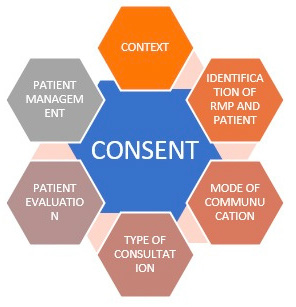
A registered medical practitioner (RMP)[6] is entitled to provide telemedicine consultation to patients from any part of India. The Guidelines have prescribed seven elements which need to be considered by an RMP to be considered before beginning a telemedicine consultation of which Consent forms an integral part.
Seven Elements to be considered before any telemedicine consultation:
The Guidelines have specifically identified provisions of patient consent under Clause 3.4. Obtaining patient’s consent is mandatory for any telemedicine consultation. Any discussion around the health-related aspects of an individual is very personal. While teleconsultation may not involve administering any procedure, disclosure of personal facts is likely to occur during telemedicine consultation and thus any such disclosure is voluntary important.
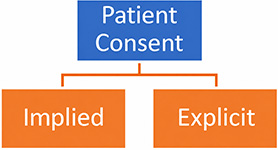
Patient consent during telemedicine consultation may be categorized into two types:
Implied Consent:
The consent is implied if the patient initiates the telemedicine consultation. The basis of this assumption is that in an in-person consultation, as the patient visits the consultant, it is assumed the patient has consented to consultation by his/her actions. When the patient walks in an OPD, the consent for the consultation is taken as implied.[7]
However, whether the initiation is genuine may be a factor in some cases as it is possible that an interested relative may misuse the procedure and wrongfully initiate the consultation, by starting the virtual call or conference, without the actual consent of the patient. The relative may give wrong information, and while this possibility exists in actual consultation as well, this possibility assumes significant importance considering that patient is actually not examined by the RMP.
This aspect was also raised in one of the criminal complaints filed in the recent unfortunate case of death of the actor Sushant Singh Rajput.[8] This FIR alleged that prescriptions were wrongly obtained online through a telemedicine and the matter is currently subjudice.
Explicit Consent:
If a health worker[9], RMP or a caregiver initiates the telemedicine consultation, an Explicit patient consent is mandatory which may be recorded in any form including an email, text or audio/video message. Patient can state his/her intent on phone/video to the RMP (e.g. “Yes, I consent to avail consultation via telemedicine” or any such communication in simple words or through a form as well).
The RMP has an obligation to record such consent in his/her patient records and such consent should be easily available and accessible to the RMP in case of any future requirement and not just on the portal which is being used for telemedicine consultation. Sometimes, the RMP may choose to disconnect his account on a particular platform for telemedicine consultations. However, the consent records should be separately obtained and persevered by RMP.
3. Circumstances warranting special consent requirements:
The manner of consent required differs depending upon whether the teleconsultation was initiated by the patient, caregiver or RMP and the procedure adopted for the consultation.
a. Telemedicine through mobile applications:
Generally, when the patients download the applications, login and request for consultation/appointment, the consent in such case can be said to be implied. Such consent can be said to be implied for both first consults[10] and follow-up consults[11]. In both these situations as the patient initiates telemedicine consultation and thereby consent is implied.
It is to be noted that, the consent discussed herein is specific to teleconsultation, while other consents and disclosures regarding the use of platform/application are separate and need to be obtained by the platform as per applicable laws.
b. Consultation basis Health worker’s advice:
Many a times, the patient instead of approaching the telemedicine applications, initially consults a health worker/RMP in-person. In such case where the patient has been seen by the health worker and in the judgment of the health worker, a tele-consultation with a RMP is required, the health worker should obtain the patient’s informed consent. In such case the health worker should also explain potential use and limitations of a telemedicine consultation. In such case, RMP should confirm the patient’s consent to continue the consultation.
c. Dispensation of medicine through RMP recommended pharmacy:
In case the RMP is transmitting the prescription directly to a pharmacy, he/ she must ensure explicit consent of the patient that entitles him/her to get the medicines dispensed from any pharmacy of his/ her choice.
d. RMP initiated support groups:
Further, in case the RMP intends to create a virtual support group to disseminate health education to a)persons suffering from specific disease condition, he/she must be wary of patient’s willingness to ensure that no violation of patients privacy and confidentiality occurs by adding them to the group without their consent. In such case, it is of utmost importance to obtain patient’s explicit consent.
4. Conclusion
Patients who were earlier apprehensive of consulting for medical issues online have especially during the period of pandemic got accustomed to the teleconsultation process and the use of telemedicine applications seem to have continued post-pandemic period as well. The reasons for this could be convenience, time efficiency and changing dynamics of the applications/platforms.
The RMPs and health workers should definitely adopt clear SOPs and procedures for ensuring that the consent is properly obtained and stored while ensuring data protection, patient safety, privacy, traceability, and accountability to avoid discrepancies.
- The article reflects the general work of the authors and the views expressed are personal. No reader should act on any statement contained herein without seeking detailed professional advice.
- Manjhi-The Mountain Man: Some facts – India Today
- https://www.who.int/publications/i/item/9789240059184
- https://www.who.int/publications/i/item/978924 0059184
- https://www.mohfw.gov.in/pdf/Telemedicine.pdf
- A Registered Medical Practitioner [RMP] is a person who is enrolled in the State Medical Register or the Indian Medical Register under the Indian Medical Council Act 1956.’ [IMC Act, 1956]
- Clause 3.4 of the Guidelines
- Bombay High Court: Criminal Writ Petition Stamp No. 2712 Of 2020
- For the purpose of Guidelines, “Health worker” could be a Nurse, Allied Health Professional, MidLevel Health Practitioner, ANM or any other health worker designated by an appropriate authority.
- First Consult means, a) The patient is consulting with the RMP for the first time; or b) The patient has consulted with the RMP earlier, but more than 6 months have lapsed since the previous consultation; or c) The patient has consulted with the RMP earlier, but for a different health condition.
- Follow-Up Consult(s) means, the patient is consulting with the same RMP within 6 months of his/her previous in person consultation and this is for continuation of care of the same health condition.
For any feedback or response on this article, the authors can be reached on Ayushi.kalelkar@ynzgroup.co.in or Siddhi.mhamunkar@ynzgroup.co.in

Author : Ayushi Kalelkar
Ayushi is experienced in corporate legal and investment and deal advisory. She is also a member of Bar Council of Maharashtra & Goa. By qualification she is a Master in Commerce and Bachelor of Law from Mumbai University.

Co-Author : Siddhi Mhamunkar
Siddhi is an associate at YNZ Legal. By qualification she is a Bachelor in Commerce and Bachelor of Law from Mumbai University.