
INTRODUCTION:
As per the NITI Aayog’s estimates, online gaming segment grew by 28% in 2021 to reach USD 1.9 billion. With increasing use, the perils associated with the same like addiction and gamers losing money through gambling or negative impact on children because of age-inappropriate games are also on rise.
Many online gaming applications are in a position to take advantage of users’ desire to make money quickly and easily by using their time to maximize their profits. Most of the times, these applications provide their terms and conditions only in small print, especially related to risks.
Users are ignorant and lack knowledge relating to privacy and consumer rights. Thus, protection of users of such online games is necessary.
On 6th April 2023 Ministry of Electronics and Information Technology (MeitY) notified Information Technology (Intermediary Guidelines and Digital Media Ethics Code) Amendment Rules, 2023 (“Rules”). These Rules are established under Information Technology Act, 2000 (“Act”). These Rules establish provisions pertaining to online gaming intermediaries and modify such provisions for social media intermediaries.
The Rules are currently challenged before Delhi and Bombay High Court, considering the provisions with respect to the right of Central Government to establish a ‘fact-check unit’ under Rule 3 which is considered by the petitioners to be violating the fundamental rights of people provided by the constitution of India.
While the decision on the challenge is yet to be passed, this article endeavors to analyze and comment on the other provisions of the Rules.
One of the aspects of these Rules is also to set the regulatory framework for the Indian online gaming intermediaries, particularly online real money games, to ensure that they run ethically and responsibly and safeguard customers from losses.
General information about online gaming can be obtained https://www.linkedin.com/feed/update/urn:li:activity:7029067982282579968
KEY DEFINITIONS UNDER THE AMENDMENTS:
| Online Game | Online Gaming Intermediary | Online Real Money Game |
| • Offered on internet which is accessible by user • Through Computer resource or intermediary • An intermediary shall grant or provide access to such user • Examples: Minecraft, Counter Strike etc. | • Person or intermediary that enable users access to online games by accessing its computer resource. • User can access one or more online games • Example: Steam, Epic Games, Origin etc. | • An online game where the user deposits cash or kind • with an expectation to earn winnings • Examples: Dream 11, Rummy circle etc. |
Requirements and Framework for permissible Online Real Money Game:
| 1. It should not be wagering on any outcome | Instead of relying on chance, the outcome of a game should be based on user’s personal skills and abilities. |
| 2. It should comply with applicable laws or any gaming rules. | The Online Game must adhere to the legal framework and rules that govern gaming activities. |
| 3. It should not be a hazard to sovereignty and integrity, security and friendly relation of India with other states | The Online Game should not contain and/or retain content that is politically sensitive, promotes terrorism, or incites hatred towards a particular group. |
| 4. It shall safeguard against user harm or any psychological harm | The Online Game should not retain and/or contain anything which is derogatory or offensive that may affect users and causes harm, whether physical or mental. |
| 5. It ensure that measures shall be taken to safeguard the children which includes parental access, control and ensure that games shall be classified as per age criteria. | The Online Games can have in place appropriate checks and measures to ensure kids from accessing inappropriate content. |
| 6. It shall safeguard its users from any harm or risk of any addiction, financial loss or fraud | e.g. the games can include repeated warning messages/disclaimers intimating users of potential risks and/or hazards. |
GAMING INTERMEDIARIES:
Rule 3 and Rule 4 impose multiple obligations on Gaming Intermediaries and through this amendment all the obligations on social media intermediary have been imposed on the Gaming Intermediaries
General mandatory obligations like displaying properly refund or withdrawal of deposit policy (including the fees and other charges payable by the user) shall be in place in addition to the rules and regulations, privacy policy, terms of service and user agreement;
The Online Real Money Game shall display the mark of verification which is provided by Self Regulatory Authority (“SRO”);
The mandatory policies like Information with respect to KYC procedure which needs to be followed by user to verify the identity of such Online Real Money Game; this procedure should be followed as per the regulations of RBI.
Further, the intermediary must ensure that the content hosted by the intermediary is strictly regulated. Intermediary is prohibited from hosting any content that:
- Belongs to other person and without authorization or license
- Impersonates another person
- Is not verified as permissible online game
- Infringes: patent, trademark, copyright
- Causes user harm[1]
- Obscene, pornographic, paedophilic, invasive of another’s privacy
- Is in the nature of advertisement or surrogate advertisement
- Which is harmful to child
- Promotion of an online game that is not a permissible online game
GAMING INTERMEDIARIES:
- Intermediaries shall ensure that before accepting any deposit from users, identification of such user is mandatory and after publishing the information of measures taken for the protection of deposit made by user
- Online gaming intermediary shall not provide any finance or credit or offer any third-party finance to its users for playing such Online Real Money Game
- The online gaming intermediary who enables the users to access any permissible online real money game shall inform its users of such change as soon as possible, but not later than twenty-four hours after the change is effected
Rule 4 (5) In India, any big social media or online gaming platform that let users access real-money games must provide a physical contact address on its website or mobile app. This is so that users can easily get in touch with the platform if they need to. It’s a new rule aimed at making sure these platforms are accountable and responsive to their users in India.
Rule 4B grants a timeframe of three-month before they need to comply with new rules around self-regulation and providing a physical contact address. This is to allow time for at least three self-regulatory bodies for online gaming to be designated. However, the government can still decide to enforce the rules earlier if they choose to. The aim of these rules is to make online gaming safer and more accountable for users in India.
Non-Observance of Rules:
Similar to other intermediaries, where an online gaming intermediary fails to observe the Rules, the intermediary shall be liable for punishment under any law for the time being in force including the provisions of the Act and the Indian Penal Code as stated in Rule 7.
ONLINE GAMING SELF REGULATORY AUTHORITY:
Apart from the introduction of the concept of online games and online gaming intermediaries, the Rules have also introduced the concept of Online Gaming ‘Self-Regulatory Authority’.
WHO SHALL BE CONSIDERED AS SELF REGULATORY BODY AND THEIR POWERS:
- To become Self-Regulatory Body an entity shall fulfil the following criteria:
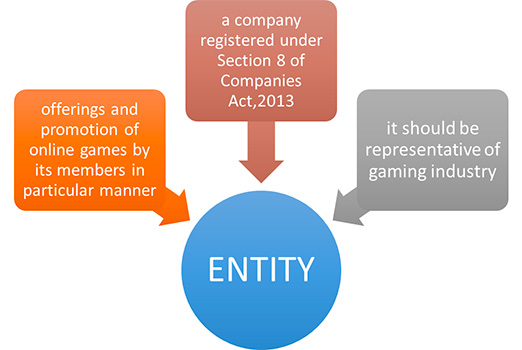
Under these Rules SROs have following powers and authority to publish the following details on their website or mobile application with respect to Online Real Money Game:
1. List of approved Online Real Money Game and it should be updated consisting the details of applicant, the dates and duration of the verification.
2. List of Members (present or past) with the dates of acceptance as a member, ID Number (Business or corporate) and the details of suspension or revocation of membership of any member.
3. They can suspend or revoke the verification by communicating in writing of the Online Real Money Game if it is non-compliant of any provisions under this Rules.
4. Give opportunity to be heard to members.
5. Framework for grievances redressal including the contact details of the Grievance Officer.
CRITERIA FOR BOARD OF DIRECTORS UNDER SELF REGULATORY BODY:
have special knowledge or practical experience;
has experience and promote the interest of users;
educationist;
an expert in the field of psychology or mental health;
expertise in IT field ;
member or officer of an organization which deals with protection of children rights;
expertise in public policy or administration or law enforcement or public finance
PROCEDURE FOR VERIFICATION OF ONLINE REAL MONEY GAME
Application to SROs
SRO relying upon information, to give a temporary approval of 3 months.
Completion of proper inquiry within 3 months.
Declaration the game as Online Real Money Game or inform the applicant in writing ground of rejection.
IMPLICATION OF AMENDMENT ON ONLINE GAMERS OR USERS:
- Due to increase in due diligence by Gaming Intermediary, users are in safe hands as the Intermediary has a duty to check whether the Online Game or Online Real Money Game which they are playing is verified and not a fraud
- Verification of Online Real Money Game assures the users thus it will reduce the risk of financial loss, addiction
- Due to introduction of KYC Procedure users of Online Game or Online Real Money Game have to follow the procedure and verify their identity before accessing such games
Conclusion
1. In conclusion, the current amendment mainly broaden the horizons of meaning of intermediaries to include online gaming intermediaries, requiring them to display a seal of approval from a certified self-regulatory organization and verify consumers’ identities prior to collecting deposits.
2. The objective of current amendment hence is to safeguard players from fraud and other wrongdoings while ensuring fairness and transparency in online gaming.
3. By fostering a safer and more responsible environment for users, India’s new regulations for online gaming may aid in addressing addiction and excessive use. This might lessen the dangers of addiction, particularly for younger generations.
- “user harm” and “harm” mean any effect which is detrimental to a user or child, as the case may be.
For any feedback or response on this article, the authors can be reached on Ayushi.Kalelkar@ynzgroup.co.in or sanika.phatak@ynzgroup.co.in or siddhi.mhamunkar@ynzgroup.co.in

Author : Ayushi Kalelkar
Ayushi is experienced in corporate legal and heads the investment and deal advisory at YNZ Legal. She is also a member of Bar Council of Maharashtra & Goa. By qualification she is a Master in Commerce and Bachelor of Law from Mumbai University.

Co-Author : Sanika Phatak
Sanika is an associate at YNZ Legal. By qualification she is Master in Corporate Law from Vishwakarma University, Pune and Bachelor of Law from Pune University.

Co-Author : Siddhi Mhamunkar
Siddhi is an associate at YNZ Legal. By qualification she is a Bachelor in Commerce and Bachelor of Law from Mumbai University.