
Introduction[1]:
Sometimes situations arise when disputing parties want to obtain urgent orders from the Court without notifying the other party. For example, a company-ABC has been prevalent in market for providing brokerage services to customers since 20 years. Suddenly, another company – XYZ launches a line of smartwatches with strikingly similar branding and design. ABC sends a notice and threatens to approach the court. XYZ receives the notice and replies, to which there is no response from ABC. XYZ has an apprehension that ABC may obtain ex-parte order from the Court. To safeguard its rights and prevent any adverse legal actions, XYZ can proactively file a caveat with the appropriate Court. This caveat, in legal terms, would act as a preventive measure in civil proceedings, allowing parties to avert ex-parte orders or judgments being passed without their knowledge.
Let us understand this better.
1. What is a Caveat?
Derived from the Latin phrase “let a person be aware,” a caveat, in the legal context, signifies a notification issued to prevent certain actions from being taken without informing the individual who has provided the notification. Within the framework of the Civil Procedure Court, the provisions governing caveats are outlined in Section 148A.
The person who files a caveat is called the Caveator (“Caveator”) and the person who has instituted a suit or is likely to do so is called Caveatee (“Caveatee”).
2. When can a Caveat is to be filed?
Pursuant to Section 148A, individuals anticipating the initiation of legal proceedings against them in any Court are entitled to lodge a caveat under the following circumstances:
- Ongoing Litigation :
When an application is anticipated or has already been filed within an existing legal proceeding. - Anticipated Litigation :
When a legal proceeding is imminent, and an application is expected to be filed within that context.
3. Who can file a Caveat?
Section 148A stipulates that a caveat may be filed by any individual, provided they possess the right to appear before the Court concerning the subject matter of the litigation. Thus, a caveat can be filed by a third party who has a relevant connection to the suit.
4. What can be the Jurisdiction for filing of Caveat?
When a potential legal proceeding is anticipated in the near future, a caveat can be filed with any Civil Court of original jurisdiction, including Appellate Courts, High Courts, and the Supreme Court. This also encompasses Courts of Small Causes, tribunals, forums, and commissions. However, it’s important to note that Section 148A of the Code of Civil Procedure applies exclusively to civil proceedings.
Caveats cannot be used against petitions filed under the Criminal Procedure Code or Article 226 of the Constitution of India, as established in the case of Deepak Khosla v. Union of India & Ors[2]. where, the Court ruled that a caveat petition under Section 148A of the Code of Civil Procedure (CPC) is not applicable in criminal proceedings. The petitioner, a complainant in a criminal case, sought to file a caveat to protect his interests against potential challenges to the summoning orders. However, the Court held that the provisions of the CPC are limited to civil suits and do not extend to criminal proceedings.
5. What is the process for filing a Caveat before the Bombay High Court?
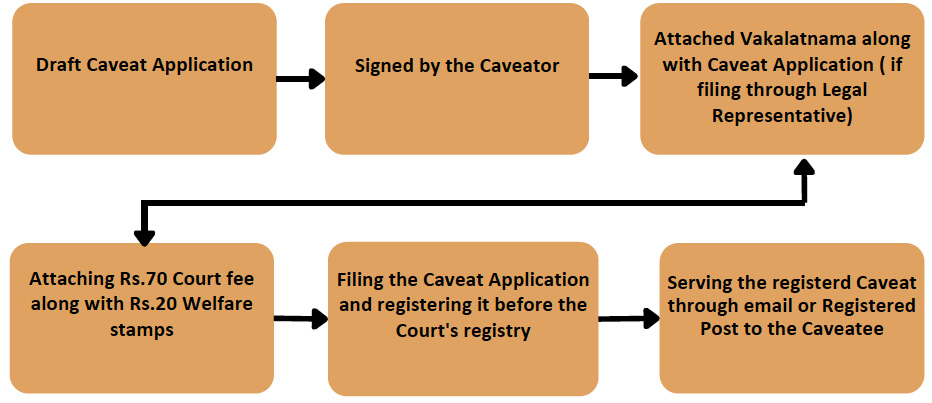
The register records the caveat date, caveator’s details, plaintiff/defendant names, and anticipated proceeding details. Court fees for filing a caveat are generally nominal. Such as in Bombay High Court it requires Rs. 70 Court Fee stamp along with Rs.20 Welfare Stamp fee. The rules and format may vary across different Courts.
6. What details does a Caveat generally have?
A Caveat should include the following information:
- Caveator’s and Caveatee’s name, address and mail id
- Court Where the Caveat is filed
- Suit/Appeal Number (if applicable)
- Brief Description of the anticipated Suit or Appeal
- Names of Likely Plaintiffs/Appellants and Respondents.
7. What are the Rights and Responsibilities in Caveat proceedings?
| Role | Duty | Right |
|---|---|---|
| Caveator | Serve a notice of caveat to the anticipated Applicant. | Be informed of any application filed against them. |
| Court | Serve a notice to the caveator upon the filing of an application. | Ensure a fair hearing and consider the merits of the caveat. |
| Applicant | Serve a notice to the caveator and provide a copy of the application. | Proceed with the application after fulfilling notice requirement. |
8. Does Caveat have time limitations?
Clause 5 of section 148 A stipulates that a caveat remains effective for 90 days. If an application is filed during this period, the Court and the applicant must notify the caveator. However, if no application is filed within the 90-day window, the caveat becomes void, and neither the Court nor the applicant is obligated to inform the caveator. To maintain their right to notice, the caveator must lodge a new caveat after every 90-day period.
9. What is the Impact of Caveat?
The most important impact of the caveat is the notification aspect, which will prevent an ex-parte order.
Regardless of the timing, this will ensure that they are notified of any relevant applications. However, one must remember that this right is limited to being notified. Caveat will not ensure that the caveator would be made party to the proceeding.
In Sanjay Prakash vs. Union of India[3], the Supreme Court of India heard a group of petitions filed by officers of the Central Armed Police Forces (CAPFs) challenging the recruitment rules that allow for deputation of Indian Police Service (IPS) officers to senior positions in the CAPFs. The IPS officers’ association filed a caveat application, but their intervention was not allowed by the High Court. The Supreme Court clarified that filing a caveat application does not entitle them to be treated as a party to the proceeding. They can apply for being impleaded before the appropriate Bench of the Court.
Conclusion:
Filing a caveat petition under Section 148A is a prudent strategy to protect your legal interests. By proactively notifying the Court of your potential involvement in a case, you ensure that you are kept informed of any proceedings that may affect your rights. This safeguard is particularly valuable in situations where there is uncertainty or a risk of legal action. By understanding the significance of caveats and utilizing this legal tool, individuals can actively participate in the judicial process and avoid potential adverse outcomes.
- The article reflects the general work of the author on the date of publication and the views expressed are personal. No reader should act on any statement contained herein without seeking detailed professional advice.
- Writ Petition (Civil) No.1703 of 2011
- Supreme Court of India: INTERLOCUTORY APPLICATION NO. 16706 OF 2021 IN PETITION FOR SPECIAL LEAVE TO APPEAL(C) NO. 12158 OF 2020
For any feedback or response on this article, the authors can be reached on pranav.mane@ynzgroup.co.in and charusheela.vispute@ynzgroup.co.in

Author : Pranav Mane
Pranav is an Associate at YNZ Legal. By qualification he is Bachelor of Commerce and Bachelor of Law from Mumbai University. He is also a member of Bar Council of Maharashtra & Goa.

Co-Author : Charusheela Vispute
Charusheela is heading Estate planning and trademark, having specialisation in property and testamentary matters. By qualification she is Bachelor of Arts and Bachelor of Law from Mumbai University.