
Introduction:
Avinash surprised his son Karan with a new remote-control gadget for his birthday, it was none other than a drone. The fancy high tech device promised hours of fun and exploration. Karan couldn’t wait to take it for a flight. He raced to the backyard, where he quickly navigated the controls, sending the drone soaring into the sky. Avinash watched with a smile, enjoying the pure joy on his son’s face. They lived next to an airport, and the airport authorities called Avinash, advising him not to give the toy to the child. Avinash asked why. The authorities then inquired if he was aware of the Drone Rules. He was not, and worse, he was unaware of the consequences of non-compliance [1].
Today we see drones been widely used in marriages to record the event in a cinematic style, in sports to capture better angles, in travel vlogs to capture majestic ariel shots; but are we aware of the framework that governs it’s use?
It is extremely vital to abide by the restrictions outlined in the Drone Rules in 2021[1] , violation of the same could lead to serious consequences considering the sensitivity aspect. A case law based on such a violation is quoted below:
In Animesh Chakraborty vs State of Odisha[2], the petitioner hailing from Kolkata, was a freelance traveller across the nation, a YouTube content creator, and a registered drone operator, was accustomed to capturing documentary photos and videos of significant religious and cultural sites. He flew his drone over the Lord Jagannath Temple at Puri in Odisha, despite it being designated as a red zone, leading to the filing of an FIR against him for alleged violations of Section 10(2) of the Aircraft Act 1934 and Section 30 (A) (4) (c) of the Jagannath Temple Act.
The court considered the petitioner’s plea for anticipatory bail in light of allegations that he violated the Aircraft Act-1937 and the Jagannath Temple Act-1995 by operating a drone over the Jagannath Temple in Puri without proper authorization. Whereas the petitioner contended that App of DGCA did not show the flying zone restriction or red zone he proceeded to document, furthermore he withdrew the video no sooner he received public comments from his You Tube channel and immediately begged apology in the channel itself. On the other hand the respondents asserted that drone operations are subject to strict regulations enforced by the DGCA and that the petitioner’s actions, including the commercial use of drone-captured footage, constituted serious violations of these regulations. The state emphasized the significance of the Jagannath Temple as a nationally protected monument and underscored the importance of safeguarding such cultural heritage sites, particularly from unauthorized drone activities that could compromise security and religious sentiments.
The Court, after considering both sides’ submissions, emphasized the significance of the Jagannath Temple as a nationally protected monument and noted its designation as a red zone under the Drone Rule 2021. It concluded that the petitioner’s actions, in violation of aviation and temple regulations, were serious offenses that compromised the sanctity and security of the temple. Thus, the Court denied the bail application, citing the gravity of the offenses and the petitioner’s failure to demonstrate sufficient grounds for leniency.
In light of the above, it is crucial to fly your drone in approved areas and avoid restricted airspace, such as near airports, military installations, heritage, religious sites and government buildings. It is important to familiarize yourself with Drone Rules in 2021 which were introduced to regulate this booming industry. The New Rules supersede the much criticized and highly restrictive Unmanned Aircraft System Rules, 2021 (“Earlier Rules”) which were released in March 2021. Through the New Rules, the Government has now significantly liberalized the regime on drones, removing express restrictions on foreign-owned and controlled Indian companies, import on drones and simplifying the drone registration and certification process, among other things.
This article aims to provide a clear and easy-to-understand insight into this legal framework.
Diverse application of drone technology:
Drones have swiftly become very important across varied industries, revolutionizing traditional practices. They act as invaluable assets in fields ranging from agriculture to infrastructure development, and from surveillance to disaster management. In agriculture, drones are utilized for crop monitoring, pest detection, locust control. Drones play a crucial role in disaster management, providing real-time assessments and assisting in search and rescue operations.
What is a drone?
The New Rules defines a “drone” as an “unmanned aircraft system” (“UAS”) which has in turn been defined as “an aircraft that can operate autonomously or can be operated remotely without a pilot on board”.
The New Rules apply to all
- UAS registered in India;
- persons who own or possess, or engage in leasing, operating, transferring or maintaining a UAS in India; and
- all UAS which are being operated over or in India for the time being
How does the Rules classify drone?
| Sr. No. | Variation by Size | Variation by Weight |
|---|---|---|
| 1 | Nano Category | a drone weighing equal to or lesser than 250 Grams. |
| 2 | Micro Category | a drone weighing equal to or lesser than 2 Kilograms |
| 3 | Small Category | a drone weighing equal to or lesser than 25 Kilograms |
| 4 | Medium Category | a drone weighing equal to or lesser than 150 Kilograms |
| 5 | Large Category | a drone weighing more than 150 Kilograms. |
Areas permitted to fly a drone:
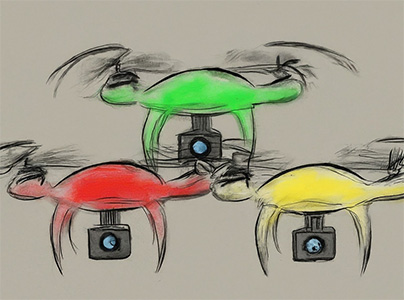
According to the DGCA certain areas have been set where drones can be flown these areas have been categorized into three categories:
The Green Zone: encompasses the airspace above India’s land areas or territorial waters wherein flying is permitted up to 400 feet vertically and the airspace up to a vertical distance of 200 feet or 60 meters above the area located between a lateral distance of 8 kilometre and 12 kilometres from the perimeter of an operational airport. 8 to 12 kilometres laterally from an operational airport.
The Yellow Zone: Prior permission from the concerned air traffic control authority shall be taken to fly in this zone. This includes airspace above the vertical distance as provided in the Green Zone i.e. the airspace above 400 feet or 120 meters in the designated green zone and the airspace above 200 feet or 60 meters in the area located between the distance of 8 kilometres and 12 kilometres from the perimeter of an operational airport.
The Red Zone: is the ‘no-drone zone’ within which drones can be operated only after permission from the Central Government.
Certifications pertaining to drone:
The Rules state that, no person shall operate a drone in India unless such drone conforms to a type certificate. The rules mandate operators to not operate any Drone unless it conforms to a type certificate or is exempted from the requirement of a type certificate under these rules, thereby inflicting a reasonable responsibility on them as well.
Type certification is the approval of the aircraft’s design and all parts, including propellers, engines, control stations, etc. This type certificate verifies that the drone meets specific safety and quality standards set forth by the DGCA.
Only DGCA certified UAS models are permitted to use the Certification Mark.
- Drones of nano category and model remotely piloted aircraft system are exempted from obtaining type certification.
Role of Digital Sky as a Single window for approvals:
To promote minimum human interface, the Union Ministry of Civil Aviation also announced the creation of a digital sky platform that would serve as a business-friendly single-window online system that permits approvals to be generated automatically.
In order to obtain the aforesaid certification, one has to enrol themselves on Digital Sky Platform by creating an account, profile and filing form D-1 along with the prescribed fee.
Registration requirements:
Anyone desiring to fly a drone must register it with the Digital Sky Platform and secure a distinct identification code. Unless granted exemption under drone regulations, individuals are prohibited from operating drones without prior registration on the digital sky platform and acquisition of a UIN.
Drone registration and obtaining a UIN are essential for ensuring traceability and accountability, similar to the license plate numbers assigned to vehicles. Once a clear digital connection is established between the drone, its manufacturer, and its operator, the UIN is issued via the Digital Sky platform.
Procedure in brief: An application in Form D-2 on the digital sky platform must be submitted, along with the required fee and information, including the unique number of the type certificate to which such unmanned aircraft system conforms. Hence the model of drone being registered should already have been granted a Type Certificate.
Upon verification of the application, the digital sky platform shall issue the applicant a unique identification number. Once received, this UIN shall be linked to the manufacturer’s unique serial number and the unique serial numbers of its flight control module and remote pilot station.
Who can operate Drones?
To operate an unmanned aircraft system, a remote pilot certificate is necessary. Only individuals registered on the digital sky platform and possessing a valid drone pilot certificate are permitted to operate drones. The remote pilot certificate specifies the category, sub-category, or classification of the unmanned aircraft system (or a combination thereof) for which it is issued.
Eligibility Criteria for Remote Pilot Certificate[4]:
A person may obtain a remote pilot licence if he
- is 18 years of age or above
- has passed class tenth examination or its equivalent
- has completed the training from any authorised remote pilot training organisation.
The procedure for obtaining a Remote Pilot Certificate is as follows:
- Training of Pilot: Any person who wants to obtain a remote pilot certificate for a drone (Unmanned aircraft system) shall complete the training and pass the test conducted by the authorised remote pilot training organisation (RTPO).
- Application Submission: Within 7 days of successful completion of training, the remote pilot training organisation shall submit an application for a remote pilot certficate in Form D-4 on the digital sky platform, along with the fee, and provide information about the individual who passed the test.
- Grant of Remote Pilot Certificate: Upon successful submission, A remote pilot certificate will be issued via the digital sky platform.
Validity of Remote Pilot Certificate : 10 Years
Exemption: Nano and micro category of drones operated for non-commercial purposes.
Broader Exemption for Research and testing purposes:
Recognized Research and development organizations, academic institutions, startups, or approved testing entities are exempt from requiring a UIN, type certificate, remote pilot certificate, or other authorizations for testing within their supervised green zone.
Drone Rules and Dynamics of Privacy:
Examining the Drone Regulations of 2021 reveals an obvious lack of protections concerning drone data collected by the operators. This leaves room for operators to exploitation of drones by using it for widespread surveillance without adequate privacy safeguards for citizens. The regulations fail to include a safeguard clause or any explicit provision aligning them with the broader Data Protection Law. Additionally, drones classified as Nano and Micro are exempt from requiring permits for non-commercial purposes. However, there need to be stringent restrictions or regulations governing the use of Micro and Nano drones. The absence of registration requirements for these categories poses a security threat, as they could be utilized for illicit purposes without oversight. Given that cameras can be affixed to these drones, particularly the smaller ones exempt from permits, there is a significant risk to individual privacy, as unauthorized activities may be conducted without any kind of liability. Therefore, it is imperative to implement checks on UAVs categorized as Nano and Micro to mitigate potential misuse.
Penalty[5]:
The maximum penalty under the Rules for violation of any of the compliance is Rs. 1 Lakh.
Conclusion
The New Drone Rules 2021 are considerably liberal and progressive. By making Digital Sky the central platform for all permissions and approvals, the government has streamlined the regulatory framework, and has focused on self-certification and minimizing manual approvals. Despite these advancements, the regulations are notably vague regarding privacy violations by drones. As drones become increasingly prevalent in various sectors, addressing privacy concerns is crucial. The current legal framework should provide clearer guidelines on privacy protection to mitigate potential misuse and safeguard citizens’ rights. New policy reforms focused on privacy will be essential to address these gaps.
- The article reflects the general work of the authors and the views expressed are personal. No reader should act on any statement contained herein without seeking detailed professional advice.
- orissa-hc-452667.pdf (livelaw.in)
- www.civilaviation.gov.in
- https://static.pib.gov.in/WriteReadData/specificdocs/documents/2022/mar/doc202232932501.pdf
For any feedback or response on this article, the authors can be reached on kedar.gurjar@ynzgroup.co.in and gauri.joshi@ynzgroup.co.in

Author : Kedar Gurjar
Kedar is an associate at YNZ Legal. By qualification he is Bachelor of Commerce and Bachelor of Law from G.J. Advani Law College, Bandra, Mumbai University.

Co-Author : Gauri Joshi
Gauri Joshi is an Associate at YNZ Legal. By qualification she is Bachelor of Commerce from Mumbai University and Bachelor of Law from SNDT University.