
“Contract” as we all know, has a long history, present, and future. From barter exchange till today, it has evolved over time. Requirement of contract is growing as business expands globally, and contract has become the foundation of commercial understanding. We engage into commercial understanding every day. For example, when we buy movie tickets or train tickets.
In simple words, a contract is a written or oral agreement between two or more parties in which one party gets benefits such as goods or services and the other receives consideration for supplying goods and services.
When Agreement becomes contract?
As per Section 2(e) of the Indian Contract Act, 1872: “Every promise and every set of promises, forming the consideration for each other, is an agreement”. While agreement is taking place between two or more parties by giving promise to each other and deciding the consideration, the parties should follow all the obligations to create a valid and irrevocable contract as mentioned in Section 2(h) that “An agreement enforceable by law is a contract”.
Sir William Anson in his Book, The Law of Contracts, says ”The law of contract is that branch of law which determines the circumstances in which a promise shall be legally binding on the person making it”.
Agreement = Offer + Acceptance
Contract = Agreement + Enforceability
What is Acceptance of Contract?
As per Section 2 (b) of the Indian Contract Act, 1872 Acceptance means “When the person to whom the proposal is made signifies his assent thereto, the proposal is said to be accepted. A proposal, when accepted, becomes a promise.”
A contract requires two or more people where one party offers (“Offeror”) the proposal and other party (“Offeree”) accepts the proposal. So, in simple words when offeree accepts the Proposal or offer, it becomes acceptance.
For example: Mr. A gives proposal to Mr. B for buying his second-hand car for Rs. 1 Lakh and Mr. B accepts the proposal/offer then it becomes an Agreement between both the Parties. An offer becomes an Agreement when there is an acceptance by other party.
What are the Types of Acceptance?
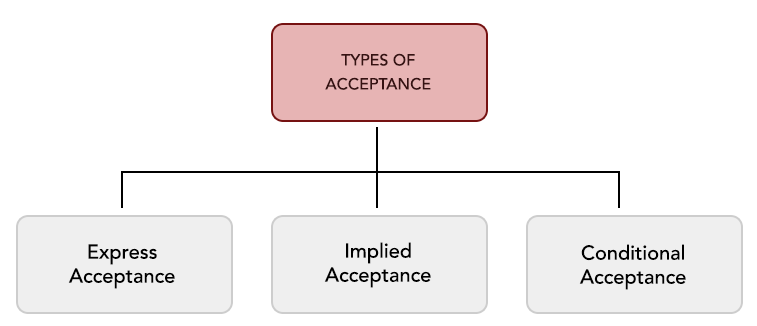
Under Indian Contract Act there are three types of acceptance.
Express Acceptance, Implied Acceptance and Conditional Acceptance. The Acceptance should be unconditional and unqualified. If you made iterations or make conditions in the offer, then the original offer gets nullified. However, if an offeree gives acceptance by giving certain changes in the terms of contract, then it is conditional acceptance.
Express Acceptance:
Express Acceptance means when offeree accepts the offer clearly without any counter offer. Express Acceptance could be oral or written but it is always advisable to have in writing. An offeree can accept the offer by writing a letter, email, WhatsApp message, orally via phone call or any other mode by saying that he is accepting this offer with all the conditions mentioned in the offer. Sometimes, when sales happen through certain portals the portals enable messaging ability wherein the sellers and buyers can convey their proposals and acceptance on the portal itself.
For Example: If Mr. A offers Mr. B to buy an agricultural land for Rs. 20 Lakhs and Mr. B sends an email saying that he is accepting his offer is an example of expressed acceptance.
Implied Acceptance:
Under section 9 of the Indian Contract Act it is given that “In so far as such proposal or acceptance is made otherwise than in words, the promise is said to be implied.” It means when an offer is accepted by offeree not orally or in a written format but by other actions made by him then that is implied Acceptance.
The scope of implied acceptance is wide because in our day-to-day life we go through such situations where we make implied acceptance.
For Example: If Mr. A wishes to watch a movie in a multiplex and while buying the ticket with all the terms and conditions mentioned at the back of the ticket, he purchased the tickets by paying ticket fare without any oral or written acceptance that is called as implied acceptance.
Haji Mohd. Ishaq vs Mohd. Iqbal and Mohd. Ali & Co. decided by the Supreme Court of India2
In this case, the plaintiff supplied 630 bags of tobacco to the defendant on his own account on the order of a go-between-man. The defendant clearly and unambiguously accepted the goods and paid a portion of the price to the plaintiff. It was determined that a liability to pay the balance had arisen. The Supreme Court ruled that the defendant’s conduct of accepting the goods and never repudiating any of the plaintiff’s numerous letters and telegrams demanding money from them clearly demonstrated a direct contract, which in law was called an implied contract by the conduct.
Lets Engineering & Technology vs Manoj Das on 4 January, 20133 decided by the Delhi High Court in Arbitration Petition 250 of 2012
Under this arbitration petition filed before the Delhi High Court, LETS Engineering Technology Services Pvt. Ltd. (for short “LETS”) prayed for appointment of an independent Sole Arbitrator to decide the claims of LETS as set out in the petition against the Respondent, viz., Digital Analysis and Software Solutions (for short “DASS”) arising out of the disputes which have arisen between LETS and DASS.
DASS disputed the existence of a valid executed agreement amongst the Parties. LETS contended that there did exist an agreement, which had been ratified and confirmed by DASS through its e-mails on all clauses including the arbitration clause. DASS in their reply stated Agreement was not signed between the parties due to disagreement on certain terms contained therein. The Hon’ble Court held that LETS and DASS’ understanding was governed by unsigned marketing agreement and in email correspondence along with attachment after analysing the detailed email correspondence between the parties with respect to the said agreement and the fact that there was no objection of any nature expressed by DASS as regards Arbitration Clause 13.2. Thus, this clause was impliedly accepted by DASS. The Court held that, the exchange of emails and their attachments as well as response of email by DASS clearly constitute written contract between parties with respect to the transaction between the parties.
Conditional Acceptance:
When the offeree is ready to accept the offer made by the offeror by proposing changes/counter offer in the terms and conditions or due to occurring some event that is considered as Conditional Acceptance.
Conditional Acceptance is a very known form in the contracts and law also allows people to make conditions if the offeree is not sure about the offer made by offeror.
Conditional acceptance is a sort of a counter offer made to the proposal of original offeror. These counteroffers are made in various ways such as by giving a counter offer of payment in or accepting offer on completion of certain event/task or action of the offeror.
For Example: If Mr. A offers Mr. B to buy a house for Rs. 10 Lakhs later Mr. B accepts the offer by making a condition that he will pay the money in three instalments then that would be considered as a conditional Acceptance.
M/s. Padia Timber Company (P) Ltd. v. The Board of Trustees of Vishakhapatnam Port Trust decided by the Supreme Court of India in Civil Appeal No.7469 of 20084
Respondent Port Trust issued a tender notice for the supply of wooden sleepers. The appellant made a conditional offer and refused to accept certain clauses of the Tender. Later, the appellant accepted some of the terms, but they added some more conditions. After a few months, the respondent placed an order for a higher rate and stated that he had claimed damages from the petitioner due to the existence of a binding contract. The Supreme Court held that, in the response to the tender floated by the Respondent-Port Trust, the Appellant had submitted its offer conditionally subject to inspection being held at the Depot of the Appellant. This condition was not accepted by the Respondent-Port Trust unconditionally. The Respondent-Port Trust agreed to inspection at the Depot of the Appellant, but imposed a further condition that the goods would be finally inspected at the showroom of the Respondent-Port Trust. This Condition was not accepted by the Appellant. It could not, therefore, be said that there was a concluded contract. There being no concluded contract, there could be no question of any breach on the part of the Appellant or of damages or any risk purchase at the cost of the Appellant. The earnest deposit of the Appellant is liable to be refunded. Thus, an offer and acceptance must be unconditional. When the acceptor adds a new condition to the contract that the proposer has already signed, the agreement is not complete until the proposer agrees to that condition.
Conclusion
Acceptance is an essential aspect of a contract because it creates a contract between the parties. Express acceptance in broad and unambiguous manner without imposition of any additional conditions is ideal. However, if one of the Parties has demonstrated acceptance through its conduct, the same shall also be upheld by the court.
- This article reflects the general work of the author and the views expressed are personal. No reader should act on any statement contained herein without seeking detailed professional advice.
- 1978 AIR 798, 1978 SCR (3) 571
- https://delhicourts.nic.in – ARB.P. 250/2012 before the Delhi High Court
- Civil Appeal No.7469 of 2008 – https://main.sci.gov.in
For any feedback or response on this article, the authors can be reached on mayuri.bhosale@ynzgroup.co.in

Author : Mayuri Bhosale
Mayuri is an associate at YNZ Legal and has completed her Bachelor of
Commerce and Bachelor of Law from Mumbai University.