
Introduction:
In today’s interconnected global economy, Indian organizations are increasingly venturing beyond domestic borders. The adoption of international standards and policies, though essential for global integration, can impose significant obligations that may strain organizational resources and hinder operational efficiency.
While such international standards and policies promote ethical and sustainable business practices, they may also impose significant risks and liabilities of non-compliance.
It’s crucial to carefully assess the practicality and enforceability of such standards before agreeing to them as contractual obligations. This is to avoid potential operational and legal disputes arising out of breach of contract.
Prevention of Sexual Harassment

A small-scale Indian service-oriented company signed an agreement with a foreign company, which includes an obligation to report details of any sexual harassment complaint (POSH) upon written request to them.
Unfortunately, the said obligation was a non-negotiable and standard obligation casted upon by the foreign company. The foreign company, during the tenure of the agreement, requests for such POSH report submission.
Note: Agreeing to foreign company’s request means violation of Indian POSH Act as the act strictly prohibits an organization from sharing POSH reports to any third party and refusing such request may amount to breach of contract.
Child Labour
Company A, an accounting firm is operating its business from a commercial complex. On the other hand, another Company B, also carrying on business in the commercial complex has engaged an 8-year-old as an office cleaning boy. Now, while entering into a contract with an international organization, the international organization insisted on an obligation that Company A will prevent child labour activity in the vicinity of its operations. Company A itself does not employ any child labour and thus Company A agreed to the said obligation.
Company A is conscious of its own obligations and necessary complains to Indian authorities for this child labour activity have been made. However, is Company A required to notify child labour activity to international organization? Will Company A be able to ensure the prevention of child labour? Will non-adherence to such clause amount to breach of its agreement?
Note: Company A cannot directly control engagement of entities in its vicinity and thus, acceptance to such clauses should be carefully thought through.

Data protection
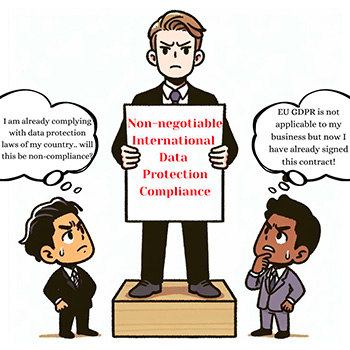
An Indian software company enters into a contract with an international company. The contract requires the Indian company to agree to certain EU GDPR data privacy laws prevalent outside India. Indian software company is concerned whether it will be practically possible for an Indian company to comply with such international laws.
Note: While it is necessary to ensure that the data privacy laws of India are followed and complied with by an Indian organization, the company should also be careful while handling international data and ensure compliance with relevant international regulations.
Insurance
Company A, a small-scale vendor, has entered a contract with an international company. The value of the contract is Rs. 2 lakhs. However, the insurance coverage clause requires company A to avail insurance for a higher amount at a coverage of $10 million. What if such a higher amount of insurance is not practically possible for small scale vendor?
Note: In such scenarios possible solutions need to be looked at such as negotiation of insurance coverage amount, alternative risk mitigation, etc. prior to accepting such clause.

Most Favored Customer

Company A, Supplier, is an Indian automobile spare part manufacturer. They create various spare parts and tools. Company B is a large international organization looking for a business opportunity in India and enters into a contract with Company A. Company B, to ensure they get the best possible deal imposes certain obligations involving priority in orders/ delivery terms, best pricing and credit terms, no advance payment, free AMC service, product warranty for a longer duration than applicable for others, quick and efficient turn around time (TAT), future discounts etc. Now, Company A is concerned about increased costs, reduced profit margins, preferred TAT, long-standing futuristic commitments and the potential legal challenges due to non-adherence. Secondly, it requires huge bandwidth on monitoring.
Note: While accepting such clause is a commercial decision, the Indian company must be clear enough with respect to the additional cost and operational obligations this may bring along. A mere acceptance for such futuristic commitments may lead to a huge impact on the financial condition and other projections of the Company.
Implementing Operational Excellence Policy
Company A, an Indian Transport company enters into contract with Company B, a foreign company. The contract refers to obligation on Company A to bring operational efficiency and whatever costs are saved due to this shall be passed over to the extent of 50% to Company B.
At the time of entering into the contract, Company A uses diesel vehicles for delivery. However, during the term of the contract Company A invests in using electric vehicles for delivery and saves costs.
Unfortunately, the contract imposes certain obligations which obligates Company A to share with company B the costs saved during the term of the contract. In reality, Company A has spent X amount of capex in order to achieve this cost efficiency. Company B has not funded this capex investment, so why should Company B receive benefits of this cost saving? Now, company A is not comfortable of sharing such saved costs with Company B and if Company A objects to do so whether this will amount to non-compliance or will it lead to breach ultimately resulting in termination of the contract.
Note: While it is necessary to ensure that the contract is complied and the performance is superior to ensure a satisfied business relationship between the parties, the Indian companies must also look at the practical scenarios of its applicability in the operational and financial context. Else they are bound with contractual obligations which cannot be complied with.

Implementation of Social Responsibilities

Company A, Tax Advisory Firm enters into a contract with an international company. Under the contract signed by the parties, Tax Advisory Firm is obligated to create and maintain separate policies for social responsibilities such as environmental obligations, sustainability etc and also additionally agree and comply to strict obligations related to carbon emission levels, this includes office premises should be in Green Sustainable environment. Agreeing to such clause will obligate Company A to shift to a sustainable IT Park, which will lead to significant incremental costs, in terms of rentals by Rs. 1,00,000/-. Unfortunately, this will take away the competitive edge of Company A and further any non-compliance will attract severe penalties.
Note: While environmental and sustainability policies may be mandatory, organizations may also have internal policies to further enhance environmental performance. However, commitment to such obligations without application of test of practicality can lead to future non-compliance and breach of contracts.
Conclusion
Mere acceptance of the international standards and policies without having plan or intention to comply will create legal dispute and other financial and operational obligations. The risks and liabilities may be:
- Financial and operational strain
- Making Indian business unviable
- Additional administrative manpower hassle
- Frequent audits and consumer bandwidth of the senior management
- Risk of being blacklisted due to unnecessary international practices and standards
- Civil/ criminal liability due to non-compliance
- Heavy Litigation/ Dispute resolution costs
- The article reflects the general work of the author and the views expressed are personal. No reader should act on any statement contained herein without seeking detailed professional advice.
For any feedback or response on this article, the authors can be reached on gauri.joshi@ynzgroup.co.in and atharva.amdekar@ynzgroup.co.in

Author : Gauri Joshi
Gauri is an Associate at YNZ Legal. By qualification she is Bachelor of Commerce from Mumbai University and Bachelor of Law from SNDT University.

Co-Author : Atharva Amdekar
Atharva is an Associate at YNZ Legal. By qualification he is Bachelor of Commerce and Bachelor of Law from Mumbai University.