
We live in a competitive world where we face competition in everything, be it education, employment or business etc. Even if we step out to buy simple products like toothpastes, ketchups and refreshments, it is not easy for us to make a simple and quick choice because of various options from brands that are easily available and also the luring advertisements that brands come up with to attract customers. In such a dynamic market customers are of tremendous value to businesses. Entities have to keep their foot on the gas not only to attract new customers but also to protect the existing ones. Further, is it possible to create a customer base without talented and faithful employees?[1]
It’s safe to say that an entity will only achieve success if it has trustworthy employees and adequate amount of customer base. In this rush of retaining customers and employees, entities usually include restrictive covenants like non-competition and non-solicitation in their agreements. We shall understand the legal aspects of non-solicitation clause in this article.
What is the meaning of Solicitation in law – The word ‘solicit’ in the context of law means luring someone with the specific intent of inducing that person to do certain act. Non-Solicitation clause is a restrictive clause and is generally adopted in business engagements or employee agreements.
Dual aspects of non-Solicitation –
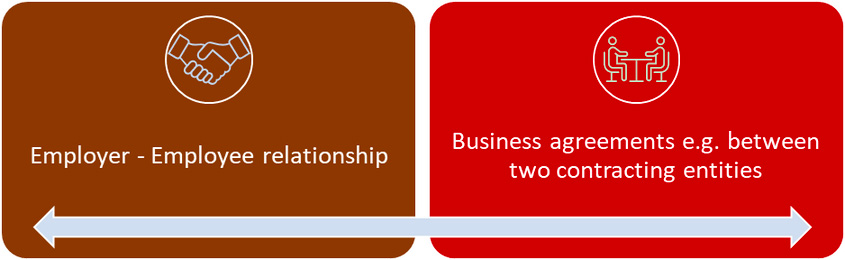
Non solicitation agreement or clause is commonly included under two relationships:
The scope of the non-solicitation is to be defined by the parties specifically as per their specific requirement. It should be noted that broad restrictions on employees or business entities to carry on their business or profession are generally frowned upon by the Courts. Simply including a broad non solicitation restriction is unlikely to help the parties as enforceability of non -solicitation clause is always subject to the satisfaction of requirements under Article 19[2] of the Constitution of India and Section 27[3] of the Indian Contract Act, 1872.
Non solicitation clause in employee engagements-
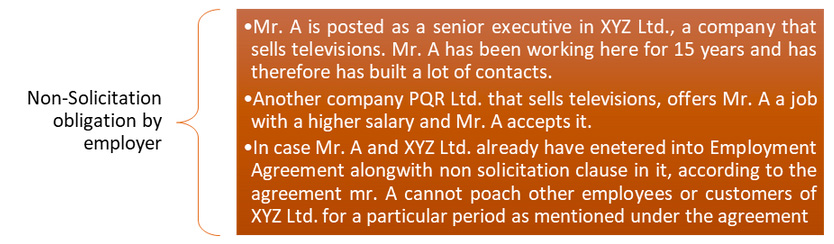
An employer generally shares a lot of confidential information and trade secrets which includes its customer details, customer contacts, marketing and financial information etc. with certain employees. Therefore, employers wish to have non solicitation restriction with its employee which is likely to restrict the employee during the tenure and after the tenure of employment to solicit any existing customers or employees of employer or misuse the critical information (like employer’s customer data base or trade secrets etc.) after joining competitor. While the employer shall endeavour to enforce the non-solicitation clause that restricts the employee from misusing contacts developed in the previous company, enforceability of these restrictions is critically examined by courts in every case to ensure that unnecessary restrictions are not placed on employees.
Now from the above example it is clear that in case there is a non-solicitation clause in the agreement signed by employer and employee, as per the contractual obligation employee is restricted to do two things, soliciting other existing employees to join the new organisation and to poach customers/suppliers/clients of existing company. However, whether such non-solicitation clause is enforceable or not is determined by Courts on case-to-case basis.
Embee Software Private Ltd. vs. Samir Kumar Shaw and Ors.[4]
In this case, Embee Software Private Ltd. (“Plaintiff”) had a business of rendering services in the field of information technology. While rendering such services files, programmes, know how, formula were prepared by the Plaintiff to suit the need of specific clients. It was important for the Plaintiff to exclusively know the source code to operate the programmes and to update them. Samir Kumar Shaw (“Employee”) was the employee of the Plaintiff, and had knowledge of the source code thereby being in a position to approach the clients of the Plaintiff with the proposal that instead of the Plaintiff, Employee will render them the necessary services and this would deprive the Plaintiff’s business.
The Calcutta High Court has held that “Employee cannot be prevented from carrying on the business subject to an important condition that the Employee will not be allowed to solicit the customers of the Plaintiff by the use of the copyrighted source code which the Plaintiff owns. Violation of such a condition shall be considered as contempt of Court and the respondents shall have to bear severe consequences such as damages and/or injunction because of solicitation.”
The case law of Desiccant Rotors International Pvt. Ltd v Bappaditya Sarkar & Anr 2009[5] is worth noting.
Bappaditya Sarkar (“Employee”) was an employee of Desiccant Rotors Pvt. Ltd. (“Desiccant”). According to Desiccant, the Employee joined Desiccant as Area Sales Manager in 1998. In year 2000, it signed the confidentiality obligation with Desiccant. On 18th July 2007, Employee resigned from Desiccant and executed an Obligation Agreement which provided that “for two years after the termination he would not interfere with the relationship of Desiccant with its customers, suppliers, and employees”.
Within three months of leaving Desiccant, Employee joined another competitive company (“Defendant No. 2”) as its Country Manager and became in charge of marketing its products which were in direct competition with Desiccant Company’s products. Desiccant alleged that Ex-employee had:
- made a backup of supplier and customer lists contained in his laptop, taking the said backup with him when he left Desiccant; and
- that Employee had even contacted the suppliers and customers of Desiccant on behalf of his new employer Defendant No. 2.
Desiccant prayed for mandatory injunction and for delivery up and rendition of accounts. Employee contended that the restriction on the Employee from approaching Desiccant’s suppliers and customers for soliciting business virtually grants a monopoly to Desiccant in its area of work and the restriction imposed is contrary to Section 27 of the Indian Contract Act, 1872 and therefore ought to be set aside.
In its judgement, The Delhi High Court held that the injunction restraining Employee is limited in scope, in the sense that it does not restrain the Ex-employee from working with Defendant No. 2 or any other person/company, thereby steering clear of preventing the former’s freedom to choose his own workplace. The injunction only restrains Employee from approaching Desiccant’s suppliers and customers for soliciting business which is in direct competition with the business of Desiccant. Hence, the injunction which has already been granted is made absolute and the application was disposed.
Non solicitation restriction amongst business entities –
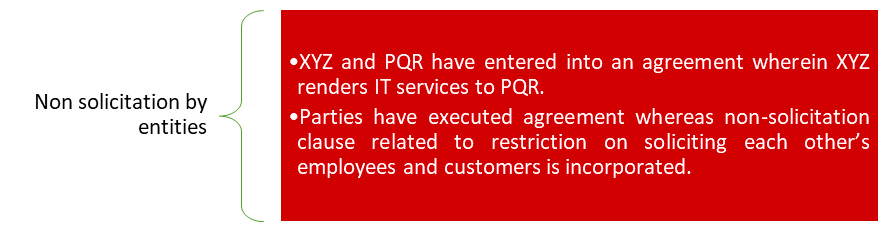
When two entities come into business obligations, one of the main concerns of two parties is that the other party should not solicit any valuable employees or customers of the other. For the same reason non-solicitation clause can be seen in different contracts between such two or more contracting entities. For example,
Enforceability of non-solicitation clause amongst customers is critically examined by the courts and the case law of FL Smidth Pvt. Ltd. v M/s. Secan Invescast (India) Pvt. Ltd. (2013) [6] is worth noting.
Under this case FL Smidth Pvt. Ltd. (Smidth) was a leading OEM and supplying cement plant machinery to various customers in India. M/S Secan Invescast (India) Pvt. Litd. (Secan) was in the business of the manufacture of heat resistant castings and was a vendor of Smidth. Both the Parties had entered into a Non Disclosure Agreement in 2006 under which non solicitation clause was covered. In 2008 Smidth came to know that Secan had directly obtained an order from one of Smidth’s client. In 2008, managing director of Secan gave an undertaking to Smidth to resolve the issue. However due to continuous alleged poaching from Secan, Smidth issued legal notices in 2011 and 2012. The learned Single Judge passed an order stating that –
“Negative covenant of the agreement can be enforced only during the period of contract and the same cannot be enforced after the expiry of agreement period and even a non-solicitation clause cannot be enforced after the expiry of the agreement period.”
Aggrieved by the order Smidth filed the appeal in the Madras High Court which was dismissed, and the Appellate Court upheld that broad post contractual restrains are not valid. The Court considered different aspects to understand facts of the case and also listed certain criteria which may determine reasonableness of restriction–
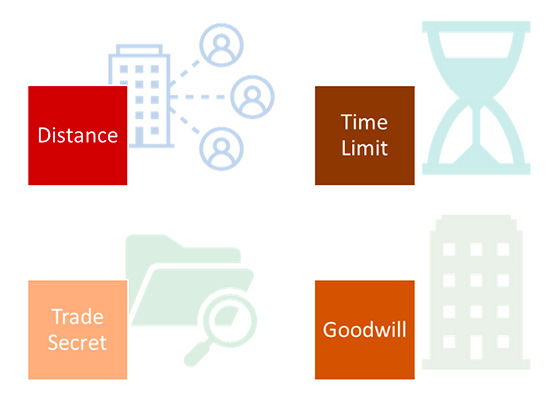
- Distance: suitable restrictions can be placed on employee to not practice the same profession within a stipulated distance, the stipulation being reasonable.
- Time limit: if there is a reasonable time provided in this clause then it will fall under reasonable restrictions.
- Trade secrets: The employer can put reasonable restrictions on the letting out of trade secrets.
- Goodwill: There is an exception under section 27 of the Indian Contract Act on the distribution of goodwill.
Further, the Court also stated that the materials produced by Smidth are not sufficient to arrive at a clear finding that Secan solicited the customers of Smidth.
Advertisement and Non Solicitation –
We see different companies publish an advertisement for hiring purpose in public domain to attract different employees who work in a similar scope of business. Is this an example of solicitation? Generally, advertisement is considered to be an exception to such restrictive clauses as companies can advertise their need of hiring through advertisement without using any competitive companies’ name. Having said that Courts have always given importance to the facts of each case and parties’ intentions. This can be better understood with Wipro versus Backman case. This case not only deals with advertisement and non-solicitation aspect but it is also related to poaching of employees.
Wipro Limited Vs. Beckman Coulter International S.A. (2006) [7]
In this case, Wipro Limited (Wipro) worked as a sole and exclusive distributor in India for Beckman Coulter International, S.A. (Beckman), for 17 years. The relationship between the Parties was documented in a form of Canvassing Representative Agreement which was entered by the Parties in January 2002 (“Agreement”). The Agreement contained a non-solicitation clause where generic advertisement was exception.
IN 2005, Beckman Coulter decided to undertake direct operations in India. For this an advertisement was issued in leading English newspapers of India, seeking employment from people.
“For all Sales and Marketing and Service and Support positions experience of working with or having handled Beckman Coulter products and or similar products would be a distinct advantage.”
Wipro Limited alleged that Beckman was acting in contradiction to the non-solicitation clause of the Agreement by issuing such an advertisement indirectly soliciting the employees of Wipro and approached the Delhi High Court for getting awarded with injunction and claiming damages.
The Delhi High Court stated that, “it is clear that Beckman has made it known to the public at large that for all sales and marketing and service and supports positions the experience of working with or having handled Beckman Coulter products and or similar products would be a distinct advantage. It is an admitted position that Wipro was the only concern which had handled Beckman Coulter products for the past 17 years in India.
This is so because Wipro was admittedly the exclusive Canvassing Representative of Beckman in India. Therefore, Beckman was making it known to the employees of Wipro that in case they applied for the positions advertised in the Sales and Marketing and Service and Support Departments, they, having handled Beckman Coulter products, would be at a distinct advantage. The indication that such persons would be at a distinct advantage is an indication that Beckman would, be interested in employing such individuals.”
Court further stated that it has no doubt that this advertisement was definitely a solicitation on behalf of Beckman.
However, court also observed that the Agreement was between the Wipro Limited and Beckman Coulter and employee is not party to the Agreement and thus the Court in its judgement held that,
- respondent is restrained during the pendency of the arbitration proceedings from taking out any other or further advertisements or to do anything to solicit, induce or encourage the employees of Wipro to leave Wipro’s employment and take up employment of Beckman and / or its agents and / or representatives and / or competitors;
- However, the employees of Wipro would be free to take up employment with Beckman, even in response to the said advertisement which has prima facie been held to be solicitation.
Drawing the curtains-
Today, we generally come across the provision of non-solicitation in contracts. However, whether the clause is enforceable just because it is included in the contract needs to be determined in every case. There should be a balance between the rights of the parties. The essence of this provision is to protect business interest of the parties to ensure that justice prevails.
It has been observed that while determining enforceability of non-solicitation in a particular scenario, Courts have given importance to the intent of the parties (whether its malice or otherwise) and the material on record.
A guesswork that the ex-employee is soliciting customers is unlikely to help the employers, unless there is some plausible case made out with some evidence on record. Employers could also give a thought to the actual language of the clause to ensure that broad, templatized and uniform restrictions are not imposed on all employees in the organization.
The role of the employee could be considered and specific reasonable restrictions keeping such role in mind could be imposed. Similarly, all business partners are not required to be restricted with a non-solicitation obligation. Considering the nature of this restriction, it should be used only in specific cases. For instance, if a business entity is offering a software license to the other through a link and there is no possibility of any interaction amongst the employees of the two entities, would a non-solicitation obligation be really necessary?
As it is rightly said by Tony Robbins, “Intention is the starting point of every action, the propelling force behind every accomplishment”. The zeal and the intent to protect one’s interest should begin right from the time the agreement is entered into and should be demonstrated through a reasonable thoughtful clause coupled with a clear system of records or correspondences to ensure that there is enough material on record in case of any mischief. We can rest the chain of thoughts by knowing that, when the right business ethics build our foundation, non-solicitation brings no hesitation! And when restrictions are imposed on one’s freedom, there is no place for solicitation.
- This article reflects the general work of the authors and the views expressed are personal. No reader should act on any statement contained herein without seeking detailed professional advice.
- Article 19 (1) (g) of Constitution of India provides Right to practice any profession or to carry on any occupation, trade or business to all citizens subject to Art. 19 (6) which enumerates the nature of restriction that can be imposed by the state upon the above right of the citizens.
- Every agreement by which anyone is restrained from exercising a lawful profession or trade or business of any kind, is to that extent void
- Embee Software Private Ltd. vs. Samir Kumar Shaw and Ors. GA 526 of 2012
- FL Smidth Pvt. Ltd. v M/s. Secan Invescast (India) Pvt. Ltd. (2013) 1 CTC 886
- Wipro Limited Vs. Beckman Coulter International S.A. 2006 (3) ARBLR 118
For any feedback or response on this article, the authors can be reached on Nandita.Damle@ynzgroup.co.in , atharva.amdekar@ynzgroup.co.in and charusheela.vispute@ynzgroup.co.in

Author : Nandita Damle
Nandita is a Legal Advisor at YNZ Legal. She is also a member of Bar Council of Maharashtra & Goa. By qualification she has completed Bachelor of Arts in Political Science and Bachelor of Law from Mumbai University.

Co-Author : Atharva Amdekar
Atharva is an associate at YNZ Legal. By qualification he is Bachelor of commerce and Bachelor of Law from Mumbai University.

Co-Author : Charusheela Vispute
Charusheela is heading Estate planning and trademark. Having specialisation in property and testamentary matters. By qualification she is Bachelor of Arts and Bachelor of Law from Mumbai University.