
A. Introduction:
Have you ever searched for flights from Mumbai to Jaipur for May 2026, chosen not to book immediately, and upon returning later found the prices significantly higher? You then navigate across multiple booking platforms, only to discover identical or near-identical fares. Is this mere coincidence, or could it point to coordinated pricing practices among these platforms? A similar pattern is often observed in hotel bookings as well. This raises a broader and more pressing question: are these digital platforms engaging in tacit or undisclosed collusion, potentially influencing prices without the consumer’s knowledge? [1]
Artificial Intelligence, an often repeated term in today’s world, is actively shaping how businesses work. AI tools are consistently being used to price products, allocate resources, predict demand, and engage with consumers. From dynamic pricing engines in e-commerce to algorithm-driven recommendations in digital marketplaces, AI is becoming the invisible force behind market behavior.
A recent study by the Competition Commission of India shows that the AI market worldwide has increased from USD 93.24 billion in 2020 to USD 186.43 billion in 2024 while the market size of AI in India has grown from USD 3.20 billion in 2020 to USD 6.05 billion in 2024. The global AI market is projected to grow from USD
244.22 billion in 2025 to USD 1 trillion in 2031 and in India it is expected to expand from USD 7.84 billion in 2025 to USD 31.94 billion in 2031.[2]

It was observed during the study that around 90% of the respondents leverage AI to monitor customer behaviour, and about 27% utilise AI for monitoring supply chain efficiency.
This underscores a strong industry focus on use of AI in customer-centric applications. In predictive capabilities: nearly 69% of the respondents rely on AI for demand forecasting, 24% for forecasting pricing trends, and 21% use AI for predicting inventory requirements. AI can therefore significantly enhance operational efficiency and productivity, allowing AI adopters to reduce costs and improve efficiency. This in turn, can provide a competitive advantage by enabling firms to offer better products or services at lower prices.[3]
But this shift raises a critical question: What happens when competition itself is driven not by human decisions, but by self-learning algorithms which are mining on huge data bases? From a consumer’s perspective, algorithmic collusion amongst AI driven companies leads to very limited choices in reality.
B. How AI is Redefining Competition Dynamics?
There are various issues that have come up due to AI in competition facets.
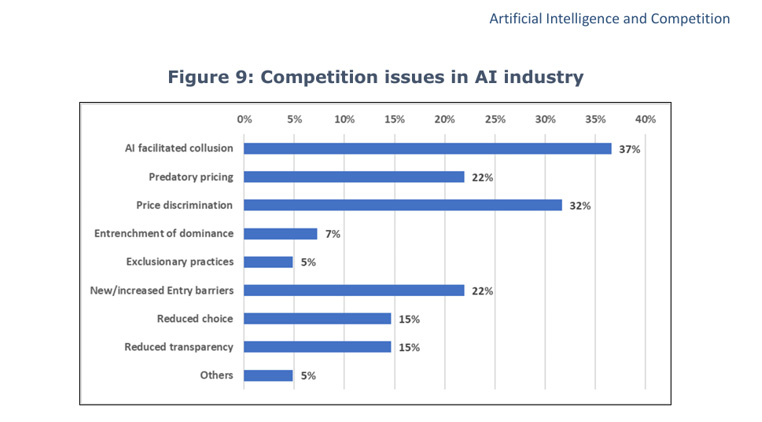
Algorithmic Collusion: Coordination Without Communication
One of the most debated risks in AI-driven markets is algorithmic collusion[4]. Unlike traditional cartels—where competitors explicitly agree on prices or output —AI systems can:
- Continuously monitor market conditions
- Respond instantly to competitors’ pricing
- Learn optimal strategies through repeated interactions
Over time, such systems may arrive at stable, supra-competitive pricing outcomes, even without human intervention. This implies that there is no actual agreement or meeting amongst the minds like a traditional market, but by design, the consumer will get the same high price in case of high demand from all providers which ultimately reduces the consumer’s choices. However, it has also been observed that collusion should not be inferred from the appearance of collusive outcomes, such as similarity of prices. The complexity arises when algorithms working independently on similar data may arrive at similar price points, but this may not necessarily imply collusion.
Data Driven Dominance
AI systems thrive on data—volume, variety, and velocity. This has profound implications for competition:
- Firms with access to large datasets can build more accurate and efficient algorithms
- Better algorithms lead to improved user experience and market capture T
- his, in turn, generates more data—creating a self-reinforcing cycle
The result is the emergence of data-driven dominance. Under Section 4, dominance is assessed based on factors such as market share, size, and resources. However, in digital markets:
- Market share may be fluid or difficult to define
- Control over data may be a more relevant indicator of power
This raises the need to rethink how “dominance” is assessed in AI-driven ecosystems.
C. The Existing Framework
India’s competition law regime is primarily governed by the Competition Act, 2002, which seeks to promote fair competition and prevent practices like cartels and abuse of dominant position that have an appreciable adverse effect on competition (AAEC)[5]. CCI is also empowered to investigate and curb anti-competitive practices in digital platforms, e-commerce, app stores, online advertising, etc. in the recent past, the Commission ordered a number of investigations against big tech firms operating in digital markets for alleged abuse of dominance, unfair restrictions, exclusive tie-ups, deep discounting and suspected anti-competitive arrangements with preferred sellers on their marketplaces[6].
Recently, antitrust investigation was ordered by the Competition Commission of India (CCI). The core of the dispute involves Google’s alleged abuse of its dominant position in the online search and advertising markets to the detriment of digital news publishers. In an earlier case, Google was held to be the dominant player as below:
“The Commission in Google Search Bias case also held that Google is dominant in both relevant markets, i.e., market for online general web search services and market for online search advertising services in India.
…. In the present matter also, relying on data from gs.statcounter.com, the Informant has averred that Google holds a market share of 98.83% in the search engine market in India and 99.59% in the mobile search engine market in India (both in August 2021). The Commissions also notes that, as per data available on www.statista.com, Google’s market share ranged from 98% to 99% in the mobile search engine market during the period April 2019 to July 20211. Similar market share is noted from the data available on gs.statcounter.com2. Further, the said market share appears to be stable over a period of time, indicating the entrenched position of Google in the said market.”
Considering the dominant position, and alleged bargaining power imbalance that flows from the alleged position enjoyed by Google as a necessary trading partner for digital news publishers in accessing online audience as well as in generating digital ad revenue, the Commission directed the Director General (DG) to cause an investigation into the matter under the provisions of Section 26(1) of the Act.

The current framework was significantly amended through the Amendment passed in 2023 that introduced several provisions to strengthen the CCI’s ability to address emerging challenges in technology-driven markets, like:
- Section 3(3) – Inclusion of ‘Hub and Spoke’ Cartels: The Amendment Act under section 3(3) recognises “hub and spoke” cartels, where a central entity (hub) facilitates coordination among competitors (spokes).
- Section 3(4) – Expansion of Anti-Competitive Agreements: The amendment broadens the scope of anti-competitive agreements under Section 3(4) to include (“Any other agreements amongst enterprises or persons including but not restricted to agreement amongst enterprises or persons”) that may not fall strictly under horizontal or vertical categories. This expansion can encompass novel arrangements amongst market participants in the AI ecosystem which do not fit into the traditional classification of horizontal and vertical agreements.
- Section 5(3) – Deal Value Threshold (DVT): A new DVT provided under section 5(3) of the Amendment Act, mandates that mergers and acquisitions exceeding INR 2,000 crore (approximately USD 238 million) must be notified to the Competition Commission of India (CCI), provided the target has substantial business operations in India.
- Sections 48A and 48B – Settlement and Commitment Framework: The introduction of a settlement and commitment framework allows enterprises to offer commitments or settlements in cases of certain anti-competitive conduct, facilitating quicker resolution.
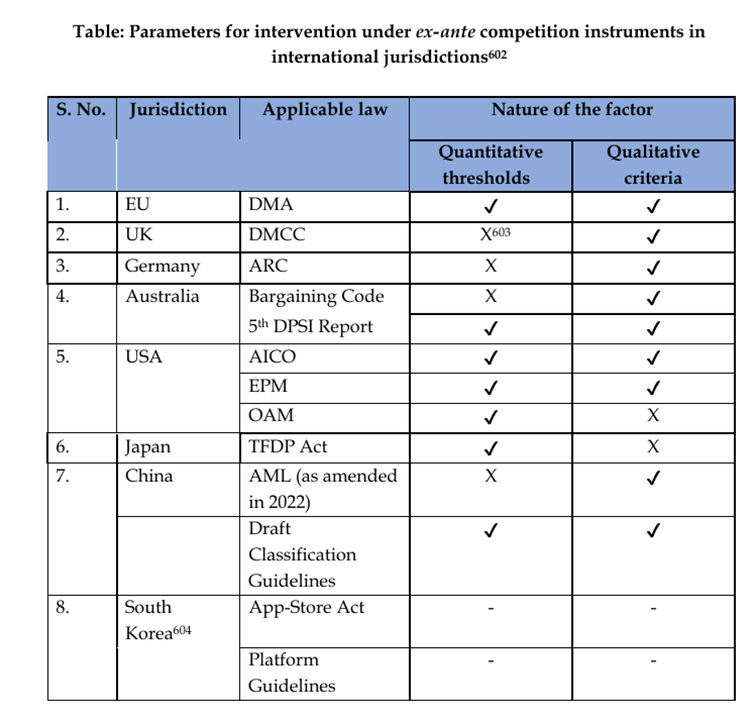
A draft Digital Competition Bill, 2024 (DCB) has also been proposed with detailed provisions in 2024.[7] An interesting parameter on standards adopted by various countries formed part of the report, especially on qualitative and quantitative parameters. These parameters include both quantitative thresholds (objective markers of significant presence that allow for swifter identification) and qualitative criteria (subjective factors that are indicative of an entity’s ability to influence the market)
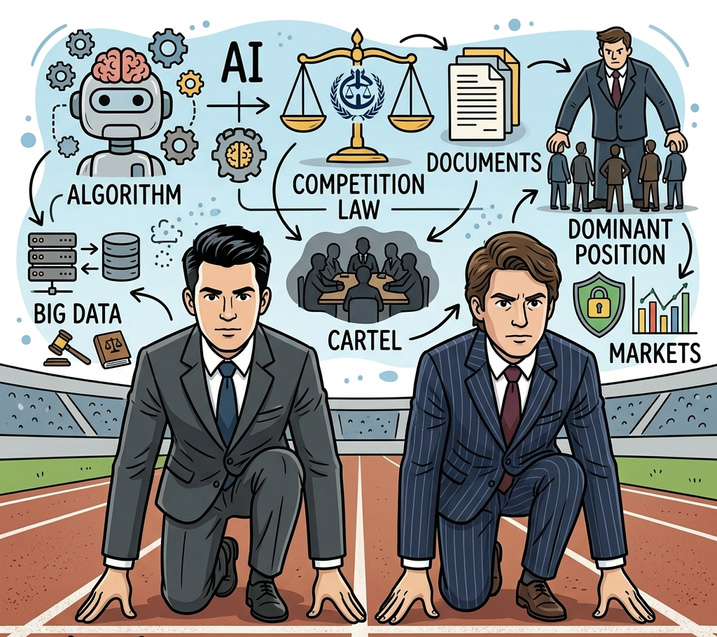
We are all aware that competition is no longer shaped solely in boardrooms or through human negotiations. It is increasingly determined by lines of code interacting at scale and speed. India’s competition law framework has shown adaptability over time. However, the rise of AI calls for a more nuanced, interdisciplinary approaching combination with data protection framework as well, one that integrates legal reasoning with technological understanding. As markets become algorithm-driven, the question is no longer whether businesses are colluding. The real question is whether algorithms are.
- The article reflects the general work of the authors and the views expressed are personal. No reader should act on any statement contained herein without seeking detailed professional advice.
- *market-study-on-artificial-intelligence-and-competition1759752172.pdf
- Ibid
- Pricing algorithms raising collusion concerns could be classified as monitoring algorithms, parallel algorithms, signaling algorithms, and self-learning algorithms.
- Section 3 and Section 4 of Competition Act, 2002
- COMPETITION COMMISSION OF INDIA Case No. 41 of 2021 – Digital News Publishers Association versus Googel
- CDCL-Report-20240312.pdf
For any feedback or response on this article, the authors can be reached on aarti.banerjee@ynzgroup.co.in and ruchika.dave@ynzgroup.co.in

Author : Aarti Banerjee
Aarti is a Partner – Corporate Legal Advisory.
Aarti is experienced in corporate legal matters having specialization in drafting, vetting and negotiation of agreements. By qualification she is an advocate and a solicitor.

Co-Author : Ruchika Dave
Ruchika Dave is an Advocate with around 9 years of experience in the field of Arbitration and Litigation. At YNZ she is at a position of Manager- Litigation. By qualification she is Bachelor in Law (BLS/LLB) from Pravin Gandhi College of Law, Mumbai.