
The pandemic brought many difficulties and challenges for the world alike and collectively we brooded on many of them. However, some challenges and difficulties remained unnoticed. Let’s give a thought to the hardships caused to the parents of children with special needs.
Imagine a scenario wherein a leading personality in corporate world and his wife are holding important management positions in their respective organization and they are financially sound. However, their topmost anxiety is about their 25 year old son who is a person with special needs. After experiencing the untimely death of peers, they are now worried that who will take care of their son in case of any unfortunate event??
While these anxieties run deep, there are certain provisions under law, which may be considered for certain relief to the concerned parents of the Person with Different Ability (PWDA) while making critical decisions such as handling property matters, bank and finance related matters etc. This Article covers the basic queries which may come up in the minds of parents of PWDA.
WHO IS A GUARDIAN?
“Guardian” according to Oxford Dictionary means the one who protects something or someone.
As per the provisions of THE GUARDIANS AND WARDS ACT, 1890, a Guardian is a person having the care of the person of a minor or of his property or of both i.e. person and property (Section 4 (2)).
A guardian of a person is another individual or a trust who is appointed to take care of a person’s needs, and take decisions on behalf of a person, owing to the fact that the person is unable to do so for himself, due to some disability.
The appointed guardian not only takes care of the day-to-day activities and needs of PWDA but may take all types of decision including financial, medical, legal for and on behalf of the PWDA fully or partially depending upon the terms of appointment.
In case of PWDA, like other children their Parents are their natural guardians till the age of 18, but after the age of 18 they need to get themselves appointed as guardians for a PWDA and this article will throw light on different legal provisions protecting the interest of the PWDA, once they achieve the age of majority. The legal provisions are scattered under different legislations like:
- Guardians and Wards Act, 1890 (“Guardian Act”)
- The Rights of Person with Disability Act, 2016 (“RPWD Act”)
- The National Trust For The Welfare Of Persons With Autism, Cerebral Palsy, Mental Retardation And Multiple Disabilities Act, 1999 and the rules pertaining to National Trust for Welfare of Persons with Autism, Cerebral Palsy, Mental Retardation and Multiple Disabilities Rules, 2000. (collectively stated as “National Trust Act”)
WHY GUARDIANSHIP IS IMPORTANT?
Generally, parents as a natural guardian take care of the following aspects:
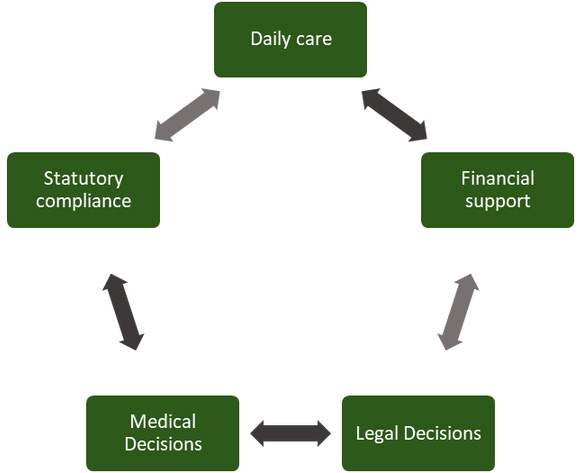
Considering the emotional and physical dependencies of any PWDA on their parents, the parents are always worried about the health and financial stability of their child with special abilities as to who will take care of their child after their demise?
The provisions of Guardians Act provide support to PWDA till he/she is minor. Once the PWDA becomes major under the provisions of applicable laws, parents of PWDA need to follow the below mentioned procedure for guardianship.
WHAT ARE THE WAYS TO SECURE THE FUTURE OF ADULT PWDA?
Following are the some of the routes whereby parents of the PWDA may get some relief. This procedure is also applicable in case of demise of the parents:
GUARDIANSHIP ROUTE:
- As per Section 14 of RPWD Act, 2016, in case a PWDA is unable to take decisions, then the district court or any other authority appointed by the state government, shall be entitled to appoint a guardian for such PWDA.
- It should be noted that the guardian shall be appointed for a limited purpose. Only in cases where PWDA is unable to take decisions, then guardian shall be appointed for a broader role.
- The actual procedure of appointment is as per Section 14 of National Trust Act.
- The Section 14 of the National Trust Act provides for the procedure for appointment of guardian for PWDA. Under this provision, the parents of the PWDA or his relative or any registered organisation shall make an application to the local level committee which is appointed under the said Act. The committee shall consider whether the PWDA needs a guardian and the purposes for which the guardian is needed. The committee shall also provide for the obligations to be fulfilled by the guardian.
Detailed Procedure For Appointment Of Guardian Under National Trust Act is as under:
A parent or relative of PWDA requires to move an application (Form A) under Rule 16(i) to the Local Level Committee of the National Trust Act seeking for appointment of a Guardian.
⇓
Following details are required to be provided on the Form A: has details regarding the:
- Person with disability (Name, age, nature of disability, address)
- The proposed Guardian (Name, age, relationship with the ward, address)
- Nature of Guardianship required i.e. whether it is for The person or the person and property
⇓
The other requirements are:
- A disability certificate
- 2 witnesses who have to sign
- Consent of the person proposed to be appointed as the guardian and the consent of the natural guardian (i.e the parents, if available).
Eligibility criteria for appointment of Guardian under National Trust Act
- He/she is a citizen of India
- Is not of unsound mind or currently undergoing treatment for a mental illness
- Does not have a history of criminal conviction
- Is not a destitute and dependent on others for his own living
- He/she has not been declared insolvent or bankrupt or has criminal conviction
Duties of the guardian:
As per section 15 and 16 of the National Trust Act, following are the duties of the guardian appointed under the provisions of the National Trust Act:
- Take care of such PWDA and his property and be responsible for maintenance of person with disability.
- The guardian should within 6 months of the date of appointment, should submit to the authority the list of movable and immovable properties of the PWDA and the liabilities and expenditure of the PWDA.
- The guardian shall also after end of the financial year, submit an annual account of the properties and assets in charge and sums received and disbursed on account of PWDA and balance of amount with him.
Removal of Guardian:
A guardian of a PWDA can be removed if any parent, relative or a registered organization applies to the local level committee, in a prescribed format, stating that the guardian is:
- Abusing or neglecting a person with disability and / or
- Misappropriating or neglecting the property.
Problems faced by parents or relatives with citizenship other than India?
The current provisions of the National Trust Act state that the guardian needs to be an Indian citizen. In an era where the world is a small and a closely knit village, and where lots of Indian Citizens are migrating abroad to make a living, only to return to the homeland years later, this seems a very outdated provision as it restricts Non-Resident Indians, OCI Card Holders and Dual Citizenship Holders from applying for Guardianship. In near future, this may affect the PWDA’s to an extent where the person who are responsible for guardianship may not be Indian citizens, and the PWDA’s may not be in a state to fend for themselves or take their own decision.
A recent judgement of the Delhi High Court has elucidated on this dilemma in the Act which appointing the guardian.
Case Law: Sunil Podar Versus The National Trust for the Welfare of Person with Autism, Cerebral Palsy, Mental Retardation and Multiple Disabilities and Others W.P.(C) 8359/2022 and C.M. Appl. 25173/2022
In this case, Petitioner and his adopted son were residents of the United States of America. The son was a Specially Abled Adult and has attained majority of age. Petitioner and his wife were legally separated. Petitioner along with his son relocated to India while his wife continued to stay in the United States of America.
The point of contention in this case was that Petitioner sought to be appointed as the guardian of his son, where Petitioner was holding the Overseas Citizen of India cards. The Rules and Regulations provided in the National Trust Act state to be legally appointed as a guardian, the individual shall be the citizen of India. In case the individual seeking to be appointed as a guardian is not a citizen of India, he will not be legally eligible to be appointed as a Legal Guardian of the specially abled adult even if the individual has been a natural guardian to the adult.
The legal issue arising out of this situation was section 14 of the National Trust Act cites Indian citizenship as the valid criteria for being appointed as a Guardian and since Petitioner was not in possession of an Indian Citizenship, his appointment as a Guardian was not permissible.
It was contended that the citizenship aspect was not provided under the National Trust Act but was left to rules and regulations and it were the rules and regulations which determined citizenship as an essential condition for being appointed as a legal guardian. The prescription of qualifications that must be possessed by guardians, thus, clearly appears to be a subject which is left for the rule and regulation making authority to evolve and formulate.
The Court ultimately observed that:
- There is merit in the idea that the requirement of a guardian being the citizen of India is designed to subserve a larger societal purpose.
- Guardianship always has and remains a subject which is regulated by statute.
- It is equally well settled that a guardian always remains under the control of the Court and subject to its directions and supervision.
- The petitioner while being the father of his son with disabilities in light of being an American citizen cannot claim or assert a vested right to be appointed as his guardian. Such a right if at all would have to flow from a provision that may be in existence, and which permits a foreigner to claim a right to be appointed as a guardian unfettered by any valid statutory restrictions that may stand placed.
- Guardianship cannot be recognised as a right that may flow from any of the provisions which stand enshrined in Part III of the Constitution and those under which protection may be claimed even by a foreign national. The makers of the Constitution deliberately and advisedly made a clear distinction between fundamental rights available to “any person” and those guaranteed to “all citizens”. In other words, all citizens are persons, but all persons are not citizens, under the Constitution.”
The Court decided to let the Local Level Committee examine and evaluate the circumstances and surroundings of the person with disabilities in question forthwith. The Committee may also advise the adoption of such further measures as may be warranted bearing in mind the welfare, overall health and well-being of the person concerned. The Court left it open to the petitioner to nominate an Indian citizen who may be appointed as the statutory guardian of the son with special needs.
It remains to be seen whether an appeal will be preferred before the Apex court and the stand the Apex court shall adopt in this regard.
PRIVATE TRUST ROUTE:
A private trust can be formed for a PWDA’s benefit and the trust through its trustees shall act as a guardian for the PWDA after the demise of the parents. Parents may transfer movable and immovable properties to the trust either before their demise through a trust deed or after their demise, through a Will and appoint trustees who may be Indian or foreign nationals[2], for the smooth facilitation of the trust. The purpose of the trust must be defined stringently and explicitly, and the roles and responsibilities of the trustees should also be defined properly. The trust deed should be drafted and prepared in detail, and the trust should be registered under applicable laws. After the trust is formed, it is important to obtain the Pan card of the trust and to open the Bank account of the Trust for the expenses of the PWDA.
CONCLUSION
As the fraction of Indian citizens migrating abroad is increasing day by day, the concern highlighted above regarding appointment of guardian after the demise of parents of PWDA needs to be looked into. Further, any discussion on this subject cannot end without highlighting the scarce facilities available to any PWDA and lack of awareness regarding this subject. While the Indian government has included provisions for guardianship, it is observed that the provisions with respect to safety and security of the rights of PWDA are scattered in different laws and there is no single enactment which covers all the aspects related to the PWDA. There are also certain administrative issues as efficient and fully functional local committees are not constituted in all districts required under provisions of National Trust Act.
“As a society we do not have power to make life fair but we do have the power to make it joyful and simpler”
- The article reflects the general work of the author on the date of publication and the views expressed are personal. No reader should act on any statement contained herein without seeking detailed professional advice.
For any feedback or response on this article, the authors can be reached on ashvini.kandalgaonkar@ynzgroup.co.in, shruti.kulkarni@ynzgroup.co.in and Shreya.Godse@ynzgroup.co.in

Author : Ashvini Kandalgaonkar
Head- Corporate Legal Advisory, is experienced in Corporate litigation and non- litigation. She is also into drafting, reviewing and negotiating commercial contracts, HR Documents and a member of ICC committee for various clients. By qualification she is Bachelor of Legal Science and Bachelor of Legislative Law (B.L.S.LL.B) from Mumbai University.

Co-Author : Shruti Kulkarni
Shruti is an associate at YNZ Legal and has completed her Masters of Commerce from Pune University and Bachelor of Law from ILS Law College, Pune. She works predominantly into drafting and reviewing of commercial contracts and handles Trademarks. She is also a member of Bar council of Maharashtra and Goa.

Co-Author : Shreya Godse
Shreya is a trainee at YNZ Legal. She is currently in second year pursuing Law in A.B.A College of Law. She has completed her Bachelor of Commerce from Mumbai University.