
With change in dynamics of workplace culture, the challenges faced by corporates are also changing [1]. Especially the shift in working styles after COVID-19, has resulted in many new issues for the corporates. Sometimes, employees engage in increasingly disruptive and even malicious behaviour towards their employers and indulge in a range of actions, from data leaks, insubordination to sabotage of company projects. These also raise serious concerns about workplace ethics, security, and the tricky balance of trust between employers and employees.
This article through various case studies examines few issues of employee misconduct, challenges faced by modern businesses and possible precautions they can take to avoid such issues.
While misconduct cannot be defined in a straight jacket formula, ‘Misconduct‘ is generally understood as “A transgression of some established and definite rule of action, a forbidden act, a dereliction from duty, unlawful behavior, wilful in character, improper or wrong behavior” [2].
Generally, appointment letters also give rights to employers to terminate employees for misconduct. Inspite of such rights, it should be noted that misconduct cannot give rise to unilateral termination without adhering to principles of natural justice, but employers can always initiate steps to conduct disciplinary inquiries and take action as per their policies and applicable laws.
To further clarify this concept, let us examine few examples.
Case Study 1: The Absconding Employee and the Consequences of Inaction
Factual Scenario: Consider a case of a software company that faced a serious issue when one of its employees suddenly resigned without prior notice and did not return the Company’s laptop. When asked to serve the notice period, the Employee refused citing favourable opportunities. Considering this scenario, Company did not accept the resignation and also demanded return of the Company property. The employee refused to return such property and demanded a clean relieving letter as a condition for returning the Company’s property.
The Company accepted the employee’s demand in the interest of recovering its laptop and assets. Soon, a significant portion of the workforce adopted similar tactics, resigning abruptly, withholding company property, and demanding compensation or favour in exchange for the return of assets. This growing culture of impunity not only disrupted business operations but also created a toxic environment of distrust.
This case highlights the crucial role of prompt and decisive action by employers when confronted with employee misconduct. Had the company taken immediate disciplinary steps and also implemented a proper return of assets policy in line with the applicable provisions, it could have worked as a deterrent to the rest of the workforce against such behavior.
Applicable Provisions: Section 452 of the Companies Act, 2013 provides for the Punishment for wrongful withholding of property wherein, if any officer or employee of a company wrongfully obtains possession of any property, including cash of the company; or wrongfully withholds it or knowingly applies it for the purposes other than those expressed in employment agreement or applicable law, he shall, on the complaint of the company or of any member or creditor or contributory thereof, be punishable with fine which shall not be less than one lakh rupees but which may extend to five lakh rupees.
{Provided that the imprisonment of such officer or employee, as the case may be, shall not be ordered for wrongful possession or withholding of a dwelling unit, if the court is satisfied that the company has not paid to that officer or employee, as the case may
be, any amount relating to—(a) provident fund, pension fund, gratuity fund or any other fund for the welfare of its officers or employees, maintained by the company; (b) compensation or liability for compensation under the Workmen’s Compensation Act, 1923 in respect of death or disablement.}In Amar Dayal Singh V/s State of U.P And Another [3], Amar Dayal Singh (the Applicant) filed an application under Section 482 of the Cr.P.C. to quash the proceedings in a complaint case (Case No. 859 of 2020) filed by Hindalco Industries Ltd. (the opposite party) before the Special Chief Judicial Magistrate, Allahabad. The complaint accused the Applicant of unlawfully retaining a company’s quarter after his dismissal from service.

The Applicant had been employed by Hindalco Industries and was allotted a company quarter in 2006. He was dismissed from service on March 7, 2011, and the company demanded that he vacate the quarter. Despite several reminders, the Applicant did not vacate the quarter, leading to the complaint in 2020. The Applicant argued that the company had not paid him the full gratuity, and therefore, he could not be charged with wrongfully withholding the property. He cited various legal precedents to support his claim that the non-payment of his dues justified his retention of the quarter.
However, the opposite party contended that the company had already paid the Applicant’s gratuity and interest, and under the terms of the quarter’s license, the Applicant was obligated to vacate the premises once his employment was terminated. They cited a Supreme Court judgment stating that once an employee’s right to retain company property expires due to termination, they must return it, and failure to do so is punishable under Section 452 of the Companies Act.
The Court, upon reviewing the case, concluded that the Applicant was wrongfully retaining the company’s quarter, and that the payment of his dues had been made. Therefore, the Court found no legal ground to quash the complaint, as the Applicant was liable for punishment under Section 452 of the Companies Act, 2013, for withholding the property.
The Court further emphasized that its powers under Section 482 Cr.P.C. to quash criminal proceedings should be used sparingly, and in this case, there was no merit in the Applicant’s claim. Consequently, the application was rejected, and the proceedings were allowed to continue.
Case Study 2: The Remote Worker Who Refused to Report
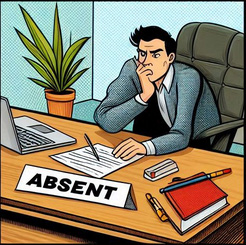
Another scenario involves an employee of a company that offered a work-from-home (WFH) arrangement to the employee, considering his health issues, with the understanding that the employee would transition back to working on-site after six months. The HR head discussed with the employee orally in a meeting. Initially, the employee agreed to this condition, but as the six-month mark approached, the employee portrayed a different understanding of having permanent work from home on medical grounds and refused to return to the office.
The Company repeatedly requested to the employee to resume work from office, but the employee only showed up for a single day. When the Company tried to mark him absent for the days, he was working from home, the employee also refused to accept this as his absentee days and stated that his medical condition did not allow him to come to work. The employee also refused to be examined by company doctor and did not produce any medical certificates, stating that there was no policy requiring him to do it.
JUDGEMENT: Recently, on 5th June 2024 the Karnataka High Court, in Shri G. Ramesh. v. The Karnataka State Seeds Corporation Ltd.[4] reiterated that absence without leave constitutes misconduct in industrial employment and justifies disciplinary punishment.
The charge made against the employee was that he remained absent unauthorizedly from duty for a total period of 541 days between 07.12.1986 and 15.09.1999 and a period of 381 days between 02.09.2000 and 15.05.2003. The employee attempted to contend that he was suffering from Tuberculosis but never furnished any documents/ medical certificates. The corporation had a specific policy that medical leave should be accompanied by Medical Certificate if the leave is sought on the health grounds. The Court confirmed the labour court’s judgement that an employee is under an obligation not to absent himself from work without worthy cause during the time at which he is required to be at work and that no employee can claim leave of absence as a matter of right.
This case highlights the potential risks of vague or poorly structured work-from-home and leave policies. While flexibility is often a key attraction for employees, unclear expectations around work location, leaves or the failure to formalize such arrangements in a written contract can create confusion and even lead to legal issues.
The employer’s lack of clear communication and failure to handle the situation proactively resulted in legal repercussions, which could have been avoided with stronger administration and clearer contractual agreements and policies.

Case Study 3: Employee Who Used Professional Platforms to Solicit Work
Third case involves an employee working for a multinational company who, being still employed, used a public professional networking platform to solicit freelance work. The posts were visible not only to the employee’s peers and managers but also to the company’s clients. This behaviour raised serious concerns about conflict of interest, breach of loyalty, and potential damage to the Company’s reputation. The employee justified the actions with reasons like extra work would enhance his/her productivity, and absence of any restriction against such solicitation in the employment documents. PROVISIONS: Employers must be proactive in establishing clear policies regarding external work commitments, including freelance or side business activities, to prevent moonlighting and the misuse of company resources. Certain statues also prohibit dual employment, like Section 60 of the Factories Act of 1948, prohibits dual employment.[5] Delhi Shops and Establishment Act also prohibits double employment [6].
While this may seem like a minor infraction, it highlights the growing issue of dual employment and the blurred lines between personal and professional identities in the digital age. In the era of social media and professional networking platforms, employees have more access to audiences than ever before.
The Challenges of Employee Misconduct in Modern Workplaces
These case studies illustrate the range of issues modern businesses face when dealing with employee misconduct. From property theft and failure to meet contractual obligations, to conflicts of interest and breach of loyalty, the challenges for employers are varied and complex. In the context of increasingly flexible working arrangements and the growth of remote work, companies must also grapple with new threats to security, productivity, and employee well-being.
What Can Employers do to create an environment of trust?
The key to preventing employee misconduct lies in proactive management and creating a workplace culture based on clear communication, accountability, and trust. Here are several steps that employers can take to minimize the risk of misconduct:
Trainings: The policies and procedures should be communicated clearly during onboarding and reinforced regularly through employee trainings for maximum impact and smooth implementation.
Establish Clear, Written Policies: Employers must ensure that employees are fully aware of expectations regarding work-from-home arrangements, leaves, dress codes, external employment, and use of company property. A detailed Code of Conduct with illustrations and examples to clarify the expectations to employees should be adopted.
Implement Strong Monitoring and Reporting Systems: To protect company assets and sensitive information, businesses must implement robust monitoring systems. These should include data protection protocols, regular audits, and channels for reporting suspicious behaviour without fear of retaliation. Designated company representatives should be empowered to implement the actual Code of Conduct adopted by the Company.
Enforce Policies Fairly and Consistently: Employees must understand that there are real consequences for misconduct. When an infraction occurs, employers must enforce policies fairly and consistently in accordance with applicable laws, to avoid setting a precedent of leniency.
Conclusion:
While the challenges presented by employee misconduct in the post-COVID workplace are not unbeatable, they do require a proactive and informed approach. By establishing clear policies and procedures, enforcing them consistently along with trainings, and fostering a culture of trust and accountability, employers can mitigate the risks associated with employee misconduct. With the right systems, companies can continue to thrive despite these evolving challenges.
- The article reflects the general work of the author and the views expressed are personal. No reader should act on any statement contained herein without seeking detailed professional advice.
- State Of Punjab And Ors vs Ram Singh Ex. Constable on 24 July, 1992(AIR 1992 SUPREME COURT 2188)
- Application U/S 482 No. – 22092 of 2021
- Case No. W.P. (C). No. 36199/2014 (Karnataka High Court)
- No adult worker shall berequired or allowed to work in anyfactory on anyday on which hehas already beenworking in anyother factory, savein such circumstances as may be prescribed.
- Section 9: Restriction on double employment—No person shall work about the business of an establishment or two or more establishments or an establishment and a factory in excess of the period during which he may be lawfully employed under this Act.
For any feedback or response on this article, the authors can be reached on ayushi.kalelkar@ynzgroup.co.in and shravani.joshi@ynzgroup.co.in

Author : Ayushi Kalelkar
Ayushi is experienced in corporate legal and heads the investment and deal advisory at YNZ Legal. She is also a member of Bar Council of Maharashtra & Goa. By qualification she is a Master in Commerce and Bachelor of Law from Mumbai University.

Co-Author : Shravani Joshi
Shravani is a law intern at YNZ Legal. She is currently pursuing LL. B. from Vivekanand college. She has completed Bachelor in Commerce from Mumbai University.