
Introduction[1]:
Try imagining a conversation on WhatsApp or Instagram without emojis, no smiley faces, no thumbs-ups, no hearts. Feels incomplete, doesn’t it? Whether it’s a simple ‘thumbs-up’, a ‘laughing face’, or a ‘heart’, these tiny icons have become integral part of how we express emotions, reactions, and nuances in our online communications. In the vast ocean of social media, messaging apps these small icons add depth and personality to our words by bridging the gap between written words and human emotions. Pure words are bland and may convey wrong messages. Emojis bring gestures to written texts that convey intended meaning.
The journey of emojis began in 1999 when Japanese designer Shigetaka Kurita crafted the first set of 176 emojis[2] for NTT DoCoMo, aiming to enhance the emotional expressiveness of digital messages. These 12×12 pixel images, inspired by manga comics, weather symbols, and kanji characters, laid the foundation for a new visual language. Over time, the Unicode Consortium[3] stepped in to standardize emojis, ensuring they looked more or less the same across different platforms and devices.
But emojis today aren’t just about fun and expression. They have also entered the legal conversation. From questions about copyright and trademark protection to their growing use as evidence in courtrooms, emojis now raise serious legal considerations. But have you ever stopped to think:
- Who owns the rights to an emoji?
- What happens if someone designs a new one?
- Can you claim IP protection over it?
Here we will explore how these everyday symbols fit into the frameworks of intellectual property law and digital communication norms.
1. Copyright Protection – The Design is an Artistic Work
When someone creates an emoji, the visual representation (the actual design or artwork) is protected by copyright law. In India, it is protected under the Copyright Act[4], 1957, as “artistic works.” Section 2(c) of the Act defines “artistic work” to include drawings, which includes digital illustrations like emojis. This applies regardless of whether the emoji is part of a font set or submitted to Unicode.
The original 176 emojis when created by Shigetaka Kurita, an art-icon like a heart, telephone, or an umbrella, are now part of the permanent collection at the ‘Museum of Modern Art’ in New York. However, Kurita never applied for copyright protection, and the emoji trend spread across the globe, with tech giants creating their own interpretations. Today, leading tech companies like Apple, Google, Samsung, Microsoft, design their own emoji sets and each version is separately copyrighted. That’s why the same emoji can look slightly different across devices.
2. Trademark Protection: When Emojis Ascend to Brand Status
Emojis can only attain significant legal protection through trademark registration when they serve as a unique identifier for goods or services. This means that if an emoji design is consistently used as a trademark on merchandise, product packaging, or as a distinctive logo, it can fall under the purview of trademark law, provided the emoji is originally designed by the owner.
It’s crucial to understand that the basic Unicode character itself, which represents the generic concept of an emoji for example- the standard “smiley face” code, cannot be trademarked. This is because it functions as a universal emoji. However, McCain (a frozen potato product manufacturer) successfully registered a 3D smiley face product as a trademark[5] in EU Class 29 (pre-fried potato croquettes and mashed potato products, deep-frozen). Agrarfrost challenged this registration, arguing the smiley face shape was common in the food sector and thus couldn’t indicate commercial origin. The General Court of EU ruled in favour of McCain, upholding the trademark registration. Court gave decision that while stating Extensive Use and Promotion that the mark was promoted by numerous advertising campaigns, it appeared on the packaging of the products and it was directly visible to consumers when purchasing via the use of transparent packaging. Also, the Court found McCain’s smiley shape was unique for potatoes. Even though frozen potatoes usually come in sticks or wedges, a study showed no other company made potato products shaped like faces.
So, this ruling was a big win for McCain. It shows that even generic emojis can be protected as trademarks if they’re unique enough to stand out. Therefore, McCain successfully trademarked their “smiley” potatoes!
Therefore, a specific styled, and distinctive visual interpretation of an emoji, one that has been uniquely designed and adopted by a company to represent its brand can be registered as a trademark. This allows a company to claim exclusive rights to that particular artistic expression when used in connection with its commercial offerings.
A notable example of this in action is Emoji Company GmbH, a German entity that gained significant attention in 2019 for its proactive approach to licensing[6] emoji characters for commercial purposes. This company doesn’t own the generic “emoji” concept, but rather, they hold extensive trademark registrations for their highly stylized and proprietary emoji designs. These trademarked designs have formed the basis for numerous profitable licensing agreements with global brands across various industries, from goods to entertainment. This demonstrates how a creative and strategic application of trademark law can transform widely recognized symbols into valuable commercial assets.

3. The Unicode Consortium: Architects of Digital Communication
For an emoji to transcend device boundaries and appear consistently across diverse platforms—be it iOS, Android, Windows, or any other operating system, it must first gain the stamp of approval from the Unicode Consortium. This pivotal non-profit organization is the global authority responsible for standardizing text and characters across all systems. Their work ensures that text created on one device can be correctly displayed and interpreted on another, irrespective of the software or hardware involved.
It’s crucial to understand that the Unicode Consortium does not engage in the creation of emoji designs[7]. Their role is far more fundamental i.e.
- they approve the concept of a new emoji and assign it a unique code point.
- This code point is essentially a numerical identifier that acts as an abstract representation of the emoji.
- Once a concept and its code point are approved by Unicode, the onus then shifts to individual technology companies such as Apple, Google, Samsung, Microsoft, and Meta to design their own distinct visual interpretations of that emoji.
- Each company’s unique rendition is then separately copyrighted, allowing them to protect their specific artistic expression. This explains why the same emoji, like a “grinning face,” can appear subtly or even significantly different across various devices and platforms.
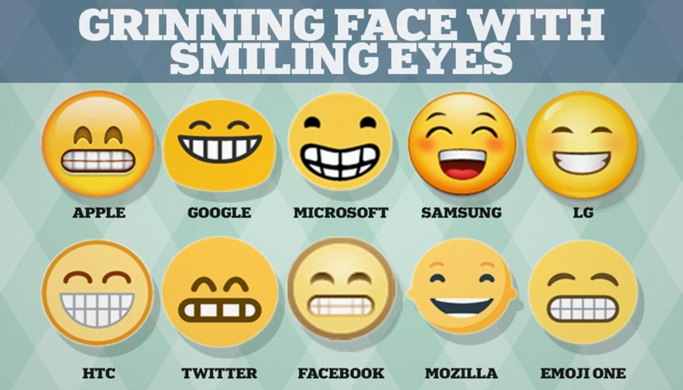
Despite light-hearted appearance of emojis, they are highly prone to misinterpretation due to an individual perception which can in turn create fertile ground for legal disputes related to intent and meaning.
4. The “Thumbs Up” Emoji Misconduct Case[8]:
In a significant writ petition before the Madras High court, the Railway Protection Special Force sought to overturn a lower court’s decision for reinstating a Constable’s dismissal for alleged misconduct. The core of the dispute involved the Constable’s act of posting a “thumbs up” emoji in an official WhatsApp group in February 2018, immediately following a message reporting the brutal murder of a superior officer.
The Force contended this emoji constituted a grave act of misconduct, interpreting it as a celebration of the crime, and the disciplinary authority removed him from service after conducting inquiry.
This was litigated by the parties before revisional authority, single judge and ultimately the divisional bench of Madras High Court for almost 6 years. While the RPF asserted this to be a misconduct, the Constable asserted that the emoji was used erroneously and unintentionally, attributing the mistake to his limited familiarity with WhatsApp and arguing the dismissal was a disproportionate punishment. The Court meticulously examined the evidence and found the Constable’s explanation credible in its judgment delivered on 14th February 2024. It acknowledged that a “thumbs up” can signify mere “acknowledgement” or “OK,” particularly for individuals, less conversant with digital communication nuances and noted the absence of any prior disciplinary record against the Constable. Ultimately, the Court dismissed the Force’s appeal, affirming the Constable’s reinstatement without back wages.
This ruling underscore the judicial recognition of emoji misinterpretation and the critical importance of context and user intent in assessing digital communication within legal frameworks.
5. Emojis in Contracts:
A number of cases from overseas show how emojis sent in response to an offer can lead to unintended contracting.
In, Canada (2023) case of South West Terminal Ltd. v Achter Land: Contractual and Evidential Implications[9], a court found a “thumbs up” emoji signified agreement to a flax purchase proposal. This decision was dependent on the emoji’s habitual use between the parties in their established business relationship, leading a reasonable bystander to conclude a binding contract was formed, relatively similar to a written signature.
In simpler terms, the case shows that even though we’re now using things like emojis to talk, the basic rules of contracts have not changed. What really matters is how people usually communicate and the situation they’re in when deciding if an informal message, like an emoji, counts as a binding agreement.
Conclusion
Emojis are not just fun they’re legally complex mini-masterpieces. As recent court cases highlight, emojis are being far from considered to be trivial in a legal context. Whether impacting employment discipline or contractual agreements, judges increasingly recognize their evidentiary weight and the potential for misinterpretation. These evolving legalities in the emojis’ space underscores that random usage of emojis in the digital realm is definitely not advisable. Having said that, the process of establishing acceptances through emojis will involve complex legal actions, if denied by the counterparty. Thus, obtaining proper confirmation or acceptance (instead of a thumbs-up) in the traditional manner should be resorted to.
- The article reflects the general work of the author on the date of publication and the views expressed are personal. No reader should act on any statement contained herein without seeking detailed professional advice.
- https://www.theverge.com/2016/10/26/13424976/moma-nyc-art-original-emoji-acquisition
- https://www.unicode.org/consortium/consort.html
- the copyright act, 1957 (14 of 1957)
- Smiley Faces for McCain – Court Upholds 3D Trade Mark – Lexology
- https://www.emoji.com/licensees/
- https://unicode.org/emoji/proposals.html
- the-director-general-and-others-v-narender-chauhan-527642.pdf
- South West Terminal Ltd v Achter Land, 2023 SKKB 116.
For any feedback or response on this article, the authors can be reached on shravani.joshi@ynzgroup.co.in and Ayushi.Kalelkar@ynzgroup.co.in

Author : Shravani Joshi
Shravani is Law Trainee at YNZ legal. She is currently pursuing LLB from Vivekanand College. She has completed her Bachelor of Commerce from Mumbai University.

Co-Author : Ayushi Kalelkar
Ayushi is experienced in corporate legal and heads the investment and deal advisory at YNZ Legal. She is also a member of Bar Council of Maharashtra & Goa. By qualification she is a Master in Commerce and Bachelor of Law from Mumbai University.