
A. What is a Geographical Indication (GI)[1]?
The key elements of the definition of Geographical Indication as provided in “The Geographical Indications of Goods (Registration and Protection) Act, 1999” in relation to goods are:
- GI is an indication which identifies such goods as agricultural goods, natural goods or manufactured goods;
- GI indicates that the goods are originated or manufactured in the territory of a country, or a region or locality in that territory;
- GI is awarded when a given quality, reputation or other characteristics of such goods is essentially attributable to its geographical origin;
- In case where such goods are manufactured goods, one of the activities of either production or processing or preparation of the goods concerned takes place in such territory, region or locality, as the case may be[2].
B. What Products can be registered under Geographical Indication?
A Geographical Indication may be registered in respect of any products as classified in the manner by the Registrar in the Fourth Schedule.[3] The Fourth Schedule classifies the goods as per the nature of the goods and constitutes of about 34 Classes.
Few of the famous registered Geographical Indications are under the following Classes:
| GEOGRAPHICAL INDICATIONS | CLASS | GOODS | GEOGRAPHICAL AREA |
|---|---|---|---|
| Kashmir Pashmina | 24 | Handicraft | Jammu & Kashmir |
| Malabar Pepper | 30 | Agricultural | Kerala |
| Dharwad Pedha | 29 | Food Stuff | Karnataka |
| Feni | 33 | Manufactured | Goa |
| Makrana Marble | 19 | Natural | Rajasthan |
| Kolhapuri Chappal | 25 | Handicraft | Karnataka & Maharashtra |

C. As a Consumer, how to figure out whether a Product is registered Geographical Indication?
The Product which is registered under the Geographical Indication Registry can use the above Geographical Indication Tag and Logo as declared by the Department for Promotion of Industry and Internal Trade along with the logos of other organizations as required.[4] However, the usage of tag and logo is not compulsory.
D. Who shall be the authorised users of the Geographical Indications?
Authorised users can be any person claiming to be the Producer of the goods in respect of which a Geographical Indication has been registered and has to apply to Registrar in writing in the prescribed manner. [5]
E. What are the advantages available to Small and Medium-sized Enterprises for getting registered as authorised users of the Geographical Indications?
Following advantages can be availed by getting registered as authorized users of the GI:
- Provides legal protection to Indian Geographical Indications, thereby increasing exports.
- Strengthen the reputation of the goods and boosts local economy.
- Builds consumer confidence about the Product, which can promote sale of genuine products at higher value.
- Support regional economic development
- Communicate their commitment to social responsibility
- Prevent fraudulent uses of IP rights[6]
One such case where an objection was raised in respect to registration of the Geographical Indication, wherein the origin of the production of the product was challenged before the Geographical Indication Registry: Banglar Rasogolla v. Odisha Rasagola
Facts: In November 2017, West Bengal State Food Processing and Horticulture Development Corporation Limited got the GI registered as ‘Banglar Rasogolla’. An objection to the GI Registration was filed citing that the origin of this famous sweet was in the Jagannath Temple of Puri in Odisha. An application for removal of the registration of the GI status was filed in February, 2018. The GI Registry notified that Odisha got the GI registered as ‘Odisha Rasagola’.
Held: It is very important to note that the GI Registry has not given registration to the term ‘Rasogolla/ Rasagola.’ It has specifically prefixed two words to the GI tag, one is ‘Banglar’ and the other one is ‘Odisha’, thereby, implying that ‘Rasogolla/ Rasagola’ is a generic word which can be used by anyone in their trade and business. Thus, so far as the law is concerned, neither of the states has got a monopoly on the word ‘Rasogolla/ Rasagola’. So, it is free for anyone in the trade to continue selling the sweet as Rasogolla/ Rasagola or any other synonym. What is prohibited is the usage of the word ‘Banglar Rasogolla’ and ‘Odisha Rasagola’ by anyone other than the ‘authorised user’ under the law.[7]
F. Who can apply for registration of Geographical Indication?
Any association of persons or producers or any organization or authority established by or under any law for the time being in force for representing the interest of the producers of the concerned goods can apply for registration of the Geographical Indications.[8]
G. What are the requirements for an application under Geographical Indication?
The application for registration of Geographical Indications should consist of the following:
- Statement which demonstrates how the goods should be designated as Geographical Indication to certain territory on the basis of their nature of origin or characteristics or the process of manufacturing taking place in such territory;
- Class of goods under which the goods are classified;
- Geographical map of the territory where such goods are produced, or the manufacturing takes place;
- Details of the Geographical Indication comprising of words or figurative elements;
- Statement containing details of the Producers of such goods;
- And any other details relevant to such application.[9]
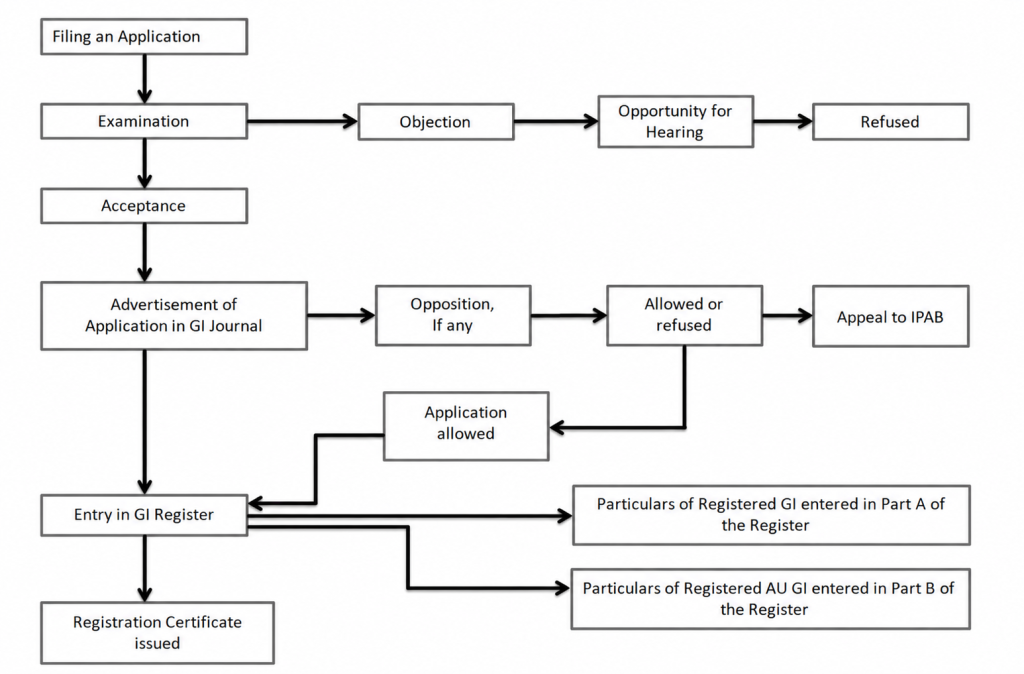
H. What is the Process for registering a Geographical Indication?
The Process for registering a Geographical Indication is as follows[10]:
I. What is the validity of the registered Geographical Indication and when should the renewal be done?
The registration for Geographical Indication shall remain valid for a period of 10 years from the date of registration. The renewal of the registered Geographical Indication can be done for a period of 10 years from the date of expiration of the original registration by making the payment of prescribed fee. [11]
J. What Geographical Indications are given an International recognition?
GI is given legal recognition on international level by the Paris Convention for the Protection of Industrial Property and the Trade Related Aspects of Intellectual Property Rights (TRIPS) Agreement.:
One of the Indian Geographical Indications which have been granted International recognition are the Kangra Tea Leaves and certain international products such as alcohol and spirits which are registered under the Indian Geographical Indications Registry are as follows:
| Geographical Indications | Class | Goods | Geographical Area |
|---|---|---|---|
| Tequila | 33 | Manufactured | Mexico |
| Polska Wodka | 33 | Manufactured | Poland |
| Champagne | 33 | Manufactured | France |
| Scotch Whisky | 32 & 33 | Manufactured | United Kingdom |
K. Who can initiate Infringement Actions?
The Infringement actions can be initiated only against the registered Geographical Indications by the Registered Proprietor. No infringement actions can be initiated against unregistered Geographical Indications.[12]
L. What are the penalties imposed under the Geographical Indications of Goods Act?
The penalties imposed under the Geographical Indications of Goods (Registration and Protection) Act, 1999[13] are as follows:
| Sr. No. | Penalty imposed for | Penalties Imposed |
|---|---|---|
| 1 | Applying false geographical indication | Imprisonment for a term up to 6 months or a fine up to Rs. 50,000/- |
| 2 | Selling goods to which false geographical indication is applied | Imprisonment for a term of 6 months to 3 years and with a fine of Rs. 50,000/- to 2,00,000/- |
| 3 | Falsely representing a Geographical Indication as registered | Imprisonment for a term up to 3 years or with fine or with both |
| 4 | Improperly disclosing place of business in connection to the Geographical Indication Registry | Imprisonment for a term up to 2 years or with fine or with both |
| 5 | Falsification of entries in the register | Imprisonment for a term up to 2 years or with fine or with both |
Conclusion
As consumers, it is critical to take caution when making purchases in areas known for certain products. It is crucial to ascertain whether establishments actively endorse and contribute to the local economy by supporting registered Geographical Indications. By doing so, not only do we contribute to the preservation of regional heritage and quality standards, but we also encourage sustainable practices that benefit local communities. In conclusion, our conscious choices as consumers play a vital role in sustaining the unique identity of products tied to specific geographic regions. By prioritizing businesses that uphold and support local Geographical Indications, we become catalysts for the preservation of cultural diversity, economic resilience, and environmental sustainability. Let our purchasing decisions reflect a commitment to nurturing and celebrating the rich heritage of local traditions and industries!
- The article reflects the general work of the author and the views expressed are personal. No reader should act on any statement contained herein without seeking detailed professional advice.
- Section 2(e) of The Geographical Indications of Goods (Registration and Protection) Act, 1999.
- Rule 21 of the Geographical Indications of Goods (Registration and Protection) Rules, 2002.
- https://ipindia.gov.in/writereaddata/Portal/News/536_1_GI_Guideline Finalised_..pdf
- Section 17 of The Geographical Indications of Goods (Registration and Protection) Act, 1999.
- https://www.wipo.int/ip-outreach/en/ipday/2021/toptips/geo_indications.html
- http://student.manupatra.com/Academic/Studentmodules/Intellectual-Property-Rights/Geographical-Indicators.htm
- Section 11 of The Geographical Indications of Goods (Registration and Protection) Act, 1999.
- Section 11(2) of The Geographical Indications of Goods (Registration and Protection) Act, 1999.
- https://ipindia.gov.in/the-registration-process-gi.htm
- Section 18 of The Geographical Indications of Goods (Registration and Protection) Act, 1999.
- Section 20,21 of The Geographical Indications of Goods (Registration and Protection) Act, 1999.
- Section 39-44 of The Geographical Indications of Goods (Registration and Protection) Act, 1999.
For any feedback or response on this article, the authors can be reached on riddhi.bhosale@ynzgroup.co.in and shravani.joshi@ynzgroup.co.in

Author : Riddhi Bhosale
Riddhi is an Associate at YNZ Legal. By qualification she has completed her Bachelor of Science in Biotechnology and Bachelor of Law from University of Mumbai.

Co-Author : Shravani Joshi
Shravani is Law Trainee at YNZ legal. She is currently pursuing LLB from Vivekanand College. She has completed her Bachelor of Commerce from Mumbai University.