
INTRODUCTION:
In the fast-growing business world of today, there is a clear need of identifying one’s products and services through a unique and a distinct brand or a trademark. Trademark is an asset to the organisation that builds reputation and brand image and thus requires zealous protection. Parties have often invoked the provisions of Trade Mark Act, 1999 and successfully restricted parties who tried to adopt similar trademarks to ride on the reputation gained by another.
LEGAL PROVISIONS:
The provision dealing with infringement of a registered mark due to phonetic or visual resemblance is included in Section 29(9) of the Trade Marks Act, 1999 – “Where the distinctive elements of a registered trade mark consist of or include words, the trade mark may be infringed by the spoken use of those words as well as by their visual representation and reference in this section to the use of a mark shall be construed accordingly.” Thus, a mark may be infringed by both spoken use and visual representation of words. The Court has repeatedly stated that while determining trademark similarities, one must consider both the ear and the eye.
The average person with average intelligence and an imperfect memory is likely to make wrong decisions, because of the deception and confusion caused by the similarities. This confusion may result in loss and damage to a registered mark’s goodwill entitling the rightful owner to claim damages.
Phonetic and visual similarity cause confusion in the minds of people. In recent years, the use of phonetic and visual similar marks in trademark has come to the forefront; it may or may not be malicious, but we can notice many consumer-based industries such as pharmaceutical and packaged food companies using phonetically and visually similar names. Despite the standard set under the Trade Marks Act, 1999 in provisions such as Sections 9 and 11, determining the distinctiveness of marks is a difficult task that requires judicial insights.
CASE STUDIES:
This article explores five case studies and with each judgement a distinct approach is adopted on how similar marks can cause confusion and why they have not been accepted.
A) Case Name: Cadbury India Limited And Ors. vs Neeraj Food Products2,
Marks: GEMS VS JAMES BOND
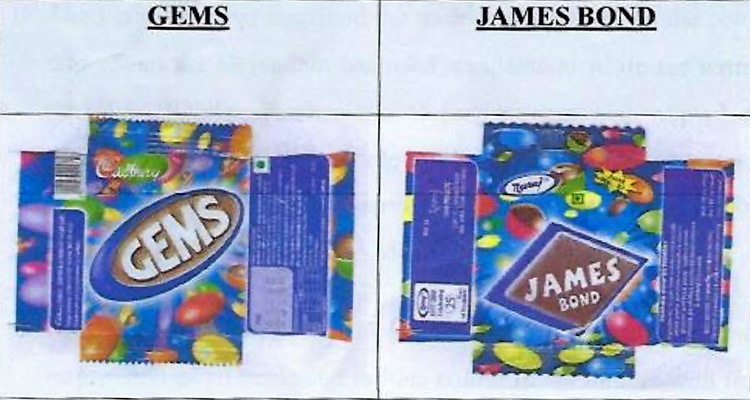
Visual Similarity: Same colour blue/purple base and colourful button chocolates;
Phonetic Similarity: GEMS and James were held to be similar.
Ratio: The Defendant’s mark was held to be visually and deceptively similar and the Court also observed that ‘GEMS’ product is usually consumed by small children, both in urban and rural areas. On the test of similarity, it was observed that the Defendant’s infringing product and the packaging as compared to Plaintiff’s product leaves no scope for doubt that both the products packages cause deception and confusion in the minds of the public. Thus, test is not that of absolute confusion but even likelihood of confusion is sufficient. Accordingly, Delhi High Court passed an order that permanent and mandatory injunction against the Defendant for infringement of trademark. Further, when the suit was decreed recently on 26th July 2022, the Delhi High Court awarded actual costs of Rs.15,86,928/- in favour of the Cadbury as it had spent substantial amount of money in litigation.
B) Case Name: Pidilite Industries Limited vs. Poma-Ex Products & Ors3 Case
Marks: FEVIKWIK VS KWIKHEAL
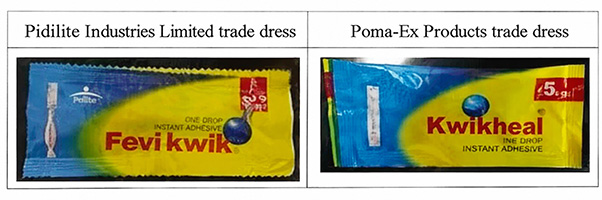
Visual similarity: Identical colour scheme and packaging
Phonetic similarity: Utilization of the word KWIK.
Ratio: Bombay High Court observed that “there exists a high degree of phonetic similarity between the mark of the Plaintiff “FEVIKWIK” and the mark of the Defendant “KWIKHEAL.” The word “KWIK” is a dominant part of the trademark of the Plaintiff “FEVIKWIK” The mark used by the Defendant “KWIKHEAL” is prima facie deceptive or misleading.
C) Case Name: Meta Platform Inc. v. Noufel Malol & Anr, Delhi High Court’s case4,
Marks: FACEBOOK VS FACECAKE /FACEBAKE

Ratio: Court noted that the mark is well known mark, and it is widely known to the general public, and Defendant is attempting to capitalize on the goodwill that such a ‘well-known trademark’ enjoys. Later, the defendants changed the mark from “facebake” to “facecake,” changing only one alphabet, after becoming aware of the court’s ad-interim injunction, but they did not appear before the court to explain their decision. The Court noted that although there are some differences between the plaintiff’s and defendants’ marks, the defendants’ overall visual representation clearly showed their mala fide intent.
The Court restrained the Defendants from using the “facebake” and “facecake” marks, the domain name, email ids, and any other “Facebook” formative trademarks of the Plaintiff, or any other mark misleadingly similar thereto, in connection with products and services related to confectionery items, or any other goods or services, and insisted that none of the defendants, their directors, proprietors, subsidiaries, affiliates, franchisees, officers, servants, agents, distributors, representatives, or anyone else acting for or on.
The Delhi High Court awarded interim actual costs of Rs.50,000/- in favour of the Plaintiff and restrained Defendant from using the “Facebake” and “Facecake” mark and the domain names.
D) Case name: Dharampal Satyapal Limited & Anr. Versus Mr. Youssef Anis Mehio & Others5
Marks: RAJNIGANDHA VS RAJNI PAAN
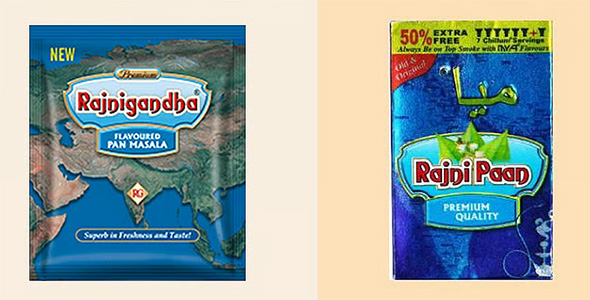
Ratio: The packaging of the contested product was purposefully created to trade off the significant goodwill and reputation of the plaintiffs in their RAJNIGANDHA marks by using an identical colour scheme, font, and labels to give the overall look and feel of the plaintiffs’ products under the RAJNIGANDHA marks. It was held that the Plaintiffs have established a case of infringement and passing off, and it is apparent that the Defendants engaged in dishonest adoption.
Further, Court stated that the Defendants have maliciously and purposefully adopted a confusingly similar mark and have simply changed “GANDHA” to “PAAN” with the objective to capitalise on the goodwill and reputation built up by the Plaintiffs, it added. Rajnigandha has previously been deemed a well-known trademark by the Court and is so entitled to a higher level of protection. According to the court, the impugned mark is misleadingly similar to the plaintiff’s mark both visually and structurally. Along with the injunction, Plaintiffs was also awarded damages of Rs. 3,00,000/-.
E) Case Name: Starbucks Corporation vs Sardarbuksh Coffee & Co. & Others6
Marks: STARBUCKS VS SARDARBAKSH
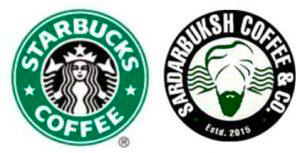
In the year 2018, Starbucks filed a lawsuit against Sardarbuksh before the Delhi High Court for utilising the word mark “Sardarbuksh,” which sounds remarkably similar to “Starbucks.” The logo of Sardarbuksh looks similar to the logo of Starbucks like similarities in the logo such as crowned maiden in the Starbucks logo and turbaned man in the logo, round shape, similar colour and also names of both the logos are sounding similar. The parties worked out certain terms and filed the same before the Court. The defendant agreed to rename all its locations “Sardarji-Bakhsh Coffee & Co.” Additionally, it was clarified and agreed upon that, if a third party uses the term “Bakhsh,” the defendant will have a right to file a suit against such a violator.
Conclusion
It is clear that the Courts have come down heavily on visually or phonetically similar marks and such cases reimpose faith in judiciary. Before registering a mark, an individual or organisation must always conduct a public search on trademark registry site. This search should be performed in addition to the wordmark search type. With its useful results, one can choose a new trademark with minimum chances of facing any objection or opposition from a third party due to similarity with any registered mark.
- The Article reflects the general work of the authors and the views expressed are personal. No reader should act on any statement contained herein without seeking detailed professional advice.
- 2007 (35) PTC 95 Del : CS (COMM) 393/2018: Delhi High Court
- 2695 of 2016 in Suit No. 653 of 2014 : Pidilite Industries Limited vs. Poma-Ex Products (02.08.2017 – BOMHC)
- CS(COMM) 499/2020 & IA 8765/2021 decided on 6th July 2022
- CS(COMM) 1255/2018 decided on 27th September 2022 by Delhi High Court
- CS(COMM) 1007/2018 & I.A.Nos.9022/2018, 10113/2018
For any feedback or response on this article, the authors can be reached on mayuri.bhosale@ynzgroup.co.in

Author : Mayuri Bhosale
Mayuri is an associate at YNZ Legal and has completed her Bachelor of Law and Bachelor of Commerce from Mumbai University.