
As per a research report[1] published by Goldman Sach Research titled, “The rise of ‘Affluent India’”[2], the cohort of affluent consumers will increase from around 60 million (6 crores) to 100 million (10 crores) people by 2027. This new found wealth is driving a demand for more exciting investment options beyond traditional favorites like bank deposits, ornamental gold, government schemes, etc., the investments options available currently in financial securities like bonds and stocks to purchase of mutual funds, has led to rise in number of Indian consumers becoming affluent.
However, a few High-Net-Worth Individuals (HNIs), who have investible assets such as bonds or stocks which are valued between Rupees 5 lakhs and Rupees 5 crore.[3] Such HNIs who are willingly to take high risks for higher profits can trade in one such type of investment, Alternative Investment Funds (AIF). Unlike traditional options, AIFs invest in a wider range of assets, offering a chance to tap into potentially lucrative but less mainstream markets.
What exactly is an AIF?
In simpler terms, an AIF is a privately managed investment fund that collects money from investors, both domestic and foreign. These funds can be structured as trusts, companies, or limited partnerships. But unlike mutual funds, AIFs come with stricter regulations and higher investment minimums.
“Alternative Investment Fund” is any such fund established or incorporated in India in the form of a trust or a company or a limited liability partnership or a body corporate which –
- is a privately pooled investment vehicle which collects funds from investors
- the investors who can invest in such fund can be Indian or foreign.[4]
Who can invest in AIFs and what is the minimum amount to be invested?
Investors who are willing to invest an amount of at least INR 1,00,00,000/- (Rupees One Crore) shall be eligible to invest in such AIFs, provided:
investors who are employees or directors of the AIF or employees, the minimum value of investment shall be INR 25,00,000/- (Rupees Twenty-five Lakhs)[5].
For an AIF to receive investment, it shall be registered with Securities Exchange Board of India (SEBI)[6]. AIFs can obtain registration from SEBI under 3 categories as follows:
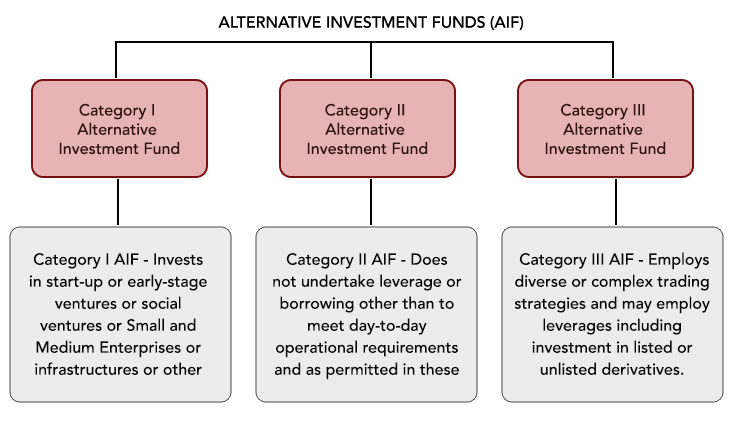
Depending on the categories of AIFs, the AIFs which are most viable for start-ups and early-stage ventures (“Investee Company”) to receive funding are the Category I AIFs. The Category I AIFs can invest up to 25% of the investable funds in an Investee Company directly.[7]
What is the process by which an AIF can invest in an Investee Company?[8]
The investment process for an AIF to invest in an Investee Company starts at the stage of
- Deal Sourcing
- AIF Managers using their networking and with the consultation of investment bankers, professional contacts, auditors and legal firms, develop a database of potential companies which can achieve their goal of higher returns.
- Information about the business or finance of such Investee Company is not readily available, so such ventures are scrutinized based on the Founders or key management person’s credentials and the competence and the ability to transform the vision into business of such Investee Company.
- The investment bankers or advisors who are appointed by the AIF managers draft a report containing brief summary of the Investee Company and the investment which can be proposed based on the business sector of the AIF.
- If the AIF managers, principals and associates are convinced with the report, the investment manager representing AIF and the Investee Company executes a Non-Disclosure Agreement to receive the Confidential Information of the Investee Company to understand the Investee Company operations, etc.
- Putting the Company Under the Microscope: Business Due Diligence
- Post the execution of Non-Disclosure Agreement, follows the Business Due Diligence to gain a comprehensive understanding of the Investee Company’s operations.
- The Business Due Diligence typically involves:
- Market research
- Collation of knowledge from advisors on the current state of the industry
- Building a preliminary financial model using management projections
- The reports of such Business Due Diligence are meticulously analyzed by the AIF Managers and the investment bankers finetune the investment and the roll-out plan to be offered to such Investee Company.
- The AIF then arrive at a decision based on such report generated by the investment bankers whether to proceed with the Investment in such Investee Company.
- The AIF and the Investee Company if are in agreement with the investment and the roll-out plan, further proceed and enter into a Term Sheet.
- Term Sheet: Setting the Stage for Investment
- A Term Sheet is a detailed document executed by the investment manager representing AIF and the Investee Company which consists of detailed proposed transaction.
- The Term Sheet is a letter of intent signed by both Parties, despite being letter of intent, it is a crucial document as it contains the terms agreed upon for the investment in the Investee Company.
- The Term Sheet consists of:
- Parties to the investment
- Proposed transaction of such investment
- Investment amount (subject to change post Due Diligence)
- Proposed capital structure post-acquisition
- Board representation
- Key Investor Rights
- Dividend Rights
- Exclusivity Period
- Condition Precedents to investment.
- Affirmative and Veto Rights
- Exit Rights
- The clauses mentioned above are negotiated prior to Due Diligence as the same form the base of the Definitive Agreements which are executed between the Parties at investment stage.
- Term Sheet is valid for a period as mutually decided by the Parties and can be extended if required.
- Diving Deep: Due Diligence Process
- The Due Diligence is commenced only post execution of Term Sheet by the Parties.
- The Due Diligence is of various types as follows:
- a. Business, Commercial and Technical Due Diligence – This in-depth review comprises of scrutiny of constitutional documents, board minutes and reports, books of account, tax returns, invoices, purchase orders, payroll statements, statutory filings, owned and leased property agreements, employee lists and agreements.
- b. Financial Due Diligence – Financial Due Diligence comprises of verification of books of account, financial statements, business transactions, tax filings, assessments of both direct and indirect tax of the Investee Company. To gain the financial view of the Investee Company, financials and records of at least past three years are mandatorily scrutinized.
- c. Legal Due Diligence – The scope of Legal Due Diligence focuses on scrutinizing the contracts and agreements entered into by the Investor Company, its Intellectual Property Rights (IPR) protection, any outstanding or ongoing litigations of the Investor Company or its Founders or key management person.
By conducting a thorough Due Diligence process, the AIF mitigates investment risks and makes informed decisions about moving forward with the transaction.
- Definitive Agreements
- Based on the Due Diligence Report, the Investee Company and investment manager representing AIF, enter into a set of binding agreements to complete the investment transaction.
- The Definitive Agreements or the binding contracts which the Parties enter into are as follows:
Share Subscription Agreement (SSA)
- The Share Subscription Agreement is the primary and the most important transaction document executed between the investment manager representing AIF and the Investee Company which records the investments against the financing received by the Investee Company against the issue of new shares.
- The SSA documents the terms subject to which the investment is made by investment manager representing AIF and the rights which are provided by the Investee Company to the AIF against such investment which are superior to any those held by ordinary investor under Companies Act as may be required.
- SSA contains provisions for reconstitution of the Board of the Company or other key appointments in the Company post investment, etc.
Share Holders Agreement (SHA)
- The Shareholders’ Agreement is the agreement entered into between all the existing shareholders of the Investee Company, the Investee Company and the investment manager representing AIF.
- This document is executed as the terms agreed in SSA for the equity investments are only binding on the Investee Company and not the existing Shareholders. Hence to bind all the existing Shareholders in the Investee Company, investment managers of AIF assert on the execution of SHA.
What are the risks that are mitigated by the Investee Company and the AIFs by execution of the legal documents in the process of investment by AIF in an Investee Company?
Risks to be Mitigated by the Investee Company:
Timely Disbursal of Capital: Disbursal of capital/funds by the AIF to the investee company as per its requirements as stated in the legal agreement is essential obligation of the AIF. Failure to perform such obligation can lead to major business difficulties for the investee company and it can hold AIF responsible for such breach and mitigate such a risk through the legal agreement.
Compliance and Licenses: Major compliances and statutory requirements to be complied by AIFs are elaborated in SEBI AIF Regulations, 2012. If there is any non-compliance on part of AIF this can massively affect the functioning of investee company and investee company can mitigate such risk through legal agreements where in compliances and statutory licenses compliance is an obligation.
Confidentiality: It is a common scenario, where AIF invests funds operating in similar categories of business in the market. In such a case, maintaining and preserving confidential information of the investee company is vital. If any of the confidential information is leaked to investee company’s competitors through the AIF, this can lead to huge business losses. confidentiality clause in the legal agreement can be used a tool of mitigation for such a risk by the investee company.
Risks to be Mitigated by the AIF (Investor):
Failure to Perform by Investee Company: It is investee company’s primary responsibility to use funds invested by AIF to fulfill its business obligations as specified in the legal agreement for ensuring returns on AIF’s investment. Use of such funds for personal purposes or for any other purpose which is not outlined in the agreement is unfair towards AIF. AIF can mitigate this risk using the legal agreement where performance requirements of the investee company are clearly stated.
Risk associated with change in control or management of investee company: The success of the investee company might be heavily reliant on the skills and experience of a few key individuals. If these key people leave the company or there is change in control, it can significantly impact the investee’s performance and ultimately, the AIF’s return on investment.
Fraudulent Practices: Even with thorough due diligence, the AIF can’t completely eliminate the risk of fraud by the investee company’s management. This could involve manipulating financial statements, inflating revenue figures, or engaging in unethical business practices. Remedies are available in the legal agreement for AIF to mitigate such risk.
Shared responsibility:
- Exit Strategy Alignment
- Compliance with Investment Agreement
Conclusion:
AIFs offer a compelling path for qualified investors seeking high-growth potential. However, due diligence and a clear understanding of the legalities involved are paramount. Consulting with a financial advisor experienced in alternative investments is crucial as such Advisor can display his expertise by establishing structured procedures for due diligence and having in place efficiently drafted legal documents like non-disclosure agreements and term sheets for navigating this complex, yet potentially rewarding, investment landscape.
This option focuses on the practical steps an investee should take before considering AIFs as one of the investors and emphasizes the importance of seeking professional guidance.
- The article reflects the general work of the authors and the views expressed are personal. No reader should act on any statement contained herein without seeking detailed professional advice.
- https://www.goldmansachs.com/intelligence/pages/indias-affluent-population-is-likely-to-hit-100-million-by-2027.html#:~:text=In%20tandem%2C%20the%20wealth%20of,100%20million%20people%20by%20 2027.
- https://www.business-standard.com/about/who-is-high-net-worth-individuals
- Section 2(b) of Securities and Exchange Board of India (Alternative Investment Funds) Regulations, 2012
- Section 10(c) of Securities and Exchange Board of India (Alternative Investment Funds) Regulations, 2012
- Section 3(1) of Securities and Exchange Board of India (Alternative Investment Funds) Regulations, 2012
For any feedback or response on this article, the authors can be reached on riddhi.bhosale@ynzgroup.co.in, shravani.joshi@ynzgroup.co.in and atharva.amdekar@ynzgroup.co.in

Author : Riddhi Bhosale
Riddhi is an Associate at YNZ Legal. By qualification she has completed her Bachelor of Science in Biotechnology and Bachelor of Law from University of Mumbai.

Co-Author : Shravani Joshi
Shravani is a Law Intern at YNZ legal. She is currently pursuing LLB from Vivekanand College. She has completed her Bachelor of Commerce from Mumbai University.

Co-Author : Atharva Amdekar
Atharva is an associate at YNZ Legal. By qualification he is Bachelor of commerce and Bachelor of Law from Mumbai University