
Understanding Capital Reduction [1]:
In simple words, reduction of capital occurs where a company reduces the amount of its share capital. Capital reduction involves strategic reshaping of a company’s financial structure. It’s a deliberate move where a company decides to decrease its total share capital, aiming for a more efficient and streamlined financial setup.
As per Section 66(1) of the Companies Act 2013:
Subject to confirmation by the Tribunal on an application by the company, a company limited by shares or limited by guarantee and having a share capital may, by a special resolution, reduce the share capital in any manner and in particular may-
- a. extinguish or reduce the liability on any of its shares in respect of the share capital not paid-up; or
- b. either with or without extinguishing or reducing liability on any of its shares
- cancel any paid-up share capital which is lost or is unrepresented by available assets; or
- pay off any paid-up share capital which is in excess of the wants of the company.
alter its memorandum by reducing the amount of its share capital and of its shares accordingly.
It is important to note that, as per this section, no such reduction shall be made if the company is in arrears in the repayment of any deposits accepted by it, either before or after the commencement of this Act, or the interest payable thereon.
Scenarios where companies might think of Capital Reduction:
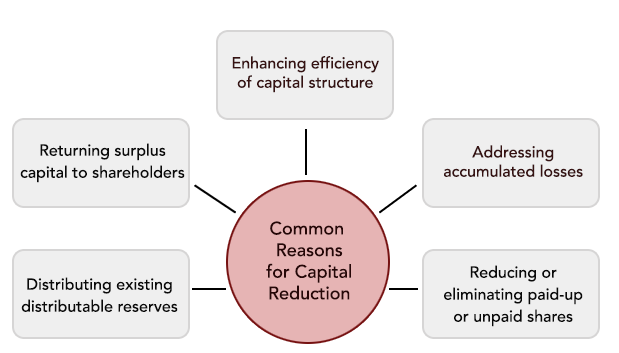
Brillio Technologies Pvt. Ltd (Appellant) vs. Registrar Of Companies & Anr (Respondent) [2]:
The Board of Directors at Brillio Technologies Pvt. Ltd decided to reduce the equity share capital by decreasing shares from non-promoter equity shareholders. This was done by using the Securities Premium Account to pay a premium. At an Extraordinary General Meeting, a special resolution was passed with 100 % of members present voting in favor of the share capital reduction. However, the National Company Law Tribunal (NCLT) rejected the application on various grounds. The company then successfully appealed to the National Company Law Appellate Tribunal (NCLAT), which addressed and resolved the grounds for dismissal in the following manner-
- No proper genuine reason has been given for the reduction of share capital: NCLAT stated that there is no law that a Company can reduce its capital only to reduce any kind of accumulated loss. With the aforesaid it cannot be said that the Appellant Company has not given any genuine reason for reduction of share capital.
- A consent affidavit from creditors has not been obtained: Since after service of notice, no representation has been received from the creditors within three months, NCLAT stated that it shall be presumed that they have no objection to the reduction.
- NCLAT stated an opinion that the SPA can be utilized for making payment to non-promoter shareholders.
- NCLAT held that selective reduction is permissible if the non-promoter shareholders are being paid fair value of their shares.
Tax Implications:
Dividend Distribution Tax Aspect:
This is like giving out profits to the shareholders. The money given to them through capital reduction is similar to dividends. According to section 2(22)(d) of the Income Tax Act 1961, this triggers a tax called dividend distribution tax, to the extent the company undertaking capital reduction possesses accumulated profits. With effect from April 1, 2020, dividend distribution tax was abolished in the hands of the company and dividend has become taxable in the hands of the shareholders as income from other sources.
Capital Gains Aspect:
Shares of a company are typically held as a ‘capital asset’ referred to in section 2(14) of the Income Tax Act by the shareholders. By virtue of capital reduction, shares are cancelled and shareholders’ interest in a company gets extinguished. This constitutes ‘transfer’ in the hands of shareholders within the meaning of section 2(47) of Income Tax Act. Thus, in the case Commissioner Of Income-Tax Madras vs G. Narasimhan[3], the Supreme Court stated that Capital gains tax implications shall arise only if the proceeds received upon capital reduction exceed the amount of accumulated profits.
Buy-Back:
Section 115 QA of the Income Tax Act, 1961 oversees taxes related to share buybacks. Previously, only shareholders faced capital gains taxes after receiving the buyback amount, allowing companies to avoid taxation. Now, both listed and unlisted companies are subject to an additional income tax at an effective rate of 23.296%. However, listed companies are exempt from Section 115 QA under the Securities and Exchange Board of India (Buyback of Securities) Regulations, 2018.
Even though buy-back can be considered as an alternative option to capital reduction for the company to repurchase its shares, it is crucial to understand that it comes with various restrictions on the process and the extent to which capital can be reduced. Section 68 of the Companies Act 2013 places stringent conditions, apart from requirement of special resolution, including maintenance of a buyback reserve and adherence to the debt-equity ratio. As per section 68(2) of Companies Act 2013, A company can’t buy back its shares or specified securities unless authorized by its articles and approved through a special resolution at a general meeting and provided it is not exceeding 25 % of the aggregate paid-up capital and free reserves. However, exceptions apply when the buyback is 10 % or less of the total paid-up equity capital and free reserves, buyback can be exercised by a board resolution.
Methods of Capital Reduction:
Most likely modes by which reduction in share capital is undertaken:
Reduction in face value of shares
In this method, the company decides to reduce the face value of shares leading to reduction of share capital without reducing actual number of shares.
Example: A company’s shares have a face value of Rs. 10 each. After a reduction to Rs. 5 per share, if shareholder owned 20 shares, shareholder’s original investment was Rs. 200 (20 shares * Rs. 10). Post-reduction, those shares shall now become Rs. 5 each. Number of shares held by the shareholder shall remain the same though the face value is reduced.
Reduction in number of shares
This method includes extinguishing a specific number of shares and these shares are cancelled and wiped out since a company can’t keep its own shares.
Example: A company has share capital of 100 shares of Rs. 10 each. If company reduces the number of shares to 50, a shareholder who owned 10 shares, having ownership of 10*10, i.e 100 will now own less shares even though the face vlaue of the shares shall remain the same.
Way Forward:
Capital reduction has, over the years, proved to be an effective mechanism for alignment of capital to address corporate needs. Having grasped the intricacies of capital reduction, it is imperative to acknowledge its flip side.
While capital reduction is a viable strategic move for companies, it necessitates patience due to its potentially time-consuming nature, often extending over a long period of time to conclude the process. Additionally, it incurs considerable costs, and the approval process rests at the discretion of the authorities, and this adds to a layer of complexity. Capital reduction in a company is akin to optimizing a computer’s storage by removing redundant files. Similar to cleaning up a computer’s storage space for better performance, capital reduction aims to enhance the company’s financial health and operational effectiveness.
- The article reflects the general work of the authors and the views expressed are personal. No reader should act on any statement contained herein without seeking detailed professional advice.
- Brillio Technologies Pvt.Ltd (Appellant) vs. Registrar of Companies & Anr (Respondent), Company Appeal (AT) No. 293 of 2019 of NCLAT.
- Commissioner Of Income-Tax. Madras vs G.Narasimhan [1999] 236 ITR 327
For any feedback or response on this article, the authors can be reached on atharva.amdekar@ynzgroup.co.in and ayushi.kalelkar@ynzgroup.co.in

Author : Atharva Amdekar
Atharva is an Associate at YNZ Legal. By qualification he is Bachelor of Commerce and Bachelor of Law from Mumbai University

Co-Author : Ayushi Kalelkar
Ayushi is experienced in corporate legal and heads the investment and deal advisory at YNZ Legal. She is also a member of Bar Council of Maharashtra & Goa. By qualification she is a Master in Commerce and Bachelor of Law from Mumbai University.