
Ready.. Set.. Go!
Sports is all about giving. It is hard to imagine how much effort an athlete has to put in consistently to brush up his/her skills and to keep improving. But this is not just one-way traffic as sports hardly fails to give it back. On a personal and global level sports have given us a lot. Sports in India is a major source of entertainment and income because of which many private investors organize various sports leagues such as Indian Premier League (IPL), Indian Super League (ISL), Pro Kabaddi etc. An ocean of opportunities is created for aspirants and this in a way helps to develop healthy international relations which injects a feeling of safety, security and sportsmanship in the country.
The globalization and commercialization of sports over the passing years has led to an integration between sports and law. Considering the amount of revenue, the field of sports generates and the pool of money that it pumps into our economy it is obvious that sports-related disputes are here to stay and are only going to grow in number.
As we say the chain is only as strong as its weakest link, it is essential to understand and address efficient dispute resolution in sports to make this chain of sports events which is one of the pillars of the Indian economy stronger than ever.
This brings us to how such disputes would be resolved with the help of current sports law scenario in India. Sports law is a niche area of practice in India. Currently there is no centralized legislation governing the area of sports. Provisions used in sports disputes are scattered into different laws like criminal law, labor law, contract law, intellectual property rights, tort law etc.
One of the recent developments has been the inauguration of Sports Arbitration Centre of India (SACI) by the Minister of Law and Justice, Kiren Rijiju in September 2021 in Ahmedabad, Gujarat.[2] SACI is intended to serve as an independent body to fast-track disputes in the sports sector.
To cut the chase, for a centralised dispute redressal mechanism for sports to function efficiently in India, there should be coordination between the Ministry and the governing bodies of various sports. Spreading awareness about this is the need of the hour and the ways of functioning of the SACI needs to be examined in detail.
Indian Sports Law:
State governments have been given the power to make legislation on sports under Seventh Schedule, List II, Entry 33 by the Constitution.[3] For promotion and regulation of Sports in India, the Ministry of Youth and Sports has been constituted by the parliament.
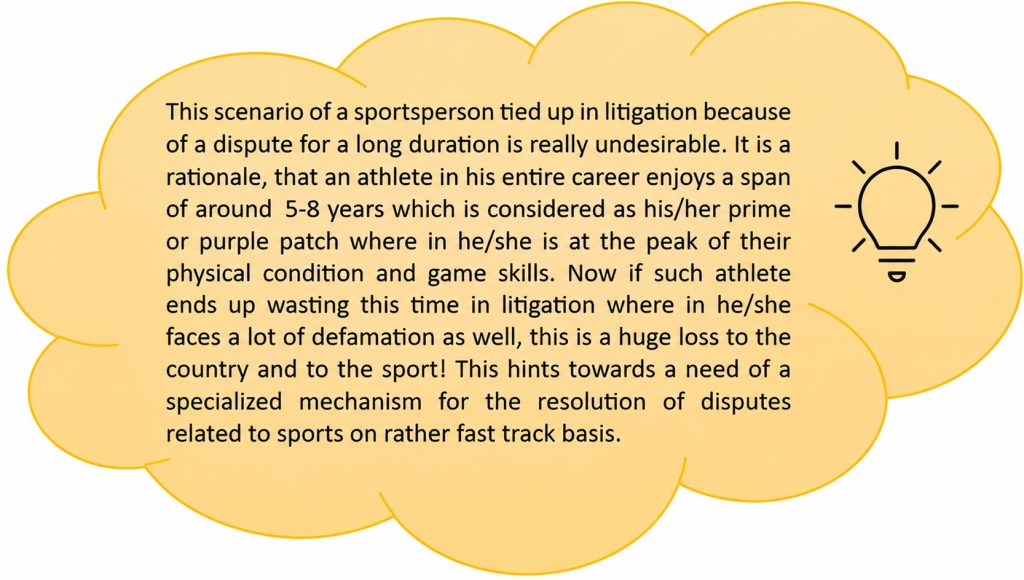
At the moment whenever a sports related dispute arises it is handled by the judiciary where it is tangled for many years. If there is an active arbitration clause, such dispute can be taken up for arbitration. But a well-organized system of arbitration for redressal of disputes dedicated to sports shall cut through the complexity which would be a win-win situation for athletes and courts of law. Sports related disputes in India are generally resolved by an internal commission appointed by sports federation or in the Supreme Court or the High Court.
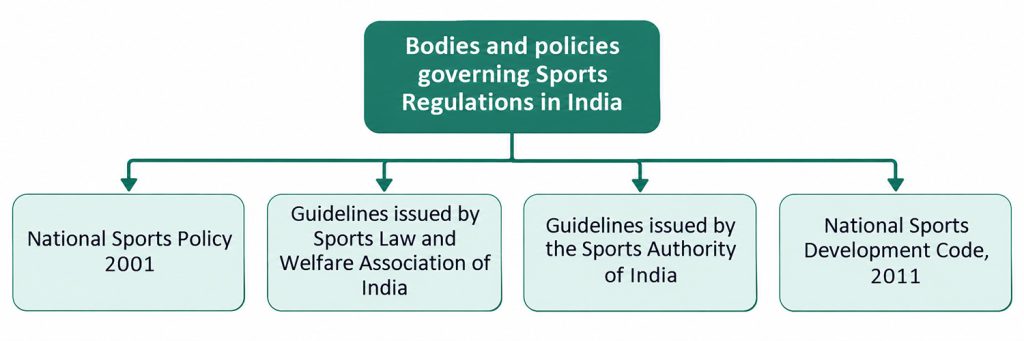
Even though such policies have been established, there is still need of an effective dispute resolution approach which shall reduce the overall time required for redressal of disputes pertaining to sports. This would help athletes to focus on their game performance.
Establishment of Court of Arbitration for Sports (ICAS) in 2011
In 2011, there were reports that under the Chairmanship of Dr. AR. Lakshmanan, a governing body was being set up the Indian Court of Arbitration for Sports (ICAS), was appointed.
These were the initial efforts made in India for establishment of an effective dispute redressal mechanism in India specially for the complex issues involved in sports.
However, the effectiveness of this Indian Court of Arbitration is not really known as all cases have been going to the regular judiciary only.
This aspect was specifically highlighted in the below mentioned cases involving Sarita Devi and Manika Batra.
Rajiv Dutta v Union of India decided by Delhi High Court in 2016[4]
In this case, a public interest litigation was filed by the senior advocate raising the issue of alleged illegal suspension of the Indian boxer named Sarita Devi from participation in the competitions of Amateur International Boxing Association (AIBA) and alleged failure of Union of India (Department of Sports), the Indian Olympic Association and Boxing India to challenge such suspension. Sarita Devi refused to accept a bronze medal at the 2014 Asian Games as she believed that she was cheated by the judges in the semi-final. Her actions violated the rules of International Olympic Committee (IOC) and AIBA regarding refusal to accept medals or making public statements regarding the officials. Sarita Devi was subsequently banned by the AIBA from boxing for one year and fined $1,000, while her coaches were banned for two years. Considering her situation, senior advocate Mr Rajiv Dutta filed a litigation and prayed that it was necessary to ensure that clear guidelines are formulated for dispute settlement within the sports bodies.
The petitioner sought a direction to the Respondent No.1 (Union of India) to take due cognizance of the Rules and Regulations framed by the Court of Arbitration for Sports (CAS) situated at Switzerland and to direct the respective Federations and Associations in India to incorporate the CAS Arbitration clause within their respective rules/regulations/bye-laws.
It was prayed in the petition that Union of India should be directed to include CAS arbitration clause in rules and regulations of National Sports Federations by incorporating a provision in the National Sports Development Code of India, 2011 providing a remedy of appeal to CAS, as it would empower sports persons in India to appeal against the unjust and unlawful decisions of international sports bodies.
While the Court acknowledged the fact that the dispute could be better resolved by making an appeal to the Court of Arbitration of Sports but no remedy was available for such appeal to CAS against the decision of the International Sports Bodies like AIBA. The Court further recorded that:
Though no mandamus can be issued to the Respondent No. 1 to incorporate such provision for remedy of appeal to CAS against the decisions of the International Sports Bodies, in the light of the facts and circumstances that have been brought to our notice in the present case, we deem it appropriate to direct the Respondent No. 1 to consider the contents of this petition as a representation and take an appropriate decision in accordance with law.
Guidelines issued by Ministry in 2016
In response to the aforesaid direction by the Delhi High Court, the Ministry of Youth Affairs and Sports suggested guidelines for Safeguarding the interests of sportspersons and provision of effective Grievance Redressal System in the Constitution of National Sports Federations in 2016.[5] The Ministry of Youth Affairs and Sports recognizes one sports federation at the national level for each sport being played in the country. Ministry of Youth Affairs and Sports has advised all National Sports Federations (NSFs) to consider that:
- an effective, transparent and fair grievance redressal system and mechanism is provided by each NSF in its constitution/byelaws for expeditious settlement of any disputes arising between the sports persons.
- a specific provision is made by each NSF that any sports person aggrieved by any decision or action of an International Sports Association/ Federation imposing any penalty or punishment by way of disciplinary action or otherwise may raise that dispute before the Court of Arbitration for Sports (CAS) which is considered as the Supreme Court of Sports Arbitration based in Switzerland.
Inspite of such guidelines, no specific provision has been made by federations.
Manika Batra vs Table Tennis Federation of India[6]
The harassment faced by an athlete again came to light in a petition filed by Manika Batra. Manika Batra, the petitioner, is an Indian Table Tennis player ranked world number 39 in the International Table Tennis Federation of May 2023. The TTFI, Respondent in the case, is the National Sports Federation for the sport of table tennis in India. Manika Batra had pleaded that:
- she was pressurized to concede a match by a national coach (another respondent) appointed by the TTFI at the Asian Olympic Qualifiers in March 2021.
- This attempt at match-fixing was done to enable a player undergoing personal coaching at the academy of the coach (respondent) to qualify for Tokyo Olympics.
- Inspite of the serious allegation, TTFI even failed to inquire into the written complaint filed by Manika Batra regarding this.
- Instead, the TTFI introduced a set of Rules and Regulations for National Camp, which mandated compulsory attendance of players at the National Coaching Camps for selection at international events.
Manika Batra believed that such rules had been framed with the malicious intent to exclude her from participating in further tournaments. This conduct of TTFI was noted by the Court and an independent committee was appointed by the High Court to examine her complaints. It was highlighted that TTFI has been taking all possible steps to shelter its own officials, as opposed to promoting the interest of its players. Considering that the suspension of activities of the TTFI would be highly detrimental to the interests of the sportspersons specially because important tournaments were scheduled later on, the court was of the opinion that till the further inquiry is carried out, a Committee of Administrators is to be appointed to manage TTFI.
Reports indicate that the matter is still not completely concluded inspite of lapse of over 2 years and the machinery that was required to be adopted by petitioner in this case was again a writ petition, instead of any specialized mechanism like arbitration for speedy resolution.
Arbitration in Sports Law:
The definition of arbitration is stated under section 2(1)(a) of the Arbitration and Conciliation Act, 1996. Arbitration is one of the methods of Alternate Dispute Resolution (ADR). It is a process of resolving disputes by appointing an impartial third party called the arbitrator or panel of arbitrators wherein the dispute is submitted by parties for arbitration and the arbitration award is binding upon the parties. It is usually a much faster and less formal process as compared to the court procedures and is the way forward when it comes to deciding disputes related to sports laws.
The International Aspect-
Many countries the United States of America, the United Kingdom, European Union, Australia, and many others have shifted their approach towards redressal of sports disputes and moved towards arbitration since many decades. Court of Arbitration of Sports (CAS) which is also referred to as the Sports Supreme Court of the World is an international tribunal set up in 1983 7in Lausanne, Switzerland by the International Olympic Committee (IOC).[7] CAS has around 300 arbitrators with expertise and technical knowledge in Sports from 87 countries.
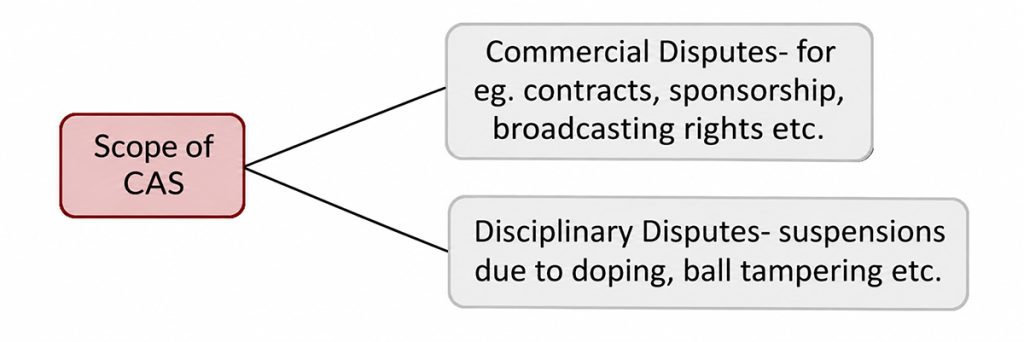
It is essential to include a clause under the contract giving CAS the jurisdiction to adjudicate the dispute so as to invoke arbitration under CAS. The sole objective of CAS is to provide quick redressal of sports disputes. The CAS has to resolve disputes within a fixed time period of 6-12 months as evident from the case law below.
Galatasaray v UEFA decided by CAS in 2016[8]
Galatasaray, the appellant in this case was a Turkish football club. Union of European Football Associations was the respondent. UEFA organised major football competitions in Europe like the UEFA Champions League and the UEFA Europa League which have worldwide viewership. The dispute arose from the alleged breach of UEFA’s Club Licensing and Financial Fair Play Regulations (CL&FFP Regulations) by Galatasaray.
In 2014 an investigation was conducted by UEFA’s Club Financial Control Body (CFCB) into Galatasaray’s finances. It was found that the club had breached the CL&FFP Regulations by failing to comply with the break-even requirement, which states that clubs cannot spend more than they earn over a given period. The CFCB imposed sanctions on Galatasaray, which included a fine of €2 million, a reduction in the number of players the club could register for UEFA competitions, and a limitation on the amount of wages the club could pay to its players for two seasons. Aggrieved by these sanctions, an appeal was filed by Galatasaray before the Court of Arbitration for Sports (CAS) to challenge UEFA’s decision.
Amongst many other issues, one of the key issues in the case was whether Galatasaray had breached UEFA’s CL&FFP Regulations and whether the sanctions imposed by UEFA were proportionate to the severity of the breach?
Galatasaray argued that the CFCB’s investigation had not been conducted in accordance with the relevant regulations and that the sanctions imposed were disproportionate. In 2016, the Court of Arbitration for Sport (CAS) upheld UEFA’s decision, stating that the CFCB’s investigation had been conducted in accordance with the relevant regulations and that the sanctions imposed were proportionate to the severity of the breach. The CAS also noted that Galatasaray had failed to provide evidence to refute the CFCB’s findings. Therefore, the CAS order was to dismiss the appeal made by Galatasaray and to uphold the sanctions imposed by UEFA.
In the above case, CAS gave its decision in a span of just six and a half months thereby reiterating its efficiency in providing a speedy resolution to disputes of high magnitude in the sports industry.
The Finish Line:
With the establishment of Sports Arbitration Centre of India in 2021, we can only hope to reach the finish line soon. We must remember that the Commission set up in 2011 was not fruitful in setting up a Court of Arbitration for Sports in India. The guidelines by the Ministry of Youth Affairs and Sports were also not taken up seriously by any of the sport federal institutions.
As there is no centralized legislation related to sports in India, this model found it difficult to derive its powers from laws scattered in multiple legislations which is the major reason why it slowed down.
We all know the amount of love sport gets in India and also the variety of games that are played in India, originated in India and are now played abroad as well. But this is just the tip of the iceberg when we talk about the love that athletes get in India. We can literally see people applying for leaves from work, school or youngsters bunking college literally in the name of illness and emergencies on the big match days. There are fans who even worship their favourite sports idols. In India, the roar of the crowd and the thrill of the game are the waves of sports that make people forget every other issue and unite in solidarity.
It is common for teams and players to come up against legal issues and only if they are timely relieved, they can get back to the sport and give all of us a performance that we crave to watch. All of this leaves the door open for us to think the amount of comfort and ease that a uniform dispute redressal mechanism would bring to athletes and the overburdened courts. The CAS has brought a lot of positives, but we need to understand not all players or teams can afford to get their disputes raised before the CAS. By setting up with SACI, one now looks forward to a centralised dispute redressal mechanism in India specially for sports, where we can spend maximum time enjoying our favourite matches and at the same time protecting the integrity of the sports as a whole.
For sports to thrive and athletes to be at their prime,
Dispute redressal must keep pace with time.
We need to ensure disputes are resolved with speed,
Then India’s sporting dreams can succeed!
- The article reflects the general work of the author on the date of publication and the views expressed are personal. No reader should act on any statement contained herein without seeking detailed professional advice.
- https://timesofindia.indiatimes.com/sports/more-sports/others/kiren-rijiju-inaugurates-countrys-first-sports-arbitration-centre-says-it-will-have-far-reaching-impact/articleshow/86532956.cms
- https://www.mea.gov.in/Images/pdf1/S7.pdf
- Rajiv Datta v Union of India WP (C) 8734/2014/
- Safeguarding the interests of sportspersons and provision of effective Grievance Redressal System in the Constitution of National Sports Federations_.pdf(yas.nic.in)
- Manika Batra v. Table Tennis Federation of India, W.P. (C) 10590/2021
- https://www.tas-cas.org/en/general-information/index/
- Galatasaray Sportif v UEFACAS 2016/A/4492
For any feedback or response on this article, the authors can be reached on Nandita.Damle@ynzgroup.co.in , atharva.amdekar@ynzgroup.co.in and charusheela.vispute@ynzgroup.co.in

Author : Nandita Damle
Nandita is a Legal Advisor at YNZ Legal. She is also a member of Bar Council of Maharashtra & Goa. By qualification she has completed Bachelor of Arts in Political Science and Bachelor of Law from Mumbai University.

Co-Author : Atharva Amdekar
Atharva is an associate at YNZ Legal. By qualification he is Bachelor of commerce and Bachelor of Law from Mumbai University

Co-Author : Charusheela Vispute
Charusheela is heading Estate planning and trademark. Having specialisation in property and testamentary matters. By qualification she is Bachelor of Arts and Bachelor of Law from Mumbai University.