
Introduction [1]
When the supply chain of an ambitious manufacturing startup collapsed due to a major cash crunch, two parties raced to the courtroom. One, a bank that had extended a term loan; the other, a vendor who had supplied raw materials for months without receiving payments. Both claimed entitlement, but only one secured a seat at the decision-making table. What made the difference?
The Insolvency and Bankruptcy Code, 2016 [2] (Code) has revolutionized the way corporate debt resolution is approached in India. But at its core lies a critical distinction between financial creditors and operational creditors. This categorization doesn’t just define the nature of the debt it determines who controls the resolution process, who gets priority in repayment, and who ultimately influences the fate of the corporate debtor.
II. Statutory Definitions Under the IBC
The IBC recognizes two broad classes of creditors:
Financial Creditor – Defined under Section 5(7) of the Code as “any person to whom a financial debt is owed and includes a person to whom such debt has been legally assigned or transferred.” A Financial Creditor is someone who has extended funds to a corporate debtor as a loan, guarantee, or by buying bonds, with the expectation of repayment with value over time. These creditors typically include banks, non-banking financial companies (NBFCs), bondholders, or institutions providing credit facilities.
“Financial Debt” (as per Section 5(8) of the Code): A Financial Debt is characterized by disbursement of funds against the consideration for time value of money. This includes:
- Money borrowed against interest.
- Debentures or bonds.
- Credit facilities or term loans.
- Any liability arising from derivative transactions or guarantees
Operational Creditor – Defined under Section 5(20) of the Code as “a person to whom an operational debt is owed and includes any person to whom such debt has been legally assigned or transferred.” An Operational Creditor is someone who owes money for supply of goods or services including employment, as part of the day-to-day functioning of the business. Unlike financial creditors, operational creditors are not concerned with investment or repayment over time but with payment for operational obligations. Operational Debt (as per Section 5(21) of the Code):
An “Operational Debt”, on the other hand, arises from:
- Provision of goods or services.
- Employment dues.
- Statutory dues owed to the government (e.g., taxes).
These debts reflect the working liabilities of the business and usually relate to commercial arrangements or service contracts.
In Prashant Agarwal v. Vikash Parasrampuria [3], the National Company Law Appellate Tribunal (NCLAT) held that interest on delayed payments, when expressly agreed upon in invoices or contracts, forms part of the “debt” under Section 3(11) of the Code. As a result, both the principal amount and the agreed interest can be clubbed to meet the Rs. 1 crore default threshold prescribed under Section 4 of the Code for initiating Corporate Insolvency Resolution Process(CIRP). The Tribunal clarified that this applies especially to operational creditors under Section 9, provided the interest obligation is clearly stipulated. Similarly, for financial creditors under Section 7, even the interest component alone, if due, may be sufficient to trigger insolvency proceedings. However, in the absence of a clear agreement on interest, only the principal debt would be considered. The ruling underscores the importance of proper documentation when relying on interest to meet the statutory threshold.
III. Rights and Role of Financial Creditor in Corporate Insolvency Resolution Process (CIRP)
Financial Creditors play a central and influential role in the CIRP. They are the primary members of the Committee of Creditors (CoC) and possess voting rights that are directly proportional to the amount of debt owed to them. This significant leverage allows them to make crucial decisions on the resolution plan, giving them the power to approve, reject, or modify proposals. Consequently, Financial Creditors have substantial control over the fate of the corporate debtor during the CIRP.
IV. Rights and Role of Financial Creditor in Corporate Insolvency Resolution Process (CIRP)
Operational Creditors are generally not part of CoC, unless their debt constitutes more than 10% of the total debt of the company. Although they have the power to initiate the insolvency process under Section 9 of the Code, their influence in the actual resolution process is very limited. Under the Code, operational creditors are legally entitled to receive at least the amount they would get if the company was liquidated under section 53. This is stated in Section 30(2)(b) of the IBC and Regulation 38 of the CIRP Regulations. However, in practice, they often receive much less because the liquidation value is usually low, and most of the recovered amount is allocated to financial creditors by the Committee of Creditors (CoC). This disparity has raised concerns about equitable treatment and bargaining power within the insolvency framework.
V. Procedure of Initiating Insolvency
Procedure of Initiating Insolvency Financial Creditors (Section 7 IBC)
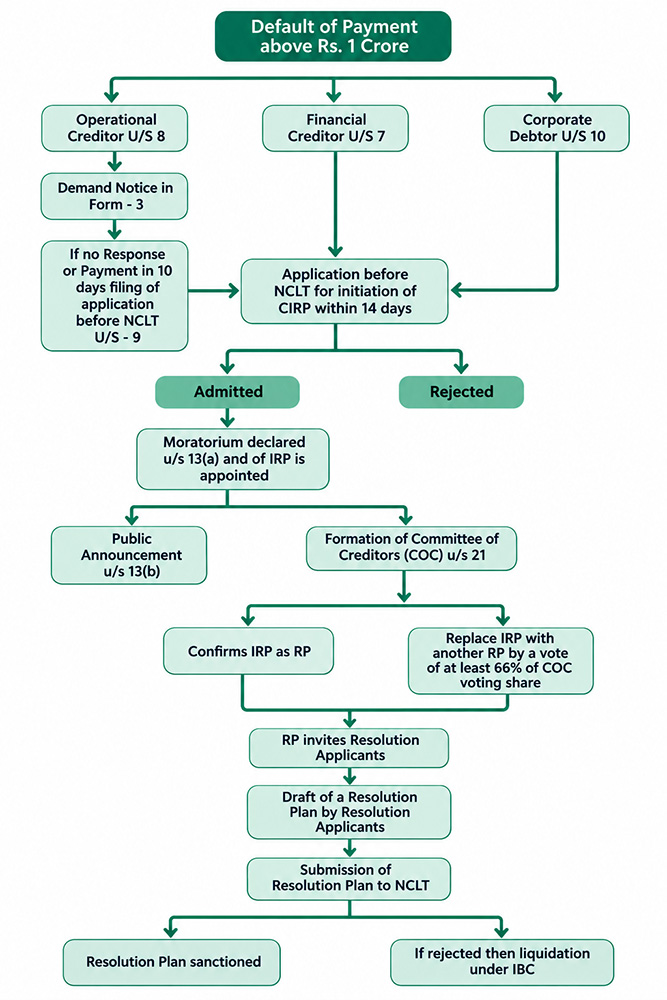
Under Section 7 of the IBC, a Financial Creditor is empowered to directly file an application to initiate CIRP with the Adjudicating Authority (NCLT) upon the occurrence of a default. Unlike an Operational Creditor, there is no prerequisite to serve a demand notice to the corporate debtor. The application is primarily based on the existence of a default, which can be substantiated by records such as financial contracts or information from credit information systems, thereby enabling a swifter commencement of the insolvency proceedings. However, as per Section 4 of the Code the default must be of at least ₹1 crore, as prescribed under the Code, for the application to be maintainable.
In Laxmi Pat Surana v. Union Bank of India & Anr [4].,the Supreme Court held that a financial creditor can initiate insolvency proceedings under Section 7 of the Code against a corporate guarantor, even if the principal borrower is not a corporate person. The Court reasoned that under Section 128 of the Indian Contract Act, the guarantor’s liability is co-extensive with that of the borrower. Therefore, when a default occurs, the liability of the corporate guarantor is triggered, making it liable as a corporate debtor under the Code. The Court rejected the argument that proceedings under Section 7 are not maintainable merely because the original loan was given to a non-corporate entity.
It clarified that default by the principal borrower is sufficient to proceed against the guarantor, irrespective of the borrower’s legal status. This ruling broadens the scope of insolvency proceedings and strengthens creditor rights against corporate guarantors.
Operational Creditors (Section 9 IBC)
For an Operational Creditor to initiate the CIRP, a specific and mandatory procedure must be followed under the Code. As per Section 8 of the Code, the creditor must first serve a demand notice under section 8(1) of the Code of the unpaid operational debt on the corporate debtor. Upon receipt of this notice, the debtor is granted a period of ten days to respond with either proof of the payment made or the existence of a prior-existing dispute. It is only after the corporate debtor fails to provide a satisfactory response within this stipulated timeframe that the Operational Creditor can, under Section 9 of the Code, file an application to the Adjudicating Authority (NCLT) to commence the CIRP. In accordance with Section 4 of the Code, similar to financial creditors, the minimum threshold of default must be ₹1 crore for the application to be admitted. This procedural safeguard ensures that only cases with a clear and undisputed debt proceed to insolvency proceedings.
Conclusion:
The division between financial and operational creditors under the Insolvency and Bankruptcy Code, 2016, has brought structure and clarity to India’s corporate insolvency framework. It acknowledges the differing roles and risks these creditors undertake and grants financial creditors greater control over key decisions, based on the assumption that they are better equipped to evaluate long-term viability and recovery prospects. However, in practice, this framework often leaves operational creditors—particularly small suppliers, employees, and service providers—with limited influence and insufficient remedies. While the Code guarantees them at least the liquidation value, this minimum protection frequently falls short in addressing the economic realities they face due to prolonged non-payment.
It is important to recognize that the IBC remains an evolving law. As commercial dynamics grow more complex, so must the legal framework. Encouragingly, the judiciary has played an active role in interpreting the Code in a manner that is pragmatic and accessible, often attempting to clarify legal provisions in terms that litigants can understand and rely upon.
- The article reflects the general work of the author on the date of publication and the views expressed are personal. No reader should act on any statement contained herein without seeking detailed professional advice.
- Insolvency Bankruptcy Code, 2016 (Act no. 31 of 2016)
- Company Appeal (AT) (Ins) No. 690 of 2022
- Civil Appeal No. 5505 of 2020, (2021) 8 SCC 481
For any feedback or response on this article, the authors can be reached on darshan.mundane@ynzgroup.co.in and shravani.joshi@ynzgroup.co.in

Author : Darshan Mundane
Darshan is a Legal Associate at YNZ Legal. By qualification he is Bachelor of Legal Science and Bachelor of Law from Government Law college, Mumbai University.

Co-Author : Shravani Joshi
Shravani is Legal Associate at YNZ legal. By qualification she is Bachelor of Commerce and Bachelor of Law from Vivekanand College.