
1. INTRODUCTION:
Eating out is becoming a norm these days and each of us have our own favourite outlets. Be it a small-time outlet selling Potato Fries near a college or a lavish restaurant serving customized portions of dishes, each outlet has its set of loyal customers. As soon as the publicity of a food service establishment rises, so does the number of its outlets across the city or sometimes across states, especially in metro cities.
While the number of outlets are increasing, here are certain points that the food service establishments need to know while expanding as provided under Regulations (defined below).
Regulation 9 under the Food Safety and Standards (Labelling and Display) Regulations, 2020 (the “Regulations”) passed under the Food Safety and Standards Act, 2006 (“Act”) provides for the requirements with respect to ‘display of information’ in food service establishments.
It is important to note the significance of Article 21 of the Indian Constitution, which protects the right to food safety, in addition to these rules. Article 21, a fundamental right, emphasises the significance of guaranteeing all citizens access to safe and wholesome food. It is important to note the significance of Article 21 of the Indian Constitution, which protects the right to food safety, in addition to these rules.
Article 21, a fundamental right, emphasises the significance of guaranteeing all citizens access to safe and wholesome food.
Food safety, protected by Article 21 of the Indian Constitution, is crucial for several reasons. It ensures the protection of public health by enforcing regulations and maintaining high hygiene standards, preventing foodborne illnesses. By adhering to food safety regulations, establishments contribute to customer satisfaction, building trust and confidence. Moreover, these measures empower consumers, enabling them to make informed choices about their dietary needs and potential health risks.
2. SURVEY:
Consumer preferences regarding labelling and information display in food service establishments play a vital role in shaping dining choices. To gain insights into these preferences, a survey was conducted by the authors to understand consumer awareness of regulations, consideration of nutritional information, the impact of displayed information on dining preferences, and perceptions of different food service establishments.
Brief summary of question and responses:
a) Question: What comes to your mind when you read the term ” food service establishments”?
It cogently came out that people have different perceptions of what a ” food service establishment” is. Most of them ( 90 %) associated i t with good old restaurants. Some mentioned cafeterias ( 46 . 7 %) and fast- food chains ( 43 . 3 %) too. Interestingly, catering services caught the attention of 53 . 3 % of the respondents, while 20 % thought of hospital cafeterias or catering. A few even mentioned food trucks and cloud kitchens, accounting for 3 . 3 % of the responses. It’ s clear that the food service industry is quite diverse, and we need to communicate and understand i ts different types better.
b) Question: Are you aware of the regulations pertaining to labeling and display of information in food service establishments?
When it comes to regulations on labelling and display, the responses were mixed. Around 36.7% of the participants knew about these rules, but 30% were unsure, and 33.3% had no idea at all. It’s essential to spread awareness about these regulations to ensure everyone is on the same page.
c) Question: Do you actively look for and consider the nutritional information displayed on menus when making food choices? 4
The survey produced some intriguing results about nutritional data. About 50% of those surveyed actively look for and take it into account while examining menus. This is undoubtedly encouraging for those who value making wise eating decisions and are health conscious. However, a portion of the population (23.3%) just partially takes into account nutritional information, and a further group (26.7%) doesn’t give it much thought at all.
3. FOOD SERVICE ESTABLISHMENTS:
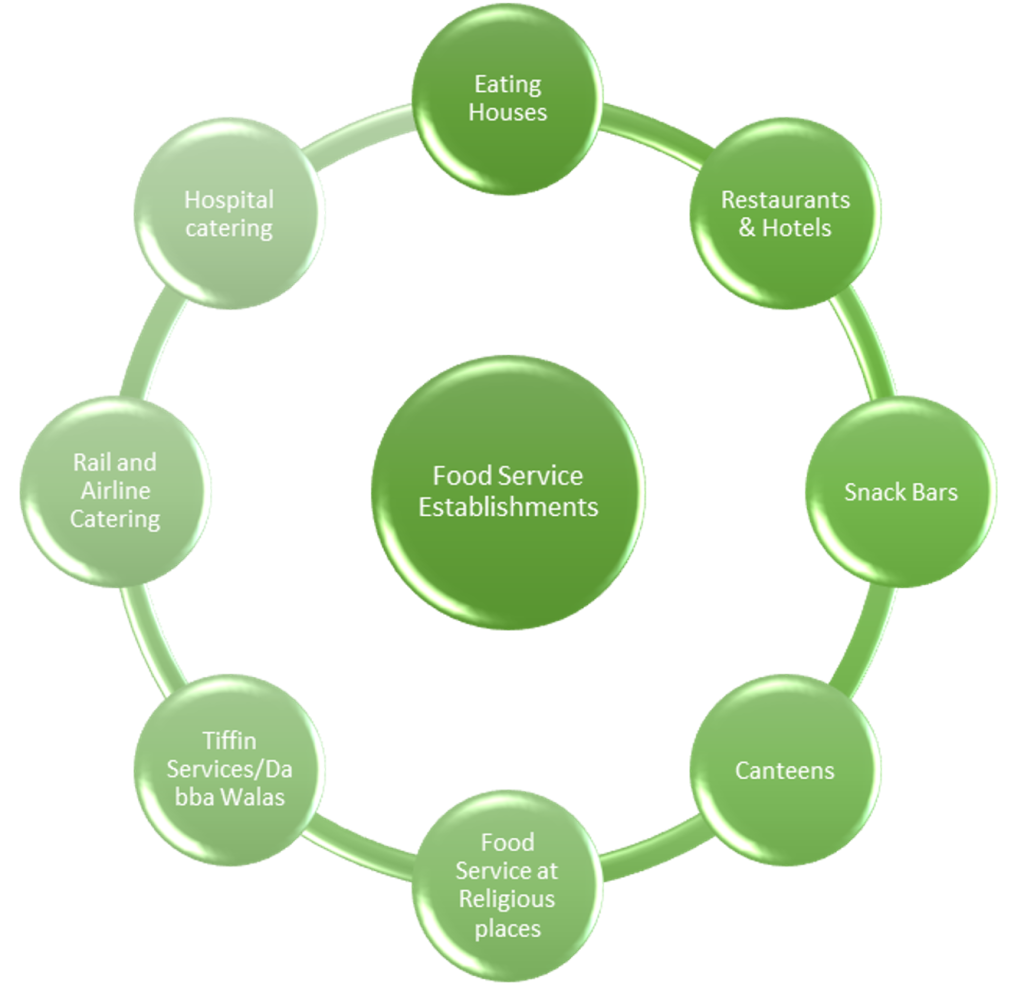
While the Act has defined ‘food business’, neither the Act nor any rules and regulations passed thereunder seem to have defined the term ‘food service establishments’.
A food service establishment can mean a place where food is not only being handled, prepared and cooked but also served for consumption. As referred in Part V of the Food Safety And Standards (Licensing And Registration Of Food Businesses), Regulations 2011 it includes premises where public is admitted for repose or for consumption of any food or drink or any place where cooked food is sold or prepared for sale.
4. DISPLAY OF INFORMATION APPLICABILITY
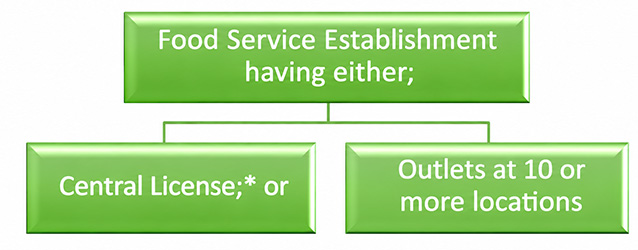
*A Central License is applicable to food businesses operating on a larger scale, such as large-scale manufacturers, importers, exporters, operators of food establishments in airports and seaports, etc. If the food business operator operates in multiple states and has an annual turnover above a specified threshold (such as ₹20 crores or as notified by the government), or engages in certain specified activities, they are required to obtain a Central License. The Central License is issued by the Food Safety and Standards Authority of India (FSSAI) or the designated authority under the FSSAI.
5. DISPLAY OF INFORMATION REQUIREMENTS
Food Service Establishments having Central license or outlets at 10 or more locations shall display the below mentioned information:
| Calorific Value | • To be displayed specified against the food items displayed on the menu, cards, boards or booklets • In kcal per serving and serving size |
| Calorific Requirement | • To be displayed as: “An average active adult requires 2,000 kcal energy per day, however, calorie needs may vary” |
| Food Allergens | • Foods and ingredients which are known to cause allergy shall be declared separately as ‘contains….: • Cereals containing gluten; • Crustacean and their products • Milk, eggs, fish, nuts, soybeans and each of their products; • Sulphite in concentrations of 10mg/kg or more (to be declared as sulphite) • Presence of ingredients due to cross-contamination shall be put in as “may contain….” • Exceptions: agricultural commodities |
| Logo | • For Veg • For Non-Veg |
| Nutritional Information | • Nutritional Properties including definitions of ‘Sugars’, ‘Added sugars’, ‘fat’, ‘dietary’ ‘fiber’, ‘nutrient’ • Energy, protein, carbohydrates, sugars, fat, cholesterol, and salt are all to be listed on the label per 100g/ml or serving. if >0.5%, saturated/trans fat “not more than” Metric vitamins and minerals, serving dimensions, package portions, and other nutrients. • Single-ingredient unprocessed/matured processed foods, some beverages, spices, additives, and alcohol are exempt from labelling requirements. Trans/saturated fats must be disclosed in oils/fats. For claims, nutritional data is required. Tolerance: 10% of nutrients claimed to be within shelf life. |
Recognising the importance of menu labelling in restaurants, the Food Safety and Standards Authority of India (FSSAI) has released a guidance document[1] on the topic. It is essential that consumers have access to correct information on nutritional value and calorie count given India’s rising tendency of eating out. The ability to make educated decisions that are in line with their dietary preferences and health requirements is provided by menu labelling.
6. RESPONSIBILITY ON E-COMMERCE FOOD BUSINESS OPERATORS:
E-commerce Food Business Operators such as Zomato, Swiggy and ONDC also have the responsibility to get the aforementioned information from respective Food Business Operators and provide on their website wherever applicable.
7. EXEMPTION
These provisions shall not be applicable to the following:
| Caterers and food service premises operating for less than 60 days in a calendar year | • This may include event caterers, seasonal food joints etc. • The 60-day threshold can be consecutive or non-consecutive |
| Self-serve condiments that are free of charge and not listed on the menu | • This may include the salt, pepper and mints, mukhwas served at the food service establishments |
| Special-order items or modified meals | • This may include the customized orders from the menus and specific cooking instructions from the customers at restaurants |
8. PENALTY:
| Offence | Penalty |
|---|---|
| Failure to comply with requirements²: Failure of food business operator or importer to comply with requirements of the Act or the rules or regulations issued thereunder. | Liable to a penalty which may extend to two lakh rupees |
| Punishment for unsafe food³: Any person who, whether by himself or by any other person on his behalf, manufactures for sale or stores or sells or distributes or imports any article of food for human consumption which is unsafe, shall be punishable- i) If the failure or contravention does not result in injury, ii) Where such failure or contravention results in a non-grievous injury, iii) Where such failure or contravention results in a grievous injury, iv) Where such failure or contravention results in death, | i) With imprisonment for a term which may extend to six months and also with Fine which may extend to one lakh rupees ii) Imprisonment for a term which may extend to one year and also with fine which may extend to three lakh rupees. iii) Imprisonment for a term which may extend to six years and also with fine which may extend to five lakh rupees. iv) With imprisonment for a term which shall not be less than seven years, but which may extend to imprisonment for life and also with fine which shall not be less than ten lakh Rupees. |
| Punishment for subsequent offences: If any person, after having been previously convicted of an offence punishable under this Act subsequently commits and is convicted of the same offence | (i) Twice the punishment, which might have been imposed on a first conviction, subject to the punishment being maximum provided for the same offence. (ii) A further fine on daily basis which may extend up to one lakh rupees, where the offence is a continuing one; and (iii) His licence shall be cancelled. |
9. Recent Reports:
The Food Safety and Standards Authority of India (FSSAI) has recently suspended the licenses of 15 Food Business Operators (FBOs) for failing to comply with regulations regarding the display of nutritional values on their menus[4]. FSSAI introduced regulations in 2020 that require FBOs with a central license and outlets in 10 or more locations to provide information such as calorific value (in kcal per serving and serving size), nutrition details, allergen information, and ingredient listings for each menu item displayed.
The suspension of licenses serves as a strong measure by FSSAI to enforce compliance with these regulations. The aim is to ensure transparency and provide consumers with essential information to make informed choices about the food they consume. By displaying nutritional values and other relevant details, consumers can better understand the composition and potential allergens present in the food items.
FBOs must abide by these rules and take the appropriate actions to update their menus and booklets with the essential information. The FSSAI’s action highlights the significance of adhering to food safety and labelling regulations for the sake of consumer rights and public health.
10. Conclusion [5]:
Considering the scenario of regulating Indian food business, up until now, the focus of regulators, food businesses and even consumers, has mainly been on the labelling and packaging requirements, especially for food as products than service. Customers’ choice of food service outlets is greatly influenced by prominently displayed accurate and thorough information about food goods, as clearly demonstrated by the survey conducted by the authors. When the question Are you more likely to visit a food service establishment that prominently displays accurate and comprehensive information about their food products? was raised, 73.3% of consumers indicating a preference for such establishments. Trust and loyalty are fostered by clear and informative labelling practises. Another 23.3% of respondents said they might have, taking into account the data and other variables. Only 3.3% of respondents said that the information displayed had no influence on their choices.
While the Regulations are in place, so far for food service industry the focus had only been with respect to licensing than on the disclaimers and display information. This scenario might change in near future with increasing number of allergies and awareness of the same in consumers and when the Authority having power to specify other food service establishments also to comply with the requirements specified in these regulations from time to time in addition to those mentioned above.
- Guidance_Note_Labelling_23_02_2022.pdf (fssai.gov.in)
- Section 55 of the Act
- Section 59 of the Act
- https://retail.economictimes.indiatimes.com/news/food-entertainment/food-services/fssai-suspends-licences-of-15-food-business-operators-for-not-displaying-nutritional-value/94039320
- “Food Authority” means the Food Safety and Standards Authority of India established under section 4.
For any feedback or response on this article, the authors can be reached on siddhi.mhamunkar@ynzgroup.co.in sanika.phatak@ynzgroup.co.in and
Ayushi.Kalelkar@ynzgroup.co.in

Author : Siddhi Mhamunkar
Atharva is an Associate at YNZ Legal. By qualification he is Bachelor of Commerce and Bachelor of Law from Mumbai University

Co-Author : Sanika Phatak
Ashvini is a Partner- Corporate Legal Advisory, She is experienced in corporate litigation and non- litigation. She is experienced in Corporate litigation and non- litigation. She provides training required under POSH Act.

Co-Author : Ayushi Kalelkar
Ashvini is a Partner- Corporate Legal Advisory, She is experienced in corporate litigation and non- litigation. She is experienced in Corporate litigation and non- litigation. She provides training required under POSH Act.