
We as humans can sometimes go to any extent for our entertainment, including entertainment at the cost of other living beings. Our earlier article AM I AUDIBLE? BY INHUMANELY TREATED ANIMAL, published on December 28, 2022 covered this aspect specifically.
Under that article we had referred to one of the important cases related to animal cruelty – Animal Welfare Board of India -vs- A. Nagaraja and Others [(2014) 7 SCC 547] (“A. Nagaraja case”). Curious to dive deeper? Find the backstory at this captivating l https://www.linkedin.com/feed/update/urn:li:activi ty:7013822207055261696 Under A. Nagaraja case, a division bench of Supreme Court of India (Civil Original Jurisdiction) delivered a judgement in 2014 banning two common sports namely Jallikattu and Bullock Cart Race (“Sports”) practiced in states of Tamil Nadu and Maharashtra respectively. However, a notification issued by the Ministry of Environment, Forest and Climate Change on January 7, 2016 (“Notification”), carved an exception which specified that bulls might be continued to be trained as performing animals at events such as Jallikattu in Tamil Nadu and Bullock Cart Races in Maharashtra, Karnataka, Punjab, Haryana, Kerala and Gujarat in the manner by the customs of common community or practice traditionally under the customs or as part of culture in any part of the country subject to certain conditions which will reduce pain and suffering of bulls.
A writ petition was again filed in 2016 challenging the Notification and on February 2, 2018, The Supreme Court of India (Civil Original Jurisdiction) passed an order and requested Chief Justice of India to constitute a bench of 5 Hon’ble judges in order to provide judgement on the pending writ petitions.
And finally, on May 18, 2023, The Supreme Court of India under its Civil Original Jurisdiction, by 5 Hon’ble judges namely J. K.M. JOSEPH, J. AJAY RASTOGI, J. ANIRUDDHA BOSE, J. HRISHIKESH ROY, J. C.T. RAVIKUMAR (“the Constitution Bench”) delivered its judgement on the questions raised by the petitioners through writ petitions.
1. What is greenwashing and why is it a concern?
Greenwashing refers to the practice where companies mislead consumers about their environmental practices or the sustainability of their products.
In India Guidelines for Prevention and Regulation of Greenwashing or Misleading Environmental Claims, 2024 (“Guidelines”)[4] represent a significant step in this direction. These Guidelines were issued by the Central Consumer Protection Authority (“CCPA”) to address misleading environmental claims and protect consumers. They form part of a broader regulatory framework under consumer protection law and aim to bring clarity, accountability, and transparency to sustainability related advertising.
Flow of events is provided below for better understanding:
May 18, 2023 – Supreme Court of India through its 5 bench judges delivered the judgement.
February 2, 2018 – Order is passed by division bench for transfer of the case to bench of 5 learned Judges.
2016 – Writ petition filed challenging the Notification.
January 7, 2016 – Notification allowing the Sports with certain exceptions.
May 7, 2014 – A. Nagaraja case.
This recent judgement delivered by Supreme Court of India through its bench of 5 learned Judges (“Judgement”) on questions raised under THE ANIMAL WELFARE BOARD OF INDIA (Petitioners) & ORS. Versus UNION OF INDIA & ANR. (Respondents) with other writ petitions preliminarily focuses on five questions which were formulated by Division Bench of Supreme Court in an order passed on February 2, 2018, to the Court related to the animal welfare and the interpretation of existing laws in India.
PETITIONERS’ CONTENTIONS:
- Petitioners challenged very act of assent of the president.
As per Article 254(2) of The Constitution of India, in case of repugnant legislation passed by the state against the Parliament, the state can enforce the legislation if they receive assent from the President. When three states namely Maharashtra, Tamil Nadu and Karnataka passed respective amendment acts (together called as “Amendment Acts”) to the original act The Prevention of Cruelty to Animals Act, 1960 (“1960 Act”), they sought assent from the President, however, Petitioners argued that for obtaining such assent, complete details were not disclosed before the President.
However, the Constitution Bench found no flaw in the process of obtaining Presidential assent having regard to the provisions of Article 254(2) of the Constitution of India.
Prevention of Cruelty to Animals (Tamil Nadu Amendment) Act, 2017
Prevention of Cruelty to Animals (Maharashtra Amendment) Act, 2017
Prevention of Cruelty to Animals (Karnataka Second Amendment) Act, 2017
Petitioners took support of Sections 3, 11 (1) (a) and (m) of the 1960 Act. These sections are related to: Based on the above sections Petitioners argued that Amendment Acts try to override the judgement given in A. Nagaraja case by division bench of the Constitution Bench and these Amendment Acts do not cure the defect particularly highlighted under the A. Nagaraja case. Petitioners also gave reference of contents of A. Nagaraja case where division bench stated out the manner in which Jallikattu played, division bench stated that the preparation of bulls for this sport is a cruelty to the animals as such animals go through mental and physical torture e.g., ear cutting, twisting of tail, poking them, keeping them hungry etc. and therefore ban of such Sports is necessary. However, Amendment Acts by lifting the ban giving free hand to people to enjoy these sports for their entertainment at the cost of pain to the contributing animals.
By replying to the contentions of the Petitioner this Court specified that “we accept the argument of the petitioners that at the relevant point of time when the decision in the case of A. Nagaraja (supra) was delivered, the manner in which Jallikattu was performed did breach the aforesaid provisions of the 1960 Act and hence conducting such sports was impermissible.”
However, this Court drew attention to the current situation and position of law. Amendment Acts introduced new regime for conducting these Sports through Rules made under the Tamil Nadu and Maharashtra Amendment Acts (Rules) and the State of Karnataka has issued statutory notification laying down rigid regulatory measures for conducting the Sports.
The Tamil Nadu Rules specifically provide procedure for execution of Jallikattu. It provides for examination of bulls with specification for arena, bull collection yard as also setting up of spectators’ gallery.
It also states that permission of collector of revenue district is required before organising Jallikattu is necessary, no enhancer such as drugs injection shall be given to the bulls and same shall be tested by the authorities Animal Husbandry Department, presence of veterinarians from Animal Husbandry Department is required during the performance of sport, shelter needs to be there for the bulls etc.
In spite of the Amendments brought in by States and efforts that have been taken for bringing about new rules, the statistics reveal a different reality-
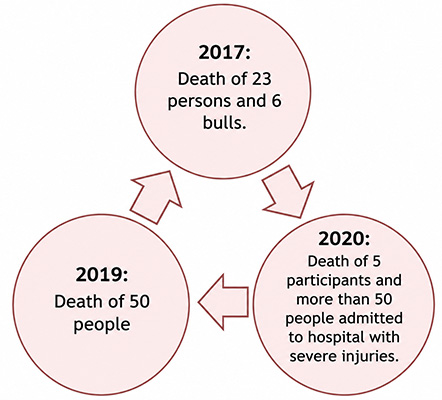
Animals have fundamental rights as also legal rights
Petitioners contended that sentient animals (animals who are able to feel) have natural rights to live a life with dignity without any infliction of cruelty.
Respondents in this issue contested that, although we accept existence of animal rights, however, such rights ought to be enjoyed subject to the legislative provisions.
The Constitution Bench while answering to the issue raised by Petitioners gave reference of A. Nagaraja case, Under A Nagaraja case division bench did not lay down that animals have fundamental rights. Para 66 of A. Nagaraja stated that:
“66. Rights guaranteed to the animals under Sections 3, 11, etc. are only statutory rights. The same have to be elevated to the status of fundamental rights, as has been done by few countries around the world, so as to secure their honour and dignity. Rights and freedoms guaranteed to the animals under Sections 3 and 11 have to be read along with Article 51-A(g) and (h) of the Constitution, which is the magna carta of animal rights.”
Therefore, the question of elevation of the statutory rights of animals to the realm of fundamental rights has been left at the advisory level or has been framed as a judicial suggestion. The Constitution Bench also stated that considering the facts and current situations, we do not think Article 14 can be invoked by any animal as a person.
Whether these Sports are part of tradition and culture.
Petitioners argued that cruel Sports cannot be considered as part of the tradition.
On this question, the Constitution Bench took a stand that this question is out of our jurisdiction. It further stated that “whether these Sports have become integral part of state’s culture or not requires religious, cultural and social analysis in greater detail, which in our opinion, is an exercise that cannot be undertaken by the Judiciary and this issue has to be concluded in the House of the People.
By analysing and answering issues raised by the Petitioners the Constitution Bench finally answered the five questioned formulated by the Division Bench of Supreme Court in an order passed on February 2, 2018 –
1.Pith and substance and colourable legislation.
The Constitution bench stated that, “The Tamil Nadu Amendment Act is not a piece of colourable legislation. It relates, in pith and substance, to Entry 17 of List III of Seventh Schedule to the Constitution of India. It minimises cruelty to animals in the concerned sports and once the Amendment Act, along with their Rules and Notification are implemented, the aforesaid sports would not come within the mischief sought to be remedied by Sections 3, 11(1) (a) and (m) of the 1960 Act.”
2. Can the impugned Tamil Nadu Amendment Act be stated as a part of the cultural heritage for the people of the State of Tamil Nadu so as to receive protection under Article 29[2] of the Constitution of India?
This Constitution Bench stated that, Jallikattu is a type of bovine sport, and we are satisfied on the basis of materials disclosed before us, that it is going on in the State of Tamil Nadu for at least last few centuries. However as stated above whether this has become integral part of Tamil culture or not requires religious, cultural and social analysis in greater detail, which in our opinion, is an exercise that cannot be undertaken by the Judiciary, but this has to be concluded in the House of the People.
3. Is the Tamil Nadu Amendment Act, in pith and substance, to ensure the survival and well-being of the native breed of bulls? Is the Act, in pith and substance, relatable to Article 48 of the Constitution of India?
The Constitution Bench stated that “The Tamil Nadu Amendment Act is not in pith and substance, to ensure survival and well-being of the native breeds of bulls. The said Act is also not relatable to Article 48[3] of the Constitution of India. Incidental impact of the said Amendment Act may fall upon the breed of a particular type of bulls and affect agricultural activities, but in pith and substance the Act is relatable to Entry 17 of List III of the Seventh Schedule to the Constitution of India, i.e., prevention of cruelty to animals.”
4. Does the Tamil Nadu Amendment Act go contrary to Articles 51A(g) and 51A(h), and could it be said, therefore, to be unreasonable and violative of Articles 14 and 21 of the Constitution of India?
This Court stated that “Our answer to this question is in the negative. In our opinion, the Tamil Nadu Amendment Act does not go contrary to the Articles 51-A (g) and 51-A(h) and it does not violate the provisions of Articles 14 and 21 of the Constitution of India.”
5. Is the impugned Tamil Nadu Amendment Act directly contrary to the judgment in A. Nagaraja (supra) and the review judgment dated 16th November 2016 in the aforesaid case, and whether the defects pointed out in the aforesaid two judgments could be said to have been overcome by the Tamil Nadu 5 Legislature by enacting the impugned Tamil Nadu Amendment Act?
As stated above, the Constitution Bench is of the opinion that The Tamil Nadu Amendment Act read along with the Rules framed in that behalf is not directly contrary to the ratio of the judgment in the case of A. Nagaraja and judgment of this Court delivered on 16th November 2016 dismissing the plea for Review of the A. Nagaraja (supra) judgment as we are of the opinion that the defects pointed out in the aforesaid two judgments have been overcome by the State Amendment Act read with the Rules made in that behalf.
After answering all five questions referred to it, in the end of the judgement the Constitution Bench stated that, “Our decision on the Tamil Nadu Amendment Act would also guide the Maharashtra and the Karnataka Amendment Acts and we find all the three Amendment Acts to be valid legislations.” This Court also gave responsibility to District Magistrate/competent authorities with respect to strict adherence to the Rules/notification passed by the Amendment Act. All writ petitions/appeal/transferred case are dismissed by the Constitution Bench.
Our View/Our Voice for the Unheard –
We agree that situation has changed since Supreme Court judgement in the A. Nagaraj case as Amendment Acts came into force and also in the same year rules with respect to code of conduct of the Sports were established by respective states. These Rules at least brought a strict procedure and a format for performance of the Sports. However, Animals can only get relief if implementation of such Rules will take place in reality.
In Isha-Upanishads, it is professed as: “The universe along with its creatures belongs to the land. No creature is superior to any other. Human beings should not be above nature. Let no one species encroach over the rights and privileges of other species.”
In our view even though these Rules and notifications are in place now, they seek to reduce pain and suffering of the animals while performing the Sports, but the question is why to cause the pain in the first place?
- The article reflects the general work of the authors and the views expressed are personal. No reader should act on any statement contained herein without seeking detailed professional advice.
- (1) Any section of the citizens residing in the territory of India or any part thereof having a distinct language, script or culture of its own shall have the right to conserve the same.
- Organisation of agriculture and animal husbandry: The State shall endeavour to organise agriculture and animal husbandry on modern and scientific lines and shall, in particular, take steps for preserving and improving the breeds, and prohibiting the slaughter, of cows and calves and other milch and draught cattle.
For any feedback or response on this article, the authors can be reached on Nandita.Damle@ynzgroup.co.in atharva.amdekar@ynzgroup.co.in and charusheela.vispute@ynzgroup.co.in

Author : Nandita Damle
Nandita is a Legal Advisor at YNZ Legal. She is also a member of Bar Council of Maharashtra & Goa. By qualification she has completed Bachelor of Arts in Political Science and Bachelor of Law from Mumbai University.

Co-Author : Atharva Amdekar
Atharva is an associate at YNZ Legal. By qualification he is Bachelor of commerce and Bachelor of Law from Mumbai University.

Co-Author : Charusheela Vispute
Charusheela is heading Estate planning and trademark. Having specialisation in property and testamentary matters. By qualification she is Bachelor of Arts and Bachelor of Law from Mumbai University.