
Intestate succession is the process of distributing a deceased person’s estate when there is no valid Will. In India, the Hindu Succession Act, 1956 (“Act”), governs the inheritance rules for Hindus, including Buddhists, Jains, and Sikhs. The Act outlines the distribution of assets and establishes a hierarchy of heirs, with different rules for male and female heirs. Understanding these rules is essential for ensuring fair and equitable distribution of an intestate estate.
Intestate Succession for Hindu Male – Class I heirs
When a Hindu male expires intestate, the Act specifies the distribution of his property among his heirs. The Act classifies heirs into Class I and Class II. The Class I heirs include:
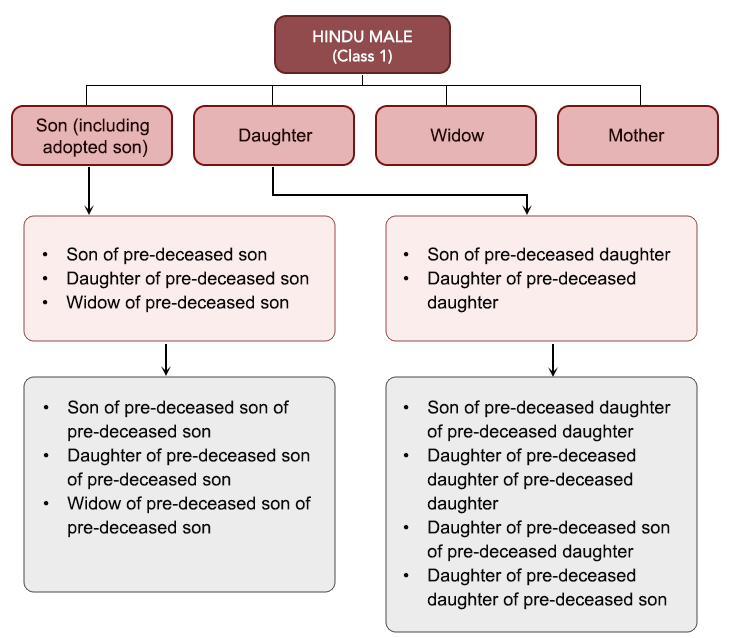
*Widow, sons, daughters and mother each receive an equal share of the estate. For example, if a Hindu male dies leaving behind a wife, two sons, and a daughter, each heir will receive an equal portion of the estate.
*The share of pre-deceased son is divided equally among surviving immediate family members (children and widow) of pre-deceased son.
*The share of pre-deceased daughter is divided equally among her surviving children and not her husband.
Intestate Succession for Hindu Male – Class II heirs
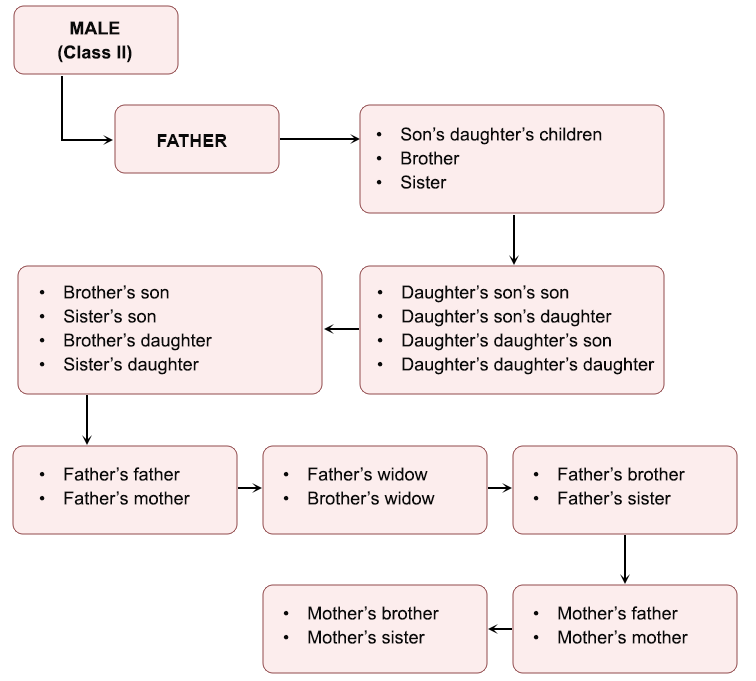
If no Class I heirs are available, the property devolves to Class II heirs.
Class II heirs are divided into nine entries, each entry being prioritized over the next. For example, if a deceased Hindu male has no Class I heirs but has a father, the father will inherit the entire estate. If there are multiple heirs within the same entry, they will inherit equally.
Principal of Distribution
When two or more heirs receive the property of an intestate under the Act, the principles of “per capita” and “tenants in common” apply.
- Per Capita: This principle means that each heir receives an equal share of the property. For example, if a male expires intestate leaving behind a widow and three children (two sons and a daughter), the estate will be divided into four equal parts, with each heir receiving one-fourth of the property.
- Tenants in Common: This term signifies that each heir owns a specific, distinct share of the property. Upon the death of a tenant in common, their share does not automatically pass to the co-heirs. The share becomes part of the deceased heir’s estate and is inherited by his/her heirs or beneficiaries according to will or the applicable intestate succession laws
Intestate Succession for Hindu Female
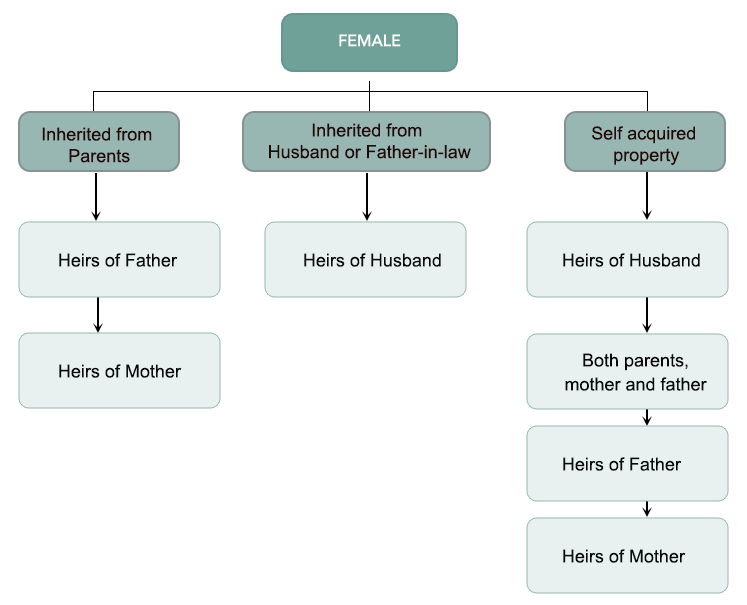
The property of a Hindu female is divided into three categories:
- Self-acquired property or property received by any other means, such as gifts or will;
- Property inherited from her husband or father-in-law;
- Property inherited from her parents
When a Hindu female expires intestate, her property is distributed among the following immediate family members:
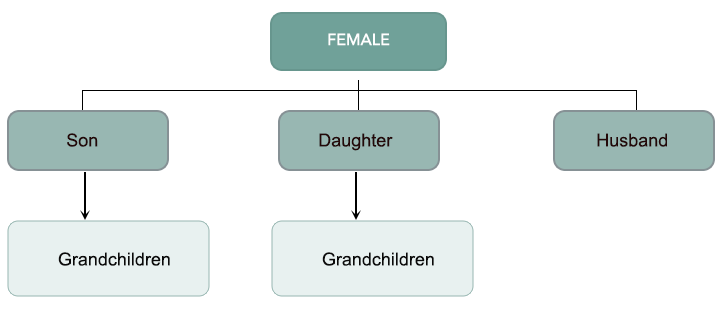
*Son, daughter and husband each legal heir is entitled to an equal share of the estate.
* The share of pre-deceased son or pre-deceased daughter is divided equally among their surviving children.
If none of the immediate family members are available, the property devolves to other heirs. The distribution of the property will vary depending on how the property was acquired.
Hindu Female as Coparcener:
The Hindu Succession (Amendment) Act, 2005, introduced significant changes for female Hindus by granting them equal rights in ancestral property. Before this amendment, only male members were considered coparceners in a Hindu joint family. The amendment now includes daughters as coparceners, granting them equal rights to inherit ancestral property, similar to sons. Even after marriage, daughters retain their rights as coparceners in their parental family.
General Provisions Related to Succession
- Rights of Unborn Children:
A child conceived at the time of the intestate’s death is legally recognized as having the same inheritance rights as if the child was born alive. - Disqualification of Murderers:
Any individual who is convicted of murder or abetting the murder of the intestate is disqualified from inheriting the property of the deceased. This provision prevents those who have caused harm to the intestate from benefiting from their estate. - Disqualification of Convert:
If a Hindu converts to another religion, they and their descendants are excluded from inheriting property under the Act. - Remarriage of Widow:
The remarriage of a widow does not affect her rights to property inherited from her deceased husband. - No Surviving Heirs:
When an individual expires intestate and has no legal heirs to inherit the property, the property shall be passed to the government along with all liabilities.
Conclusion:
The intestate succession of property without a Will, can be a complex and lengthy process, often leading to extensive litigation. This complexity arises from the need to follow statutory laws to identify right heirs and distribute the estate, which can lead to disputes and delays.
In the recent judgement[2], the primary issue was the inheritance of property under Hindu law, specifically whether a daughter could inherit her father’s self-acquired property when no other legal heirs were present prior to the enactment of the Hindu Succession Act, 1956. The Court found that the property in question was the deceased’s self-acquired property, not joint family property.
The parties litigated through three courts for almost 3 decades: i.e.
Partition suit was filed by the heirs which was decreed on 1st March 1994 by the Trial Court;
This decree was unsuccessfully challenged before the Madras High Court on 21st January 2009;
This High Court’s judgement was again challenged through Civil Appeal before the Apex Court and the Court finally decided successfully in favor of the daughter through its judgement on 22nd January 2022.
The Apex Court concluded that a daughter could inherit her father’s separate property even in the absence of male heirs. The case analysed the provision of the Act to ascertain the proper order of succession. Ultimately, the Court upheld the daughter’s right to inherit the property, overturning the lower court’s decision and acknowledging her entitlement to the inheritance.
Conversely, a will (testamentary provision) provided a more efficient and controlled approach to property distribution as it clearly expresses the testator’s intentions and minimize disputes and expedite the estate’s administration. Thus, clear testamentary provisions are crucial to avoid the complexities and disputes of intestate succession.
- The article reflects the general work of the author on the date of publication and the views expressed are personal. No reader should act on any statement contained herein without seeking detailed professional advice.
- Arunachala Gounder (Dead) By Lrs. Versus Ponnusamy and Ors., Civil Appeal No. 6659 of 2011
For any feedback or response on this article, the authors can be reached on charusheela.vispute@ynzgroup.co.in and pranav.mane@ynzgroup.co.in

Author : Charusheela Vispute
Charusheela is a Partner of Estate planning and trademark, having specialisation in property and testamentary matters. By qualification she is Bachelor of Arts and Bachelor of Law from Mumbai University

Co-Author : Pranav Mane
Pranav is an Associate at YNZ Legal. By qualification he is Bachelor of commerce and Bachelor of Law from Mumbai University. He is also a member of Bar Council of Maharashtra & Goa.