
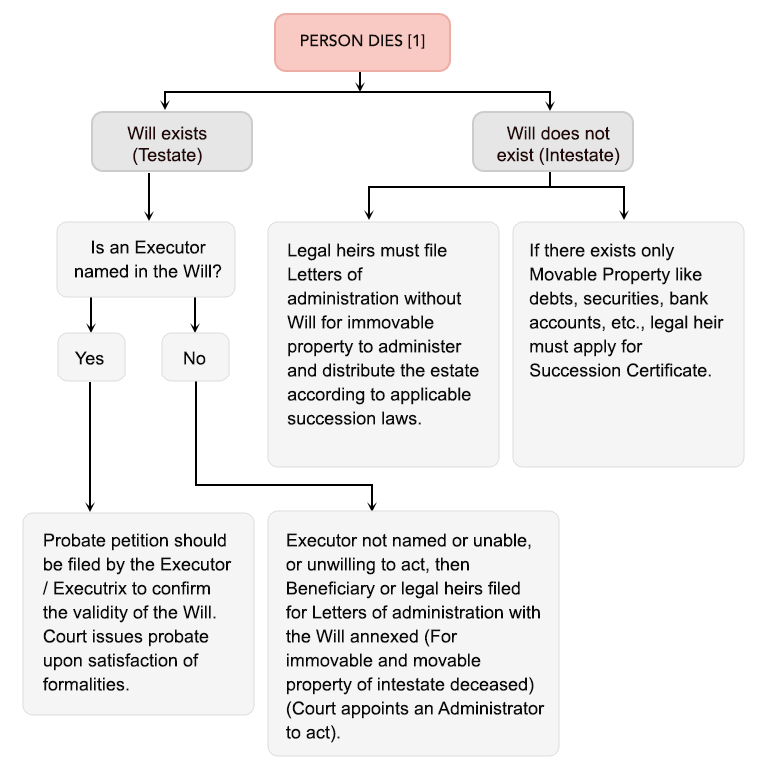
When a person passes away, the distribution of his/her estate is governed by personal succession laws. In India, specifically in Bombay (Mumbai), Maharashtra[2], the process is regulated under the Indian Succession Act, 1925 (hereinafter referred to as “the Act”). The Act outlines the legal procedures for the administration of estates, especially in cases where the deceased has left behind a will (testate succession) or has died without a will (intestate succession).
This article aims to distinguish between four critical legal instruments used in the administration of estates in Bombay/Maharashtra:
- Probate Petition;
- Letters of Administration with Will;
- Letters of Administration without Will;
- Succession Certificate.
Each of these instruments serves a unique purpose and is subject to specific procedural and legal requirements.
Probate is a formal legal process by which the court certifies the validity of a Will left by a deceased person. In essence, probate is a court order confirming that a will is valid and authentic, and that the executor named therein has the authority to administer the deceased’s estate. The probate process in Bombay, Maharashtra, is governed by the Act and is mandatory where the Will involves movable as well as immoveable property situated in the territory[3].
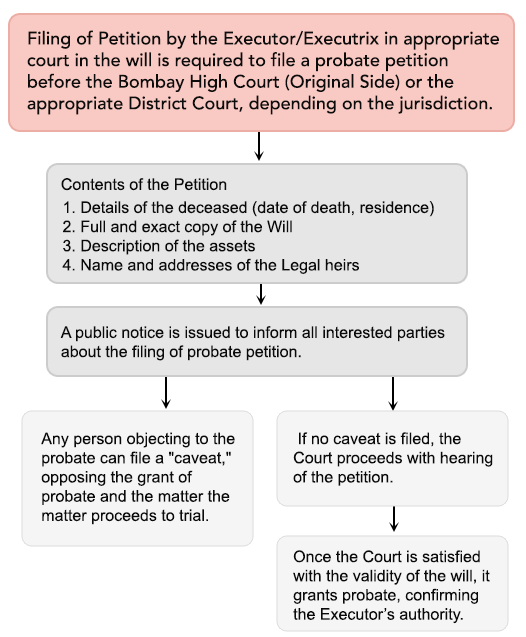
Legal Effect of Probate:
The grant of probate is conclusive evidence of the genuineness of the will. Without probate, the executor / executrix cannot lawfully distribute the deceased’s estate, particularly in cases involving immovable property .
Procedure for Obtaining Letters of Administration with Will:
Where a deceased has left a will but no executor is named, or the named executor is unable or unwilling to act, the Court can issue Letters of Administration with Will annexed. This document grants authority to an administrator (appointed by the Court) to act in the place of an executor in administering the estate according to the terms of the will.
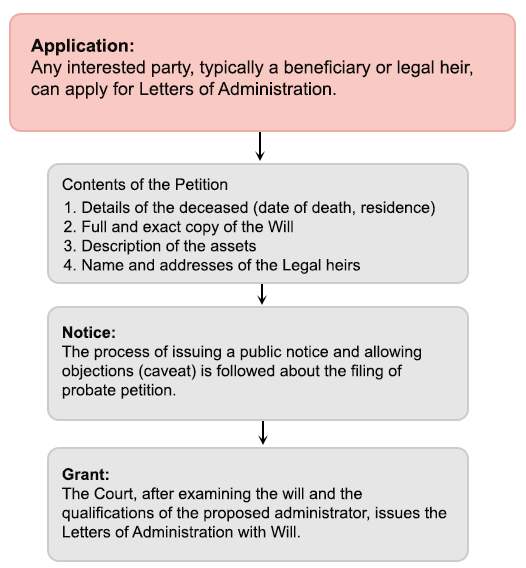
Legal Effect:
The Letters of Administration with Will confer authority on the appointed administrator to administer the estate according to the will’s provisions. Like probate, it is conclusive evidence of the right to administer the estate, particularly for transferring immovable property .
Letters of Administration without Will (Intestate Succession):
When a person dies intestate (i.e., without leaving a will), the estate is distributed according to the rules of intestate succession as prescribed under the Act. In such cases, the legal heirs must obtain Letters of Administration without Will to administer and distribute the estate.
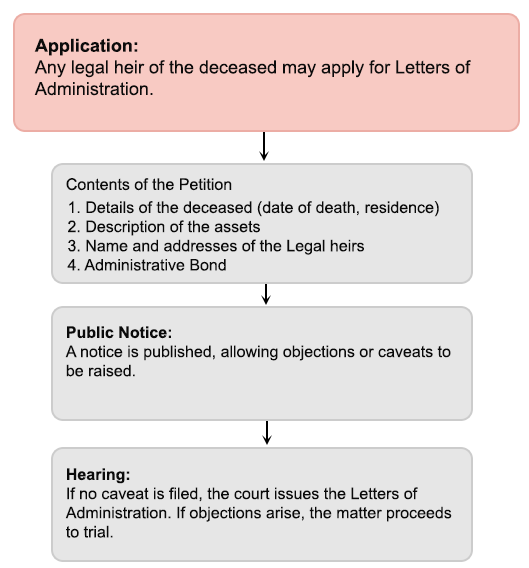
Legal Effect:
The grant of Letters of Administration without Will allows the legal heirs to distribute the estate among themselves in accordance with the law of intestate succession. It is required for the legal transfer of immovable property and bank accounts.
Succession Certificate:
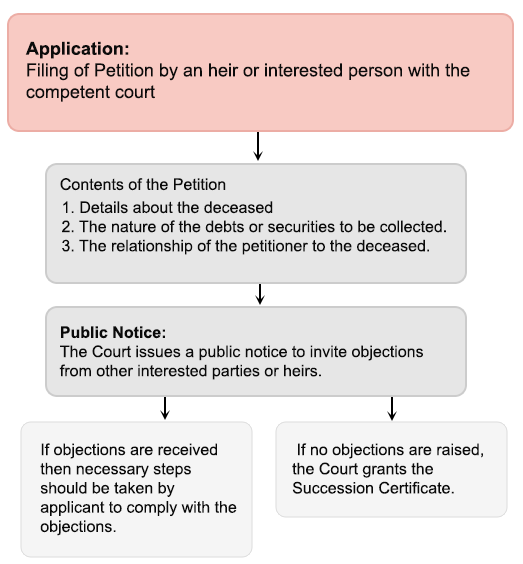
A Succession Certificate is distinct from probate or letters of administration and is to be obtained essentially when the property of the deceased is movable property, such as debts and securities (e.g., bank accounts, shares, fixed deposits).
The Succession Certificate serves as a legal document that grants the rightful heirs or beneficiaries the authority to collect debts or securities owed to the deceased. It also provides authority to the debtors or institutions that release the funds in favour of legal heirs.
Legal Effect:
The Succession Certificate grants the petitioner the right to collect and manage the debts or securities of the deceased. It does not cover rights to immovable property, nor does it confer ownership of the estate, but it is critical for the legal transfer of movable property .
Conclusion:
In the Bombay/Maharashtra jurisdiction, several legal instruments are employed for estate administration, each tailored to different scenarios of succession. Probate is necessary when a person dies leaving behind a will, and it serves as a legal validation of that will, enabling the named executor to administer the estate according to its terms.
If there is a will but no executor, or if the executor is unable or unwilling to act, then Letters of Administration with Will are required to authorize someone else, usually a legal heir, to manage the estate.
In cases where the deceased dies intestate (without leaving a will), Letters of Administration without Will must be obtained by the legal heirs, granting them the authority to distribute the estate in accordance with the applicable inheritance laws.
Another important legal instrument is the Succession Certificate, which is primarily used for the collection of debts and securities (movable assets) of the deceased.
It is required whether the deceased had a will or died intestate, and it provides a legal mechanism to ensure that these assets are appropriately transferred to the rightful beneficiaries. Each of these instruments serves a specific purpose within the overall framework of estate administration, ensuring that the assets of the deceased are properly managed and distributed according to either the will or the rules of intestate succession. The procedure for filing these testamentary petitions includes court fees of Rs. 75,000/- for property valued above Rs. 11,00,000/-.
- The article reflects the general work of the author on the date of publication and the views expressed are personal. No reader should act on any statement contained herein without seeking detailed professional advice.
- This procedure is not applicable to rest of Maharashtra.
- If immovable property is situate outside territory or if the deceased had multiple immoveable properties, then there may be additional requirements.
For any feedback or response on this article, the authors can be reached on ankita.doke@ynzgroup.co.in and kedar.gurjar@ynzgroup.co.in

Author : Ankita Doke
Ankita is an Associate at YNZ Legal. By qualification she is Bachelor of Law from Pune University.

Co-Author : Kedar Gurjar
Kedar is an Associate at YNZ Legal. By qualification he is Bachelor of Commerce and Bachelor of Law from G.J. Advani Law college, Bandra, Mumbai University.