
How frequently do we come across entities facing cash crunch?[1] Maintaining a healthy cash flow is crucial for enterprises in order to cater it’s business operations. Many enterprises grapple with financial challenges stemming from delayed or non-recovery of dues, escalating this issue to the prolonged nature of traditional court proceedings. As of December 31, 2023, the Bombay High Court faced a backlog of over seven lakh cases, with more than 83% being civil matters [2]. This significant backlog often results in extended litigation periods, further straining businesses awaiting financial resolutions. In such circumstances one must be aware of legal framework mechanism known as a “summary suit.”
Let us understand this better.
1. What is a summary suit?
Order XXXVII of the Civil Procedure Code outlines the special summary procedure, designed to expedite specific types of suits by preventing unnecessary delays caused by defendants who lack a valid defense. Designed for the swift adjudication of cases involving clear monetary claims, summary suits provide a streamlined process that can expedite recovery.
A summary suit is a special type of civil proceeding for cogent recovery matters like:
- Suits based on bills of exchange, hundies, Invoices, bills, promissory notes etc.
- Suits where the plaintiff seeks to recover a debt or a liquidated monetary demand payable by the defendant, either with or without interest.
- Suits arising from a written contract, an enactment where the sum recoverable is a fixed amount or a debt (excluding penalties), or
- Suits based on guarantee, provided that the claim against the principal pertains solely to a debt or liquidated demand.
2. What is an ordinary suit?
An ordinary suit, also known as a regular civil suit, is the most common type of legal proceeding initiated under the Code of Civil Procedure, 1908 (CPC)[3]. It applies to general civil disputes between individuals or entities where there is no specific provision for an expedited hearing unless pressed for by way of an application. Ordinary suits cover a wide range of disputes, such as property disputes, suit for damages, breach of contract, recovery of money, and other civil matters that do not fall under special categories like summary, commercial suits or criminal matters.
3. How does a summary suit differ from an ordinary suit?
Summary suits adopt a summary procedure and give limited opportunities to the Defendant. Though this appears to be a violation of the basic principle of natural justice, ‘Audi Alteram Partem’, that no one should be convicted without a hearing, this method is only applied in circumstances in which the defendant does not present a triable issue. Unlike regular civil cases, a trial under this procedure commences only if the judge grants permission to the defendant to contest the claim.
4. What is leave to defend?
In a Summary Suit, the Defendant does not have an automatic right to defend the case. Instead, the Defendant must seek permission from the Court to present their defence. This permission is called “Leave to Defend.” In ordinary civil cases, a Defendant has the inherent right to defend themselves as soon as they are served with a summons. However, in a Summary Suit, the law assumes that the Plaintiff’s claim is clear and undisputed, making a detailed trial unnecessary unless the Defendant can show a valid defense.
5. When can leave to defend be granted?
Leave to defend in a Summary Suit shall only be denied if the Court is fully convinced that the facts presented by the Defendant fail to establish the existence of a substantial defense or that the proposed defense is frivolous or vexatious in nature. Furthermore, in instances where the Defendant acknowledges liability for a portion of the amount claimed by the Plaintiff, the Court shall not grant leave to defend unless the Defendant deposits the admitted sum before the Court.
6. What is the limitation to file ordinary / summary suits?
The limitation to file the aforementioned suits is for 3 (three) years from the date when the cause of action arises.
7. When can the judgement be passed in favor of the plaintiff in summary suits?
The court may issue a judgment in favor of the plaintiff under the following circumstances:
- The defendant fails to apply for leave to defend, or their request for such permission is denied.
- The defendant, despite being granted leave to defend, does not comply with the conditions set by the court.
8. Key Differences at a glance
| Feature | Ordinary Suit | Summary Suit |
|---|---|---|
| Governing Laws | Civil Procedure Code | Order XXXVII of Civil Procedure Code |
| Purpose | General civil disputes | Quick recovery of liquidated sums |
| Need for Full Trial | Yes | No, unless leave to defend is granted |
| Scope | Broad | Limited to written contracts, promissory notes, invoices, bills etc. |
| Defendant’s Right to Defend | Unrestricted | Restricted |
| Time Efficiency | Lengthy | Faster |
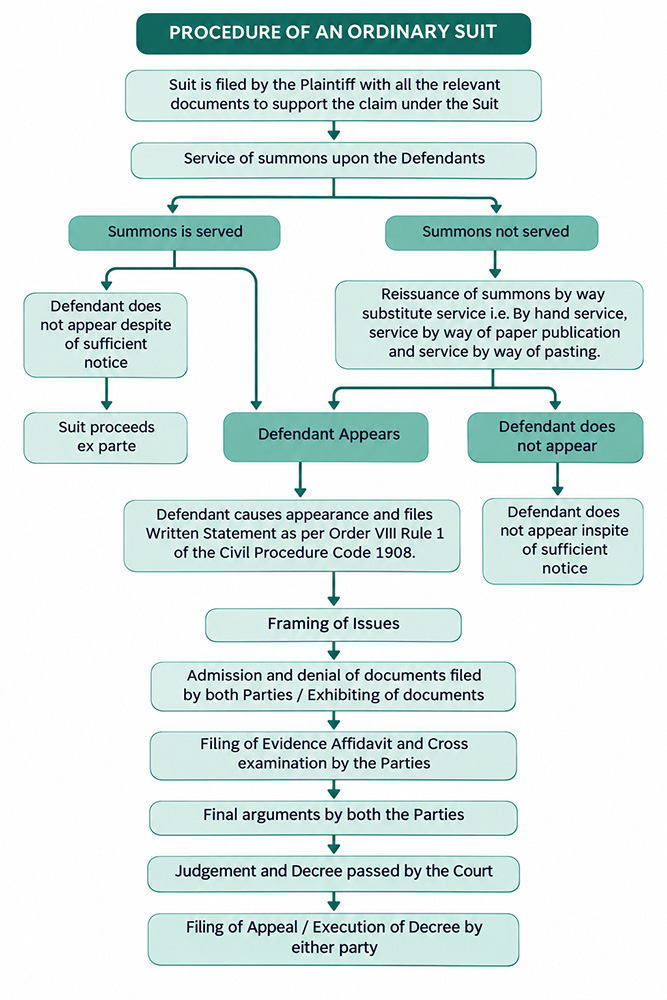
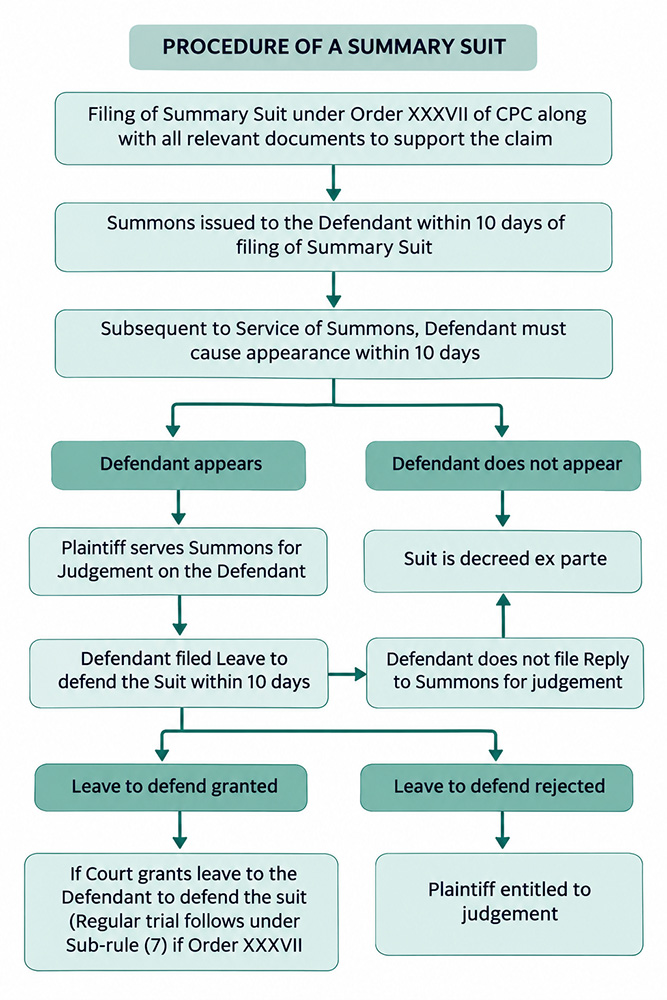
Let’s understand certain aspects of Summary Suits wit the help of few case laws:
A. M/S. MOBILE ARTS S.A.L. VERSUS M/S. MAUJ MOBILE PRIVATE LTD. [4]
Facts of the matter in brief:
The Petitioner, a Lebanon-based digital advertising company, and the Respondent, an Indian media company, entered into an agreement on 15.01.2019 for digital advertising services related to the Respondent’s brands, “Gamesbond” and “Video Vogue.” The services were provided as per agreed terms, and three invoices totalling USD $120,576.43 were raised. The Respondent made a partial payment of USD $10,001.60 and later agreed to clear the outstanding dues in six monthly installments of USD $20,000, with interest waived. However, on 21.05.2020, the Respondent cited financial difficulties and later proposed a one-time payment of USD $20,000 instead of the full amount, warning of a prolonged legal battle otherwise. The service provider sued the customer and the lower court, granted unconditional leave to defend to the Respondent.
This decision was reversed by the Hon’ble Bombay High Court and a judgement was issued in favor of the Service Provider. The reasoning adopted by the Court was that:
- the claim was cogently based upon admitted written contract and invoices;
- the Court emphasized the critical role of clear and precise correspondence between the parties which established the Defendant’s acknowledgment of the services provided.
This decision underlines the importance of maintaining clear and consistent communication in any contractual relationship, as such correspondence serves as key evidence in legal matters.
B. UT OF J&K AND OTHERS THROUGH: MR. SAJAD ASHRAF, GA VERSUS SHABIR AHMAD DAR AND OTHERS [5]
Piece workers associated with the Estates Department of J&K executed civil, electrical, and sanitary works based on approved annual rates to meet government accommodation and furniture needs. Following the abrogation of Article 370, the Estates Department withheld ₹40 lakhs due to changes in codal formalities related to payment disbursement. Consequently, the workers (Respondents) filed a Summary Suit under Order 37 of the CPC in the trial court for the recovery of unpaid bills amounting to ₹57 lakhs. The trial court, recognizing the commercial nature of the suit, issued summons to the Estates Department (Petitioners). The Petitioners sought leave to defend, arguing that the absence of a written agreement invalidated the summary suit.
The High Court observed that the Petitioners had admitted to the execution of works and the pending bill amount of ₹37.82 lakhs, and it is an established law that invoices and bills constitute written contracts under Order 37 CPC[6]. The High Court dismissed the petition and upheld the trial court’s decision to deny unconditional leave to defend.
Conclusion
In a variety of disputes pending before the court, classification of suits into ordinary suits and summary suits helps in establishing an efficient and structured legal system. By categorizing disputes based on their nature and urgency, this classification reduces procedural delays, facilitates speedy redressal and timely resolution of cases.
Ordinary Suit is an umbrella head covering all kinds of civil suits, Summary suits, on the other hand, serve as a fast-track mechanism, primarily designed for the recovery of money and liquidated claims, enabling plaintiffs to bypass lengthy trials in Ordinary Suits when the defendant lacks a substantial defense. Understanding these distinctions empowers litigants to choose the most suitable legal route, optimizing both time and resources.
- The article reflects the general work of the author on the date of publication and the views expressed are personal. No reader should act on any statement contained herein without seeking detailed professional advice.
- timesofindia.indiatimes.com
- https://www.indiacode.nic.in/bitstream/123456789/2191/1/A1908-05.pdf
- WRIT PETITION NO.5795 OF 2024:HIGH COURT OF BOMBAY
- HIGH COURT OF JAMMU & KASHMIR AND LADAKH AT SRINAGAR:CM(M)/39/2023
- M/s Punjab Pen House vs. Samrat Bicycle Ltd. (AIR 1992 Delhi 1)
For any feedback or response on this article, the authors can be reached on ankita.doke@ynzgroup.co.in and kedar.gurjar@ynzgroup.co.in

Co-Author : Ankita Doke
Ankita is an Associate at YNZ Legal. By qualification she is Bachelor of Law from Pune University.

Author : Kedar Gurjar
Kedar is an Associate at YNZ Legal. By qualification he is Bachelor of Commerce and Bachelor of Law from G.J. Advani Law College, Bandra, Mumbai University.