
LEGAL DUE DILIGENCE[1]
The ancient maxim vigilantibus et non dormientibus jura subveniunt tells us that the law assists those who are vigilant and not those who are indolent or sleep over their rights[2].
In an investment deal once the Investor and Investee agree upon the terms of arrangement, the Parties usually sign the Term Sheet. Upon execution of Term Sheet, the Investor should initiate the Technical, Financial, Legal and Tax Due Diligence by entering into Non-Disclosure Agreement with Investee Company.
To understand the concept of due diligence better, one can refer to Chander Kanta Bansal v. Rajinder Singh Anand, (2008) 5 SCC 117 which states:
“As per Black’s Law Dictionary (Eighth Edition), “diligence” means a continual effort to accomplish something, care; caution; the attention and care required from a person in a given situation.

“Due diligence” means the diligence reasonably expected from, and ordinarily exercised by, a person who seeks to satisfy a legal requirement or to discharge an obligation.
According to Words and Phrases by Drain-Dyspnea (Permanent Edition 13A) “due diligence”, in law, means doing everything reasonable, not everything possible. “Due diligence” means reasonable diligence; it means such diligence as a prudent man would exercise in the conduct of his own affairs.
Hence, while it is general practice to impose wide warranties and obligations on the Investee Companies to safeguard Investor’s rights, the decision as to whether to go ahead with an investment deal transaction is majorly taken on the basis of the detailed due diligence carried out on the Investee. While conducting the due diligence, the investor should ensure that all the necessary enquiries are made. Considering the urgency of the deal, investee should also be reasonably prepared for the due diligence which may be achieved by adopting simple steps like mock due diligence to highlight the issues early on and rectification of such issues before the actual Due Diligence is carried out by Investor. This is like a net practice in a cricket match.
The basic process of conducting a due diligence can be seen as below:
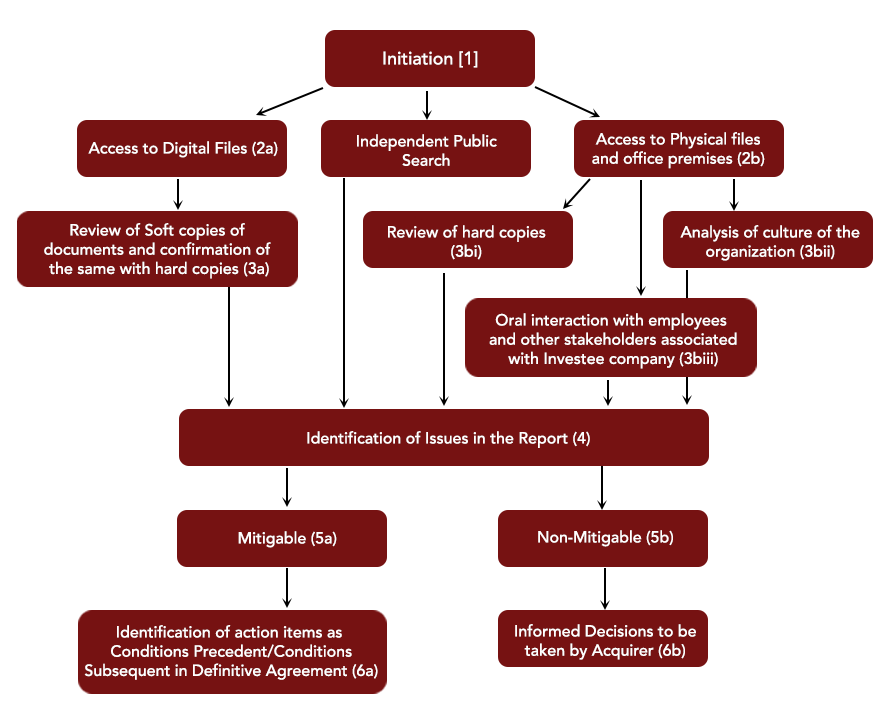
Legends:
1. The documents and information of the Investee Company are sought by the Investor. It is imperative that the Investee Company should be able to produce the data lot in as less time as possible, ideally within one week.
2a. The entire data of the Investee should be made available in digital form through drive/drop box. The data can be masked for better protection of Investee Company’s confidentiality.
2b. In addition to accessing the digital data, the Investor team may also seek access to the physical files, visit and inspection of office premises, go-downs etc.
3. Once the information and access are provided, the investor team carries out thorough review and search mainly by way of:
- Review of soft copies of the documents and mapping the same with original hard copies.
- Review and verification of hard copies of agreements, licenses, certificates, compliance documents etc.
- Interaction with Promoters, employees, vendors, clients and other stakeholders of the Investee Company.
- Visit to and inspection of the office premises, go-downs, manufacturing units etc. of the Investee Company
4. Upon review and verification of the data, the issues are identified with respect to any errors, omissions, non-compliance, violations with respect to various transactions and activities undertaken by the Investee Company till date.
5. Once the issues are identified, the same can be broadly segregated into,
- Mitigable Issues
- Non-Mitigable issues
6a. Mitigable Issues such as non-registration/non-renewal trademarks/logos/unsigned documents which can be rectified and identified as Conditions Precedent or Conditions Subsequent in the Definitive Agreements depending upon gravity of the matter.
6b. Non-Mitigable Issues are generally high risk concerns such as pending criminal cases against the Directors of the Company. Any Court or Arbitration adverse orders, judgments or statutory demands made by Government departments, Any potential or contingent liabilities, any bad debts, terminated business contracts, potential infringement of third party intellectual property rights can lead to future cashflow hit. The Investor is informed by the legal team about such critical findings. Based on that the deal may be restructured and accordingly the deal value may be reduced, or the payment of the deal value is staggered or additional provisions are created or it can lead to calling the deal off as the worst case scenario.
- The article reflects the general work of the authors and the views expressed are personal. No reader should act on any statement contained herein without seeking detailed professional advice.
- This principle has also been included in our statutes. Section 3 of the Transfer of Property Act specifically states that sometimes a purchaser may be deemed to have notice of a fact if he could have reasonably found it through an inquiry into the facts of the matter
For any feedback or response on this article, the authors can be reached on ayushi.kalelkar@ynzgroup.co.in and charusheela.vispute@ynzgroup.co.in

Author : Ayushi Kalelkar
Ayushi is experienced in corporate legal and heads the investment and deal advisory at YNZ Legal. She is also a member of Bar Council of Maharashtra & Goa. By qualification she is a Master in Commerce and Bachelor of Law from Mumbai University

Co-Author : Charusheela Vispute
Charusheela is heading Estate planning and trademark, having specialisation in property and testamentary matters. By qualification she is Bachelor of Arts and Bachelor of Law from Mumbai University.