
Introduction to Co-Production Agreement:
How often do we see “pre-anticipated blockbusters like Bollywood movie “Animal” released earlier this year” getting tangled in the legal drama right before its release? This shows that film making is both an art and a business and the life of film maker is nothing less than a roller coaster.
Collaboration is key in such projects and co-productions can be a thrilling ride, filled with association and complexities.
Think of a film as a giant puzzle. Co-production agreements are the glue that holds the pieces together, ensuring different production houses working on a specific project are on the same page. More than just money, it’s a carefully crafted blueprint that protects filmmakers and producers, transforming that initial spark of an idea into a cohesive masterpiece.
HOW CO-PRODUCTION WORKS?
Film production can be broadly categorized into two primary models: state-driven co-productions and private co-productions. State-driven co-productions are collaborative efforts where the government plays a significant role. These films often prioritize themes of national history and cultural heritage. To facilitate their creation, the government may offer financial subsidies and other forms of support. In contrast, private co-productions involve partnerships between independent production companies. These companies have greater creative autonomy and may pursue a wider range of narratives in their films.
A well-drafted and negotiated Co-production agreements serve a multi-faceted purpose. It serves as a locking mechanism, outlining the rights, responsibilities, and financial arrangements of each party throughout the co-production process.
TYPES OF CO-PRODUCTIONS:
To ensure a smooth and successful collaboration, the Co-Production agreement should address the following key elements:
1. Listing financial contributions and Profit sharing
Primarily, there should be an establishment of a framework for financial contributions by the Parties. Specifically outlined within the agreement are the total budget breakdown and the specific contribution ratio for each co-producer. This ensures transparency and avoids any potential disputes during or after production.
2. Creative Control
While some co-producers might solely /contribute financing, others might bring valuable industry expertise to the table. While a lead producer may have primary creative control, the agreement should define the decision-making process for key aspects like script approval, casting, music, direction and production elements. It’s crucial to outline the level of collaboration and approval rights for each co-producer.
Creative control allows filmmakers to shape the narrative, characters, and overall aesthetics of the project, ensuring that it aligns with their artistic vision.
In M/S Magic Lantern Productions vs Creative Eye Ltd on 26 March, 2010[3] writer Rajita Sharma, as the creator sued producer Creative Eye over the television series “Yeh Pyaar Na Hoga Kam.” Sharma claimed she created storyline and script but Creative Eye terminated their agreement and tried to deny her credit. The parties had entered into various MOUs, including a co-production MOU. However, no relief was granted by the Court. The Court drew an important distinction between film production and production of TV serials.
In the interim order, the Court held that, “The production of a film and distribution of the same at one stroke just cannot be compared with the production of T.V. Serial basically when the requirement is to broadcast one episode at one time on day to day or weekly basis. The initial concept may be modified, tested and/or even changed in every episode as per the demand. There is no strict jacket formula, to telecast or broadcast or direct every episode as per the basic concept as announced initially.
In the present case, factually every episode if written separately by other screenplay/writer and produced accordingly under the direction of different Director, the claim of petitioner to put their name and/or to give them credit in the present facts and circumstances is un-acceptable.”
The final determination of the rights of the parties was subject to arbitration proceedings.
3. Roles of Each Producer
The Co-production agreement defines the specific roles and obligations of each producer, ensuring a clear understanding of creative input and decision-making authority. The lead producer often has a larger share of the say, but the agreement clarifies the extent of that control.
4. Production Schedule and Delivery
A detailed production schedule with milestones and deadlines for completion ensures everyone is on the same page. This section should also specify the delivery format and timeline for the final product.
5. Intellectual Property Rights
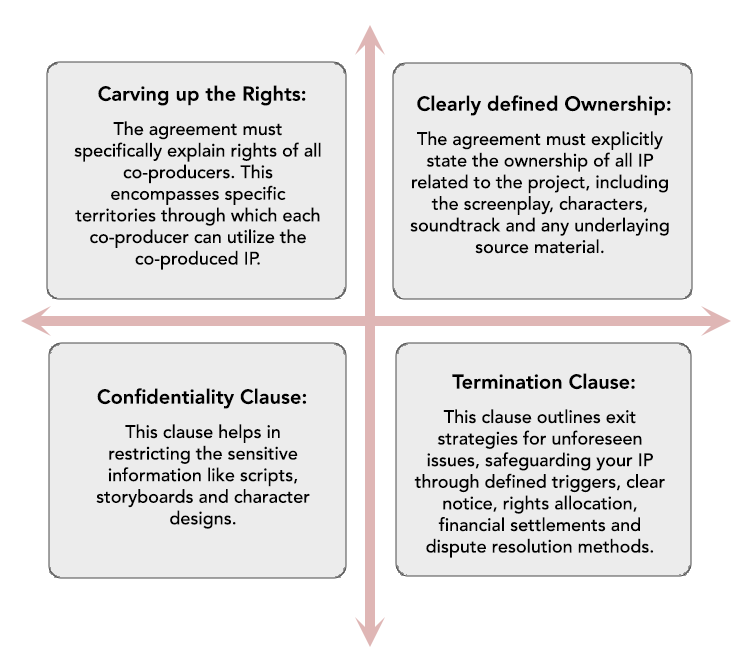
Within this collaborative spirit lies a crucial question: how do you protect the intellectual property (IP) that forms the very foundation of your film? A well-crafted intellectual property clause in the Co-Production agreement acts as the shield for your IP. Ownership of the co-produced work, including copyrights, trademarks, and distribution rights, must be clearly established. The agreement should address how these rights will be exploited and any potential limitations.
6. Dispute Resolution
The agreement should establish a mechanism for resolving any disagreements that may arise during the co-production process. This might involve mediation, arbitration, or litigation, depending on the parties and their preferences. Typically, the disputes are related to sharing of profits, the parties may agree definition in terms of generic parlance but in reality, accounting terminologies may differ and that may affect profit sharing.
7. General legal considerations
Beyond these core aspects, co-production agreements address a multitude of legal considerations as mentioned above and may even include potential tax implications depending on the co-producing countries. A well-drafted co-production agreement serves as a comprehensive roadmap, ensuring a smooth and successful filmmaking journey for all parties involved.
By addressing these key elements, a co-production agreement brings transparency and safeguards the legal and financial interests of producers.
International Aspect:
International co-productions offer a unique pathway to access lucrative foreign markets. Studios can partner with local companies situated abroad, to produce films which meet their co-production criteria, often involving quotas for themes, filming locations, and actors. However, these criteria can be subjective and challenging to meet, as evidenced by the scrapped project of Iron Man 3 co-production.
An alternative strategy is creating “dual versions” of a film, catering to international and specific country’s audiences with specific edits or additions. This approach highlights the potential benefits and complexities of international co-productions, where studios must balance their creative vision with the requirements of foreign markets.
Did you know that these films were co-produced internationally?


Let’s understand the complexities of a co-production with an interesting judgement passed by the Delhi High Court in T-Series vs. Reliance Entertainment: A Profit-Sharing Showdown[4]
The case cantered on a profit-sharing dispute between T-Series (Super Cassettes Industries) and Reliance Entertainment and highlighted the various issues around production.
THE PLOT:
T-Series provided Reliance Rs.268 crore on loan for the production of 11 Hindi films. However, a disagreement arose when T-Series claimed Reliance still owed ₹60.23 crore on the loan. To secure repayment, T-Series sought to block the release of movie “Amar Singh Chamkila” which was releasing on an OTT platform and potentially other Reliance films too.
COURTROOM CLIMAX:
During the hearing, it came to light that actually the film was produced by Reliance through WSF, a limited liability partnership,7 of which, Reliance is one of the partners, holding approximately 99.99% of the capital share. Further, the promotional material of the movie identified Reliance as the producer.
Under Section 2(uu) of the Copyright Act, 1957, the designation of ‘producer’ is attributed to the person who takes the initiative and responsibility for making the work.
While Reliance claimed initially that WSF was sole producer of the film and Reliance was a mere licensee, this was vigorously debated amongst the parties. Under the License Agreement, Reliance has been authorized by WSF to grant sub-licenses to other entities for films produced by WSF. In that capacity, Reliance executed the Netflix Reliance Agreement.
The parties had approached the court at interim stage and the Court examined all the arrangements amongst the parties, including the loan agreement, license agreements, definition of revenues, lien rights etc. However, considering the stage a detailed examination of the role of Reliance as a producer was not confirmed, and the court held that:
“Given these complexities, a straightforward identification of Reliance as a producer is obscured, requiring further detailed examination, that is beyond the scope of this hearing. At this stage, while it cannot be definitively concluded that Reliance is the sole and exclusive producer, the evidence presented prima facie indicates that WSF is the actual and legally recognized producer of the film “Amar Singh Chamkila,”” concluded the judgement.
As the role of Reliance as producer was not confirmed, T Series could not claim the entire amount from the Netflix arrangement towards it’s lien, and thus the release was permitted basis the monetary understanding amongst the parties of depositing certain amount by Reliance.
BEHIND THE SCENES: POTENTIAL CLAUSE AT PLAY:
In this case WSF was identified as the producer with the documents filed before Central Board of Film Certification, contrary representations in different proceedings led to this situation.
WRAP:
The above case shows why clear co-production agreements are essential when making movies with multiple companies. These agreements should lay out how profits are shared, what to do if disagreements arise, and how films made by one company even when working with others are handled. By having these details ironed out beforehand, filmmakers can avoid legal headaches and focus on the actual task- lights, camera…. action!!
- The article reflects the general work of the authors and the views expressed are personal. No reader should act on any statement contained herein without seeking detailed professional advice.
- https://indianexpress.com/article/cities/delhi/production-company -animal-co-producer-delhi-high-court-netflix-release-9110337/
- Bombay High Court: Arbitration Petition 348 of 2010
- Delhi High Court: IA 6607 of 2024
For any feedback or response on this article, the authors can be reached on shravani.joshi@ynzgroup.co.in and aarti.banerjee@ynzgroup.co.in

Author : Shravani Joshi
Shravani is a Law Intern at YNZ legal. She is currently pursuing LLB from Vivekanand College. She has completed her Bachelor of Commerce from Mumbai University.

Co-Author : Aarti Banerjee
Aarti is a Partner- Corporate Legal Advisory. Aarti is experienced in corporate legal matters having specialization in drafting, vetting and negotiation of agreements. By qualification she is an Advocate and a Solicitor.