
Introduction[1]:
The global fashion industry, a $1.7 trillion[2] powerhouse (2022), is dominated by iconic brands like Louis Vuitton ($32.3 billion), Gucci ($18.2 billion), Chanel ($9.1 billion), and Christian Dior (a staggering $126.54 billion as of November 2022). While India holds a 4% share of the global textile and apparel market, generating $44.4 billion [3] in revenue, its handcrafted sector generates significantly less. This disparity is striking, given the unique designs and rich traditions embedded in Indian handicrafts, why should their intellectual property, their copyrights and designs, be valued any less than those of established luxury brands?
In today’s interconnected world, where even high-quality counterfeits of luxury items like Rado watches, Nike shoes, and Louis Vuitton handbags are readily available, the line between inspiration and infringement has become blurred. While brand counterfeiting is a well-documented problem, a less publicized but equally concerning trend is the appropriation of designs from smaller, independent creators by larger companies. This is another form of ” infringement.” This practice, though often overlooked, poses a significant threat to emerging designers and raises serious ethical questions. Let us understand few aspects of intellectual property rights with respect to handicrafts.
The Big Controversy : What if I tell you Christian Dior allegedly copied design of Indian Local Brand?
A few years ago, in January 2018, a striking case of alleged design infringement came to light when Elle India featured Bollywood star Sonam Kapoor on its cover. The orange block-printed dress she wore, designed and sold by Dior, captured a striking resemblance to designs by People Tree, a local Indian brand. People Tree subsequently brought the alleged plagiarism to public attention, sparking a wider conversation about intellectual property within the fashion industry.
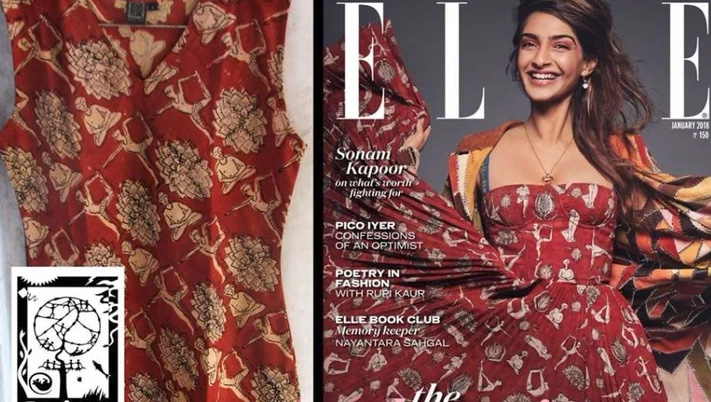
- Protection of Artwork: Specifically, drawings of yoga postures (Natrajasana and Padmasana) with lotus flower motifs. This is the primary subject of Dior’s alleged copying.
- Protection of Hand Block Prints: This includes the handcrafted blocks and the resulting fabric prints. People Tree uses a unique “Dabu” printing technique specific to Kaladera, Rajasthan.
It was widely discussed that the artwork and hand block prints would qualify as a protected “artistic work”[4] under copyright law, granting People Tree exclusive rights like:
- Economic Rights: Control over reproduction, derivative works, and publication.
- Moral Rights: The right to be recognized as the author and to prevent alterations that harm the work’s integrity.
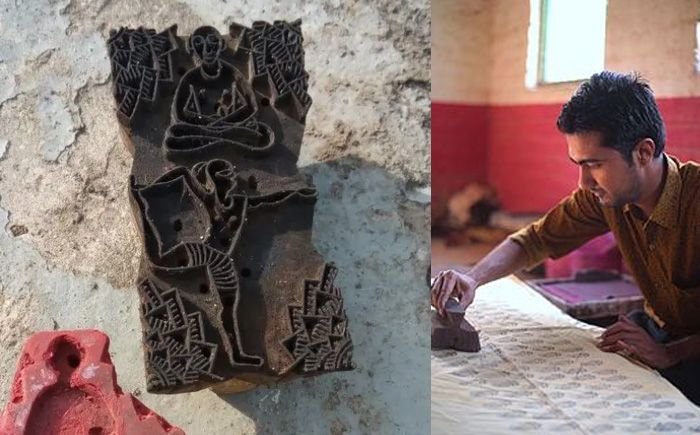
How to protect your IPR rights if you are into handicrafts?
- Identifying Intellectual Property: For artisans and handicraft creators, the first step to protecting your work is recognizing the intellectual property (IP) within each creation. This includes not only the overall design but also specific elements like patterns, motifs, colour combinations, and unique techniques. Consider what makes your work distinctive is it a particular weaving style, a traditional carving method, or a unique combination of materials? These elements can be protected through various IP mechanisms like
- Copyright (for artistic works)[5]:
There is a constitutional mandate of Article 29 to protect cultural heritage, Indian law offers crucial safeguards for traditional handicrafts. The Copyright Act, 1957, under Section 2(c), extends protection to “artistic work” encompassing a broad range of creations including “any other work of artistic craftsmanship.” This provision serves as a vital tool for preserving traditional handicrafts by granting copyright protection to the artistic elements inherent in them. - Geographical Indications (GIs) (for products tied to a specific region) [6]
Under section 2(f) of GI Act, the definition of goods under the GI Act includes handicrafts. A GI is a legal right that recognizes a product’s unique connection to a specific region or locality. By securing a GI for your craft, you establish legal ownership and prevent others outside your designated area from producing or selling imitations under the same name. This not only safeguards your designs but also enhances the market value and reputation of your products, ensuring that consumers recognize their authentic origin and quality.
Several Indian handicrafts hold Geographical Indication (GI) status, including Bagru hand block print from Rajasthan, Bastar Dhokra from Chhattisgarh, Kashmiri Hand-Knotted Carpets, Kashmir Pashmina from Jammu and Kashmir, and Kolhapuri Chappals from both Karnataka and Maharashtra. - Handicrafts may also come under TCE Traditional Cultural Expressions and Traditional Knowledge (TK).
While there is no universal definition of handicraft, WIPO[7] identifies handicraft as:- they are produced by artisans, completely by hand or with the help of hand-tools or even using machinery, provided the artisan’s direct manual contribution remains the most substantial component of the finished product;
- they are representations or expressions that are symbolic of the artisan’s culture;
- they encompass a wide variety of goods made of raw materials;
- their distinctive features can be utilitarian, aesthetic, artistic, creative, culturally attached, decorative, functional, traditional, or religiously and socially symbolic and significant;
- there are no particular restrictions on production quantity, and no two pieces are exactly alike.
- Additional characteristics that may apply to “traditional handicrafts” include the fact that they are transmitted from generation to generation and that they are linked to an indigenous or local community.
- Copyright (for artistic works)[5]:
Registering Your Intellectual Property:
Once you’ve identified the protectable IP in your work, the next crucial step is registration. Copyright protection is automatic upon creation for original artistic works, but registering your copyright provides stronger legal standing in case of infringement. For designs, formal registration with the relevant authorities grants exclusive rights to use that design.
Certification Marks:
A Certification Mark (also known as a Conformity Mark, Mark of Validity, or Assurance) is a label on a product signifying that its manufacturer has verified compliance with specific quality standards. These marks can also indicate a product’s origin, materials, manufacturing method, purity, or other characteristics.
Moreover, for Handicraft artists and brands the Crafts Council of India (CCI) recognizes excellence in craftsmanship and community contribution through awards and certifications.
Zealously guarding your intellectual property
Even with registered IP, vigilance is key. Regularly monitor the marketplace, both online and offline, for any instances of infringement. This includes checking online as well as offline marketplaces, craft fairs, and retail stores for similar designs or products being sold without your authorization. If you discover an infringement, it’s important to take action. This may involve sending cease and desist letters, contacting online/ offline platforms to remove infringing listings, or, in more serious cases, pursuing legal action. If you don’t take action, then you may be held ineligible for legal action due to acquiescence[8]. Consistent monitoring and enforcement are essential to deter infringers and protect the value of your intellectual property.
Conclusion
Protecting India’s artistic heritage is not merely a legal exercise but a matter of cultural preservation and economic justice. From identifying the intellectual property within each creation to actually registering it and rigorously monitoring the marketplace, vigilance is paramount. While traditional IP tools like copyright, design rights, and GIs are important, a sui generis system, adapted to the unique needs of handicrafts, offers a powerful complement. Negotiations on a sui generis international legal instrument for the protection of TK and TCEs are currently taking place in the WIPO Intergovernmental Committee on Intellectual Property and Genetic Resources, Traditional Knowledge and Folklore (IGC).[9]
As legal frameworks for traditional cultural expressions strengthen, the focus must shift towards protecting the very essence of these art forms and crucially empowering the original creators. This approach ensures that the custodians of these traditions, not just large brands, reap the rewards of their artistry, preserving India’s cultural legacy for generations to come.
- The article reflects the general work of the authors and the views expressed are personal. No reader should act on any statement contained herein without seeking detailed professional advice
- The Most Valuable Luxury Brands in the World in 2019 – Business Insider
- Textile Industry in India, Leading Yarn Manufacturers in India – IBEF
- https://www.indiafilings.com/learn/what-are-the-different-types-of-work-under-copyright-section/#:~:text=Section%2014%20of%20the%20Indian,%2C%20dramatic%2C%20musical%2C%20and%20artistic
- Copyrightrules1957.pdf
- wipo-pub-rn2023-5-5-en-intellectual-property-and-traditional-handicrafts.pdf
- Section 33 of Trademarks Act, 1999 wherein it is provided that if the proprietor of an earlier trade mark has acquiesced for a continuous period of five years in the use of a registered trade mark, being aware of that use, he shall no longer be entitled on the basis of that earlier trade mark–
- to apply for a declaration that the registration of the later trade mark is invalid, or
- to oppose the use of the later trade mark in relation to the goods or services in relation to which it has been so used, unless the registration of the later trade mark was not applied in good faith.
- WIPO paper
For any feedback or response on this article, the authors can be reached on shravani.joshi@ynzgroup.co.in and Ayushi.Kalelkar@ynzgroup.co.in

Author : Shravani Joshi
Shravani is Law Trainee at YNZ legal. She is currently pursuing LLB from Vivekanand College. She has completed her Bachelor of Commerce from Mumbai University.

Co-Author : Ayushi Kalelkar
Ayushi is experienced in corporate legal and heads the investment and deal advisory at YNZ Legal. She is also a member of Bar Council of Maharashtra & Goa. By qualification she is a Master in Commerce and Bachelor of Law from Mumbai University.