
In this article we shall look the step-by-step procedure for registration of trademark in India. [1]
Step 1 : Trademark Search and Filing of Application
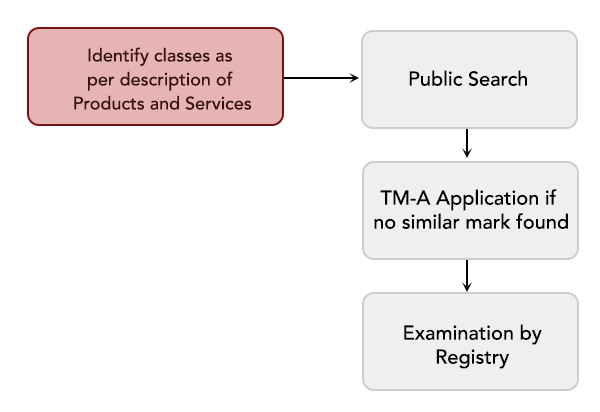
It is important to choose a unique and distinctive trademark which is not descriptive to your goods or services. Trademark is divided into 45 classes[2] as per the NICE classification[3] and each class represents different goods and services. It is required to identify applicable classes under which registration of Trademark needs to be applied.
Once the classes are identified, it is important to conduct an online public search on the website of IP India https://ipindiaservices.gov.in/tmrpublicsearch/frmmain.aspx to check if any identical or similar trademark that has been already filed or registered with the trademark registry. If no similar trademark is found, TM-A form can be filed for registration of Trademark in the prescribed manner along with applicable statutory fees to the Registry within whose jurisdiction the principal place of business of the applicant is situated. The filing of application is allowed in online or offline mode. Upon receipt of acknowledgment by registry, applicant is eligible to use symbol of (™) beside the trademark.
Step 2 : Examination of Trademark

Upon completion of formalities checks, the trademark application is examined by Registrar of Trademark. Subject to the provisions of the Act, the Registrar may refuse or accept the Application, as they may think fit. In case of a refusal of an application, the Registrar shall record in writing the grounds for such refusal or conditional acceptance and issue an examination report. The applicant is required to reply to the examination report in writing within 30 (thirty) days from the date of receipt of the examination report.If the Registrar is not satisfied with the reply, the Registrar may issue hearing notice. During the hearing, the officer provides an opportunity to the applicant to defend their application against objection raised by Trademark Registry. Based on the facts, the officer either accepts the application or rejects the same. If the application is accepted, the trademark shall be published in trademark journal for 4 months for third party opposition. If no objection is filed within the prescribed period, the applied trademark will be registered, and system generated copy of registration certificate will be issued by trademark registry. The registered trademark is valid for 10 years. After 10 years applicant can renew the registered trademark by paying prescribed fees.
Step 3 :Third Party Opposition
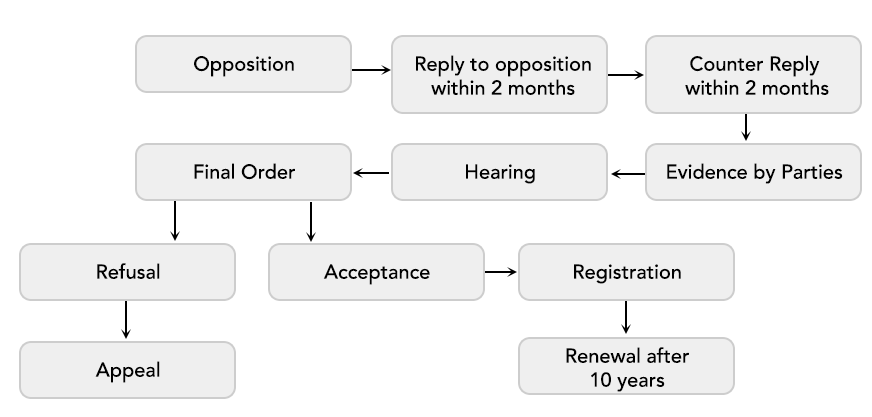
Any person can file notice of opposition in writing within 4 months from the date of the advertisement or re-advertisement of an application in trademark journal. The notice of opposition should be filed in Form TM-O with applicable fees. An opposition usually based on any absolute grounds as mentioned in Section 9 of the Act and any relative grounds as mentioned in Section 11 of the Act.
- The Trademark Registry shall serve soft copy of the notice of opposition to the applicant.
- Upon receipt of notice of opposition, the applicant has to file counterstatement in Form TM-O within 2 months from the date of receipt of the copy of opposition notice. The Registry shall serve a copy of counter statement to the opposition party.
- The opponent shall submit evidence supporting its opposition to the application within 2 months to the registry.
- Upon receipt of evidence of opponent, the applicant should file its evidence in support of trademark application within 2 months.
- After the evidence stage, the registry shall keep the matter for hearing and send system generated email to both the parties.
- In case the applicant has not appeared on first date of hearing, the registry may adjourn the matter. Further, if the applicant is not present on the adjourned date of hearing and has not informed its absence in advance, the application may be treated as abandoned by the registry.
- Similarly in case the opponent is not present on first date of hearing, the registry may adjourn the matter. Further, if the opponent is not present on the adjourned date of hearing and has not informed its absence in advance, the opposition may be dismissed.
- After hearing both the parties, the hearing officer passes necessary order.
- Any aggrieved party can file appeal before the Appellate Board within 3 months from the date of order of the hearing officer.
Once the trademark is registered, it doesn’t mean that your job is over. It is necessary to regularly monitor new trademark filing and oppose any trademark application that may infringe your registered trademark.
Case Study 1:
Britannia Industries Ltd. v/s Rakesh Kumar Jain, Vijay Kumar Jain (trading as “Rakeshkumar Maheshkumar”) and Anr.[4]
Using a well-known trademark that has acquired reputation and goodwill in the market is a common practice to gain business advantage. In this case Britannia had registered its trademark “GOOD DAY” which has been continuously and uninterruptedly in use since 1986 for the goods viz. biscuits and cookies. It came across the respondent’s application for the registration of mark ”GUD DAY’ in Devanagari script in Class 30 in respect of “Salt” which is advertised in Trademarks Journal No. 1507 dated 24th October 2011. The applicant filed its opposition reply against the respondent’s said application and successfully contended that:
- the impugned label mark contains the expression GUD DAY, which is identical to the applicant’s prior adopted, registered and well-known trademark GOOD DAY.
- The use of the impugned mark by the Respondent No. 1 is bound to lead confusion in the mind of the public and members of the trade.
The Respondents argued that the impugned mark was distinctive of Respondent No. 1’s goods. The same was independently and honestly adopted and openly, bone-fide used by the Respondent No. 1 was not upheld and the Appellate Bench observed that:
There was phonetical, structural and visual similarity between Respondent No. 1’s mark and applicant’s registered trademark. The Appellate Bench held that the adoption of the mark “GUD DAY” label phonetically similar/deceptively similar to that of the Applicant GOOD DAY mark and allowing the same would severely prejudice the essence of Trademark Law and would likely to mislead consumers believing products of Respondent No. 1 emanating from that of the Applicant. Hence the bench directed the Respondent No. 2 to delete the entry of registered Trademark No. 1424212 for the mark “GUD DAY” label in Class 30 in the name of Respondent No. 1 from the Register under the provisions of the Act and GOOD DAY is declared a well-known mark.
Case Study 2:
The Official Liquidator of Ideal Jawa (India) Limited and Ors. Vs Registrar of Trademarks, Government of India Trademarks Registry and Ors[5]
In this judgement before the Karnataka High Court the question of registration of the trademark “Yezdi” was before the Court. The core issue in the various applications which were disposed of by this common order was:
- the issue of ownership of the mark and if the Company continued to exercise ownership rights over the mark (despite liquidation)? and if so,
- can any other person appropriate the said marks to himself by the process of registration of the mark with the trademark registry?
The impugned trademark “Yezdi” was registered in 1969 in the name of Ideal Jawa (India) Ltd (“Company”). The Company was wound up in 2001, and the Official Liquidator (OL) was appointed to oversee the dissolution process. Due to these liquidation proceedings and the discontinued operations of the Company, the trademark registry removed the registration of impugned trademark in 2007. In 2013 and 2014, Mr. Boman Irani (who was also the director of the Company since 1990) filed applications before the trademark registry of Delhi, Mumbai and Ahmedabad for registration of impugned trademark, which were granted.
Further Mr. Irani also entered into certain arrangements with Mahindra & Mahindra through Classic Legends Pvt. Ltd. for usage of the impugned trademark Yezdi.
Thereafter, Official Liquidator filed an application for cancellation of this registration of the trademark in favour of Mr. Boman Irani.
The Official Liquidator stated that impugned trademark is custodia legis, being an asset of the Company. Mr. Boman Irani contended that the mark was not the asset of the Company and vested in him as he is the legal heir of Mr. Rustom Irani who envisioned the mark and thus was inherited by him. He also stated that he had been using certain domain names under the same name. The matter was heavily contested with intervention applications filed by Mahindra & Mahindra and the employees of the Company.
Considering the facts of the case, the Court upheld the contentions of the Liquidator and cancelled all registration certificates issued by Registrar of Trademarks, Mumbai, Delhi and Ahmedabad in favour of Mr. Boman Irani.
The Court declared the same as null and void and restrained Mr. Boman Irani and Classic Legends Pvt. Ltd., or any person claiming though or under them from using the mark “Yezdi” or any other mark containing the word “Yezdi” as a word or a device including all domain names which use the word/mark “Yezdi”. Additionally, Mr. Irani and Classic Legends Pvt. Ltd. were each made liable to account and pay to the Company for all gains made from the use of the trademarks of the Company and also directed to pay Rs 10 lakhs to the official liquidator towards the costs and distribution during winding up proceedings of the Company [6].
This is a welcome judgement which clarifies many important issues especially relating to continued ownership and goodwill of trademarks inspite of liquidation proceedings.
- The article reflects the general work of the authors and the views expressed are personal. No reader should act on any statement contained herein without seeking detailed professional advice.
- First 34 classes come under the goods section and rest of the classes come under the service section [2] First 34 classes come under the goods section and the rest of the classes come under the service section.
- https://www.wipo.int/classifications/nice/nclpub/en/fr/? basic_numbers=show&class_number=1&explanatory_notes=show&gors=&lang=en&menulang=en&mode=flat¬ion=&pagination=no&version=20 190101
- ORA/68/2013/TM/AMD
- Karnataka High Court : CA 71 of 2018 in Company Petition 76 of 1991
- It is reported that parties were to file an appeal against this judgement
For any feedback or response on this article, the authors can be reached on charusheela.vispute@ynzgroup.co.in and kedar.gurjar@ynzgroup.co.in

Author : Charusheela Vispute
Charusheela is heading Estate planning and trademark, having specialisation in property and testamentary matters. By qualification she is Bachelor of Arts and Bachelor of Law from Mumbai University.

Co-Author : Kedar Gurjar
Kedar is an associate at YNZ Legal. By qualification he is Bachelor of Commerce and Bachelor of Law from Mumbai University.