
Everyone loves gifts! The concept of gift also has a legal connotation, and essential provisions of valid gift are explained in the Transfer of Property Act 1882 (“Act”) such as types of property that may be gifted, modes of giving gift, competent transferor, revocation of gift, execution of gift etc.
“Gift” is defined as “the transfer of certain existing movable and immovable property made voluntarily and without consideration, by one person called the donor, to another, called the donee, and accepted by or on behalf of the donee2.” In simple words, any transfer of ownership of certain property or assets without consideration is known as a ‘Gift.’ This article analyses the concept of gift from legal perspective.
ESSENTIAL ELEMENTS OF GIFT
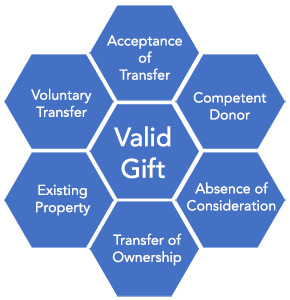
- Acceptance of Transfer: It is important that the gift must be accepted by donee. If the donee of gift dies before accepting it, then that gift shall be void by law because of lack of acceptance of the donee. In certain scenarios, donee may refuse to accept the gift i.e., if the gift is an onerous or not beneficial to the donee. Acceptance of the gift may be expressed or implied. The donor can make a gift to several donees.3 If the gift is made to two or more donees and one donee does not accept, it becomes void to the interest which he would have taken if he had accepted it. For example, If A gifts her 4 golden bangles to her four daughters B, C, D and E – 1 golden bangle each. Daughter E refuses to accept it. In this case, the gift of 1 golden bangle to daughter E becomes void and goes back to A. The remaining 3 golden bangles for the other three daughters remain valid.
- Competence of Donor: A donor must be a competent person to make the gift. It means that at the time of making gift the donor should be major and in a sound mind. It is interesting to note that the donee need not to be a competent person at the time of accepting the gift. A gift made to an insane person, or a minor, or to an unborn child existing in the mother’s womb is valid subject to its lawful acceptance by the guardian on behalf of the donee.
- Transfer of ownership: There must be transfer of ownership from the donor to the donee, as without transfer of property there will be no gift. While making a gift, the donor must intend to pass all the rights and liabilities in respect of such property to the donee. The donor can make conditional gifts subject to the provisions of the Act, provided that the conditions are lawful. In the case of Sridhar & anr vs N. Revanna & ors4., grandfather of respondent had gifted a property to the respondent, with a condition that the donee or his younger brothers who may be born hereafter would have no right to alienate the gifted property. Respondent executed sale deed in favour of third parties. Thereafter, appellant filed case against respondent stating that such sale is null and void. The Supreme Court dismissed the appeal and held that the donee (respondent) had the right to transfer the property received under the gift deed. As per section 10 of the Act, it is expressly held that any condition on the donee to not alienate the property is a void condition.
- Existing Property: Gift can be a movable or immovable property that is in existence and transferable at the time of making the gift. Future property cannot be transferred. Section 124 of the Act states that the property consisting of both the existing and future property is void as to the latter. For example, ‘A’ has a house which is owned by him. He contracted to purchase a plot of land adjacent to the said house, but the sale (of the plot of land) in his favour is yet to be completed. He makes a gift of both the properties (house and land) to ‘B’. As per the provisions of the Act, gift of house is valid, but the gift of the plot of land is void.
- Transfer without consideration: Gift is generally made for natural love and affection and not for any consideration as otherwise it will become sale. Hence an essential element of valid gift is that it should be without any consideration.
- Voluntary transfer: The donor must make the gift voluntarily with his free consent without any force, fraud or undue influence.
A transfer of gift may be revoked and considered as void by law when the essential elements of transfer are not implemented properly.
FORMAL PROCEDURE FOR EFFECTING A GIFT 5
It is important to note that the gift of the immovable property can be validly effected only by a registered gift deed executed by or on behalf of the donor and attested by at least two witnesses. Section 17(1)(a) of the Registration Act, 1908 lays down that a gift deed of immovable property is required to be compulsorily registered regardless of its value.
In the case of Smt. Gomtibai vs Mattulal6, it was held by the Supreme Court that in the absence of written instrument executed by the donor, attestation by two witnesses, registration of the instrument and acceptance thereof by the donee, the gift of immovable property is incomplete.
Registration is optional while gifting a moveable property and it may be effected by delivery of possession, irrespective of the valuation of the property. The mode of delivering the property depends upon the nature of the property.
Registration of gift deed is to be done according to the provisions of law. The steps involved in the registration process are:
- The details of the property should be mentioned in the gift deed
- Details of donor and donee
- It should be signed by the donor
- The donor and the donee must be present in the office of Registrar at the time of registration
- It should be attested by at least 2 witnesses
- The stipulated stamp duty has to be paid and get the deed registered.
- The documents required for the registration of gift deed like PAN Card, Aadhar Card of the donor, donee and witnesses.
For registration of gift deed, the stamp duty varies for men and women as well as from state to state. According to amendment in Maharashtra Stamp Act, the stamp duty in Mumbai and other parts of Maharashtra is applicable on the market value of the property as follows7:
| Transfer | Stamp duty on market value |
|---|---|
| Any person to other person (without any consideration) | 5% |
| Family member in relation (without consideration) being mother, father, brother, sister or grandparents of the donor | 3% |
| Family member in relation (without consideration) being husband, wife, son, daughter, grandchild or daughter in law of deceased son of the donor. | Rs. 200/- |
For the gift of immovable property within family, the registration fee will be Rs. 200/. Additional 1% Local body Tax (LBT) shall be charged on stamp duty and registration fee.
REVOCATION OF GIFT
A gift once made cannot be cancelled or revoked. However, section 126 of the Act is an exception to this rule and provides two exceptions when gift can be revoked or suspended under certain circumstances:
- Revocation by mutual agreement of donor and donee: If donor and donee mutually agreed with the condition that the gift shall be revoked on specific event. However, such an event should not depend on the discretion of the donor. If the event is in the donor’s discretion, then the gift is void wholly or partly, depending on the case. For example, A gives a house to B with the condition that he might take it back if B dies before A. B agrees to this condition and B dies before A. The gift can go back to A.
- Revocation by rescinding the contract between the two parties: A gift deed is a contract between the donor and the donee. According to the provisions of Indian Contract Act, 1872, without free consent of party, the contract is void. Thus, if a gift is not made voluntarily, the consent of the donor is obtained by fraud, undue influence or force, the gift may be rescinded by the donor.
ONEROUS GIFTS8
Onerous means “burden with obligation”. Where the donor gifts a donee with several things in a single transaction, and one of them is a burden to the donee where the rest are beneficial to the donee, the donee can accept the entire gift – including the burdened property or reject completely. He cannot accept the gifts with benefit and reject the ones with a burden. For example, A has shares in company X running in difficulty, and company Y, which is functioning successfully. A gift all of his shares from both the companies to B. B cannot take shares from company Y and refuse to accept the shares from X. Here, B can either accept shares from both the company or reject them all.
If the donor is gifting several things in two or more separate and individual transaction, of which one individual transaction is of burden, the donee can accept the gifts with benefits and reject the one with a burden. For example, A has shares in company X which is running in difficulty, and company Y, which is functioning successfully. A gift the shares from company X and Y in two separate and individual transactions to B. Here, B can refuse the shares from company X. This doesn’t mean that he cannot accept the shares from company Y. B can refuse shares of X and get shares of Y. This is because each transaction is done separately and individually.
UNIVERSAL DONEE
When the donor gifts his whole property to the donee, the donee is liable to all the benefits and obligations that the donor holds. In this case, the donee is personally liable to pay all the debts and liabilities of the donor at the time of the gift. The liability to pay all the dues applies only to the extent of the property’s value and not above that.
EXCEPTIONS
It is interesting to note that section 129 of the Act specifically states that the provisions of chapter VII of the Act are not applicable to:
- Gifts of movable property made in contemplation of death- This exception is based on the maxim donations mortis causa which recognizes the typical practice of gifting in contemplation of his death. These are exceptional gifts and covered under Section 191 of Indian Succession Act 1925 under a chapter XXIII (Gifts in Contemplation of Death) and specify that death bed gifts are confined to movable property and takes effect only if the donor dies9.
- any rule of Muhammadan law
- The article reflects the general work of the author on the date of publication and the views expressed are personal. No reader should act on any statement contained herein without seeking detailed professional advice.
- Section 122 of the Act
- Section 125 of the Act
- Supreme Court- Civil Appeal No.1209 of 2020 (arising out of SLP (C) No. 7493 of 2014)
- Section 123 of the Act
- Civil Appeal No. 1519(N) of 1980, decided on October 1,1996
- https://www.e-stampdutyreadyreckoner.com/gift.php
- Section 127 of the Act
For any feedback or response on this article, the authors can be reached on charusheela.vispute@ynzgroup.co.in

Author : Charusheela Vispute
Charusheela is a Partner of Estate planning and trademark, having specialisation in property and testamentary matters. By qualification she is Bachelor of Arts and Bachelor of Law from Mumbai University